




Removing SEM Dye?

Thread Starter
Team Owner


Joined: Sep 2006
Posts: 31,270
Likes: 4,362
From: Westminster Maryland
 Removing SEM Dye?
Hi,
Has anyone had any experience removing SEM dye from vinyl covered interior parts like a door panel. (Taking green dye off a black panel.)
It's been on the panel for 20+years.
Thanks very much!
Regards,
Alan
Has anyone had any experience removing SEM dye from vinyl covered interior parts like a door panel. (Taking green dye off a black panel.)
It's been on the panel for 20+years.
Thanks very much!
Regards,
Alan

Melting Slicks


Joined: Nov 2001
Posts: 2,793
Likes: 58
From: God's Country The Old Dominion
When I was prepping my interior for a re dye I cleaned everything with paint thinner. Continued cleaning began to remove the old dye. I think it would work but you would have to be careful not to damage the original color.
Roy
Race Director


Joined: Apr 2011
Posts: 11,183
Likes: 3,335
From: North of Toronto - Ontario
Hi Alan
Are they trying to save the original black or will it be re-dyed black when the green is gone?
Lacquer thinner will remove SEM coatings but may be too hot for the vinyl and affect the grain (test a small area where it wraps around the panel?) Acetone will also remove and shouldn't be as hot. Mineral spirits may remove (it will on plastics anyway) with some brush work and shouldn't affect the vinyl
M
Grain of salt, mileage may vary, professional driver on closed course, results not typical, see a doctor if it last longer than 4 fours, etc
Are they trying to save the original black or will it be re-dyed black when the green is gone?
Lacquer thinner will remove SEM coatings but may be too hot for the vinyl and affect the grain (test a small area where it wraps around the panel?) Acetone will also remove and shouldn't be as hot. Mineral spirits may remove (it will on plastics anyway) with some brush work and shouldn't affect the vinyl
M
Grain of salt, mileage may vary, professional driver on closed course, results not typical, see a doctor if it last longer than 4 fours, etc
Last edited by Mooser; Oct 18, 2015 at 10:33 PM.

Team Owner

Joined: Jan 2006
Posts: 37,637
Likes: 3,118
From: Crossville TN
There should be NO reason to remove SEM dye from an interior panel. You simply re-dye that panel whatever color you want. Just clean with detergent/water/dry, then shoot it again.
Now, if that green stuff is PAINT.......
Now, if that green stuff is PAINT.......
Thread Starter
Team Owner
Joined: Sep 2006
Posts: 31,270
Likes: 4,362
From: Westminster Maryland
Hi M,
My goal is to save the original black vinyl under the green dye.
Although finding excellent/unused door panels is almost impossible I really don't want to put a re-dyed panel on my car.
Another member's thought was that getting the green dye off the majority of the panel would be likely doable, but getting it out of the 'Comfort Weave' detailed area entirely might prove to be be more difficult.
I too am concerned what effect a solvent that's hot enough to work on the dye might do to the surface of the vinyl.
I also wonder if the fact that the dye has been on the vinyl for long a time will make it more difficult to get off successfully?
?????
Regards,
Alan
My goal is to save the original black vinyl under the green dye.
Although finding excellent/unused door panels is almost impossible I really don't want to put a re-dyed panel on my car.
Another member's thought was that getting the green dye off the majority of the panel would be likely doable, but getting it out of the 'Comfort Weave' detailed area entirely might prove to be be more difficult.
I too am concerned what effect a solvent that's hot enough to work on the dye might do to the surface of the vinyl.
I also wonder if the fact that the dye has been on the vinyl for long a time will make it more difficult to get off successfully?
?????
Regards,
Alan
Race Director
Joined: Apr 2011
Posts: 11,183
Likes: 3,335
From: North of Toronto - Ontario
Hi Alan
Then the mineral spirits will be your best bet (test small area etc) as we've used that on lots of vinyl over the years to clean them.
If you just wet a soft cloth (terrycloth type) with it and rub the folded over vinyl you should be able to see if the green is transferring to the cloth.
If is is going to separate, getting it out of the nooks and crannies of the grain will be a pain. I've got a small "nail brush" that's actually used for scrubbing vegetables that I use for cleaning out engravings on aluminum that would get into the grain without scratching the surface.
All that said, I'm not sure what the original finish will be like once the green is removed since the SEM actually bonds to the surface. I thing you might still need to apply a dust coat of black to get some sheen back or even out the panel.
Can't say since I've never done one like that. Worse comes to worse, chances are you have an excellent set of re-dyed panels for someone else
M
Then the mineral spirits will be your best bet (test small area etc) as we've used that on lots of vinyl over the years to clean them.
If you just wet a soft cloth (terrycloth type) with it and rub the folded over vinyl you should be able to see if the green is transferring to the cloth.
If is is going to separate, getting it out of the nooks and crannies of the grain will be a pain. I've got a small "nail brush" that's actually used for scrubbing vegetables that I use for cleaning out engravings on aluminum that would get into the grain without scratching the surface.
All that said, I'm not sure what the original finish will be like once the green is removed since the SEM actually bonds to the surface. I thing you might still need to apply a dust coat of black to get some sheen back or even out the panel.
Can't say since I've never done one like that. Worse comes to worse, chances are you have an excellent set of re-dyed panels for someone else
M
Thread Starter
Team Owner
Joined: Sep 2006
Posts: 31,270
Likes: 4,362
From: Westminster Maryland
Hi M,
Thanks for your additional thoughts.
I want to think I can make this work…..but my wife reminds me that I ALWAYS think I can make things work, and this is a VERY pricey 'experiment'.
Regards,
Alan
Added…. I know only a fool would pay this much for a set of re-dyed panels and yet I see myself being willing to be that fool.
Thanks for your additional thoughts.
I want to think I can make this work…..but my wife reminds me that I ALWAYS think I can make things work, and this is a VERY pricey 'experiment'.
Regards,
Alan
Added…. I know only a fool would pay this much for a set of re-dyed panels and yet I see myself being willing to be that fool.
Last edited by Alan 71; Oct 19, 2015 at 09:22 AM.
Team Owner
Joined: Jan 2006
Posts: 37,637
Likes: 3,118
From: Crossville TN
Alan..
I know what aperfectionist you are, Alan; but I think you are going too far on this one. The panels were dyed at the OEM vendor's factory originally. Re-dyeing just brings it back to it's original state in the right color. That's probably something the vendor did originally, if they were left with too many of a non-popular color.
Trying to remove the existing dye will damage the part MORE than the 'extra' dye underneath will do. If you want to save that panel, re-dye it.
I would not use SEM in the spray cans. It's good dye, but it is the wrong sheen for factory-new. Get some liquid SEM mixed at a pro auto body paint store to your interior color code. Then spray with your equipment, or with a Pre-Val bottle/gas sprayer you purchase at the same auto body paint store. It will look factory-new.
And, no, you will never get the green dye color out of the comfort weave fabric; but a re-dye will recolor it.
I know what aperfectionist you are, Alan; but I think you are going too far on this one. The panels were dyed at the OEM vendor's factory originally. Re-dyeing just brings it back to it's original state in the right color. That's probably something the vendor did originally, if they were left with too many of a non-popular color.
Trying to remove the existing dye will damage the part MORE than the 'extra' dye underneath will do. If you want to save that panel, re-dye it.
I would not use SEM in the spray cans. It's good dye, but it is the wrong sheen for factory-new. Get some liquid SEM mixed at a pro auto body paint store to your interior color code. Then spray with your equipment, or with a Pre-Val bottle/gas sprayer you purchase at the same auto body paint store. It will look factory-new.
And, no, you will never get the green dye color out of the comfort weave fabric; but a re-dye will recolor it.
Corvette Stories
The Best of Corvette for Corvette Enthusiasts

Top 10 Most Expensive Corvettes Ever Sold on Bring A Trailer
Brett Foote
10 Things Every Corvette Owner Needs (2026 Edition)
Michael S. Palmer
8 Most "Only Corvette Owners Understand" Quirks and Problems
Pouria Savadkouei
10 Reasons the C6 Z06 is Still A Performance Benchmark After 20 Years
Joe Kucinski
How Much Horsepower Every Corvette Engine "LOST" in 1972
Joe Kucinski
Top 10 DOs and DON'Ts for Protecting Your Convertible Top!
Michael S. Palmer
Top 10 Most Explosive Corvettes Ever Made: Power-to-Weight Ratio Ranked!
Joe Kucinski
150 hp to 1,250 hp: Every Corvette Generation Compared by the Specs That Matter
Joe Kucinski
8 Coolest Corvette Pace Cars (and Replicas) of All Time
Verdad Gallardo
Melting Slicks


Joined: Jan 2012
Posts: 3,039
Likes: 504
From: myrtle beach sc
Army
Alan, I know and understand that you want original panels, but Al Knoch will make the OEM style cardboard door panels, and I am pretty sure that they have the original GM dies to do it with. I feel that this would be better choice, especially with that comfort weave insert. Lou.
Thread Starter
Team Owner
Joined: Sep 2006
Posts: 31,270
Likes: 4,362
From: Westminster Maryland
Hi Lou,
Thanks for the suggestion!
For the 1970+ panels Knock uses the same vinyl 'skin' on their fiberboard backed panels as they do on the abs backed panels.
The definition of the grain in the vinyl, and especially the appearance of the 'comfort weave' detail panel, leaves something to be desired for some people.
Regards,
Alan
Thanks for the suggestion!
For the 1970+ panels Knock uses the same vinyl 'skin' on their fiberboard backed panels as they do on the abs backed panels.
The definition of the grain in the vinyl, and especially the appearance of the 'comfort weave' detail panel, leaves something to be desired for some people.
Regards,
Alan
Melting Slicks
Joined: Jan 2012
Posts: 3,039
Likes: 504
From: myrtle beach sc
Army
I did not realize that Al Knoch door panel grain is slightly different. I know that my AK 68 only basket weave seat material has a slightly different, not as deep, pattern to it. Lou.
Thread Starter
Team Owner
Joined: Sep 2006
Posts: 31,270
Likes: 4,362
From: Westminster Maryland
Hi Lou,
If you look closely at an ORIGINAL 1970+ door panel the 'grain' in the vinyl doesn't appear to continue 'under' the comfort weave imprint.
While on a REPRODUCTION door panel you can see that 'grain' under the comfort weave impression and in addition the comfort weave impression that's added isn't nearly as distinct as on the original panels.
The difference while noticeable is something that only matters to very few folks!
Regards,
Alan
If you look closely at an ORIGINAL 1970+ door panel the 'grain' in the vinyl doesn't appear to continue 'under' the comfort weave imprint.
While on a REPRODUCTION door panel you can see that 'grain' under the comfort weave impression and in addition the comfort weave impression that's added isn't nearly as distinct as on the original panels.
The difference while noticeable is something that only matters to very few folks!
Regards,
Alan
Team Owner
Joined: Jan 2006
Posts: 37,637
Likes: 3,118
From: Crossville TN
The original Comfort-Weave material is very 'breatheable', as the weave is not a solid surface...it is just a bunch of interlocking loops of plastic material.
The reproductions I've seen, are NOT permeable; they just are 'hot-stamped' vinyl so that the outer surface has a similar appearance to the original material.
I wouldn't think you would opt for the repro stuff, Alan. Would you?
The reproductions I've seen, are NOT permeable; they just are 'hot-stamped' vinyl so that the outer surface has a similar appearance to the original material.
I wouldn't think you would opt for the repro stuff, Alan. Would you?
Thread Starter
Team Owner
Joined: Sep 2006
Posts: 31,270
Likes: 4,362
From: Westminster Maryland
Hi,
I believe we're talking only about the 'comfort weave' IMPRINT in the door panel, not the 'comfort weave' MATERIAL used in the seat covers.
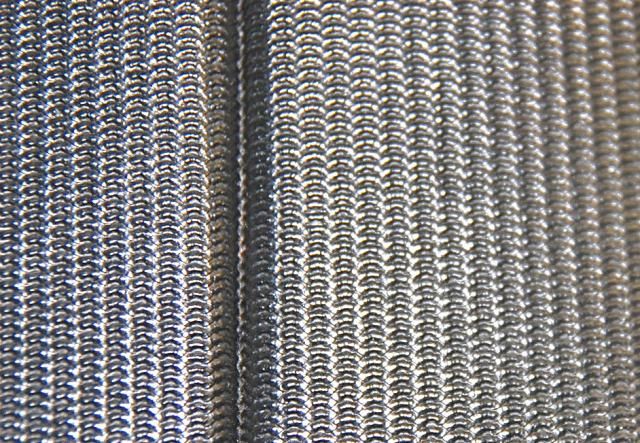
The difference in the original seat material and the material used in reproduction is pretty easy to spot.
I really don't think the original material was 'woven', I think it's an impression that's additionally perforated with millions of tiny holes. I think if it were woven, when it was cut it would 'unravel'.
Regards,
Alan
The original 'comfort weave' material in the seats lets the light shine through the holes and also lets the deteriorating yellow seat cover foam come through.
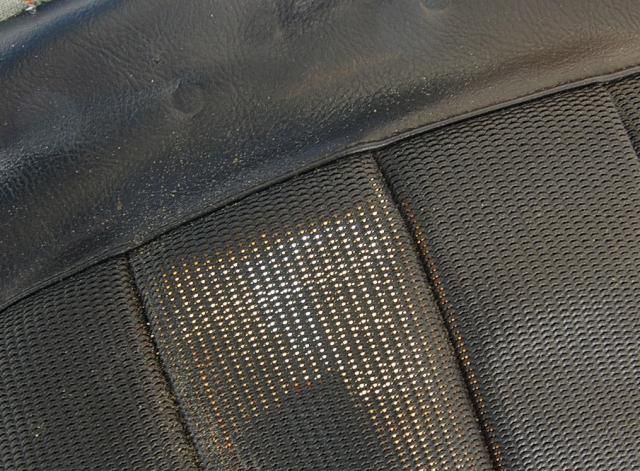
Original 'comfort weave' material.
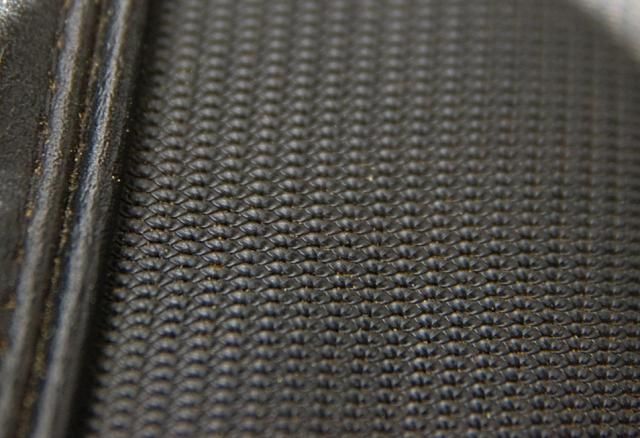
The reproduction 'comfort weave' material.
I believe we're talking only about the 'comfort weave' IMPRINT in the door panel, not the 'comfort weave' MATERIAL used in the seat covers.
The difference in the original seat material and the material used in reproduction is pretty easy to spot.
I really don't think the original material was 'woven', I think it's an impression that's additionally perforated with millions of tiny holes. I think if it were woven, when it was cut it would 'unravel'.
Regards,
Alan
The original 'comfort weave' material in the seats lets the light shine through the holes and also lets the deteriorating yellow seat cover foam come through.
Original 'comfort weave' material.
The reproduction 'comfort weave' material.