




1975 Stingray Restore Thread

Thread Starter
Advanced

Joined: Jul 2010
Posts: 82
Likes: 0
From: Jackson MS
 1975 Stingray Restore Thread
Instead of opening a hundred threads asking a hundred different questions I figured I contain it to one thread. Naturally I will be posting pictures as I go.
A quick background about me: I'm 25 and work in the IT field, 4 years as a system administrator for the Marine Corps (0656) and now as a help desk analyst while the GI Bill pays me and school. The most I've ever done to a car are oil changes and I seafoamed my 94 Z28 once.
Scheduled for this weekend is going to be a tune up for the motor. It starts right and has a pretty good idle, but under acceleration sounds like she maybe missing, there is a lot of heat passed in the cabin during drives lasting longer the 30mins, and there is a hissing from the right hand side of the engine bay after shutting her down but I don't see a steam jet or anything. As for the heat it starts at the peddles and slowly starts to fill up the cabin. Car as smells like its running very rich, smells like a boat.
I'm hoping all this can be fixed by changing all the fluids, spark plugs, and wires.
Now I have no experience doing any of this, I have a Haynes repair manual as guidance. Am I getting in over my head? My main goal is to basically do as full a maintenance as I can with out really tearing anything apart.
Sorry for the book, but thanks in advance for any advice.
A quick background about me: I'm 25 and work in the IT field, 4 years as a system administrator for the Marine Corps (0656) and now as a help desk analyst while the GI Bill pays me and school. The most I've ever done to a car are oil changes and I seafoamed my 94 Z28 once.
Scheduled for this weekend is going to be a tune up for the motor. It starts right and has a pretty good idle, but under acceleration sounds like she maybe missing, there is a lot of heat passed in the cabin during drives lasting longer the 30mins, and there is a hissing from the right hand side of the engine bay after shutting her down but I don't see a steam jet or anything. As for the heat it starts at the peddles and slowly starts to fill up the cabin. Car as smells like its running very rich, smells like a boat.
I'm hoping all this can be fixed by changing all the fluids, spark plugs, and wires.
Now I have no experience doing any of this, I have a Haynes repair manual as guidance. Am I getting in over my head? My main goal is to basically do as full a maintenance as I can with out really tearing anything apart.
Sorry for the book, but thanks in advance for any advice.

Safety Car


Joined: Aug 2001
Posts: 4,883
Likes: 11
From: North Easton Mass
Instead of opening a hundred threads asking a hundred different questions I figured I contain it to one thread. Naturally I will be posting pictures as I go.
A quick background about me: I'm 25 and work in the IT field, 4 years as a system administrator for the Marine Corps (0656) and now as a help desk analyst while the GI Bill pays me and school. The most I've ever done to a car are oil changes and I seafoamed my 94 Z28 once.
Scheduled for this weekend is going to be a tune up for the motor. It starts right and has a pretty good idle, but under acceleration sounds like she maybe missing, there is a lot of heat passed in the cabin during drives lasting longer the 30mins, and there is a hissing from the right hand side of the engine bay after shutting her down but I don't see a steam jet or anything. As for the heat it starts at the peddles and slowly starts to fill up the cabin. Car as smells like its running very rich, smells like a boat.
I'm hoping all this can be fixed by changing all the fluids, spark plugs, and wires.
Now I have no experience doing any of this, I have a Haynes repair manual as guidance. Am I getting in over my head? My main goal is to basically do as full a maintenance as I can with out really tearing anything apart.
Sorry for the book, but thanks in advance for any advice.
A quick background about me: I'm 25 and work in the IT field, 4 years as a system administrator for the Marine Corps (0656) and now as a help desk analyst while the GI Bill pays me and school. The most I've ever done to a car are oil changes and I seafoamed my 94 Z28 once.
Scheduled for this weekend is going to be a tune up for the motor. It starts right and has a pretty good idle, but under acceleration sounds like she maybe missing, there is a lot of heat passed in the cabin during drives lasting longer the 30mins, and there is a hissing from the right hand side of the engine bay after shutting her down but I don't see a steam jet or anything. As for the heat it starts at the peddles and slowly starts to fill up the cabin. Car as smells like its running very rich, smells like a boat.
I'm hoping all this can be fixed by changing all the fluids, spark plugs, and wires.
Now I have no experience doing any of this, I have a Haynes repair manual as guidance. Am I getting in over my head? My main goal is to basically do as full a maintenance as I can with out really tearing anything apart.
Sorry for the book, but thanks in advance for any advice.
There may still be some papers available on the forum by Lars that cover tuning. If you follow them you should end up with a good-running engine. If you can't find the papers maybe you could PM Lars and ask him for copies.
A properly tuned engine may run cooler and help the cabin heat problems, but cabin heat is a common complaint in the C3 world.
There is probably a wealth of information on the web for tuning a 350 engine. The Vette engine is no different from other 350's when it comes to tuning.

Rick B.

Team Owner


Joined: Nov 1999
Posts: 26,679
Likes: 17
From: This vette goes to 11 Milford MA
St. Jude Donor '03-'05
A typical tune up on a 75 is distributor cap and rotor, plugs and wires, PCV valve, air filter and fuel filter. That will give you a good base to start from.
You also want to check the igntion timing with a timing light. Most driveability issues with the 75 style come from the carburetor. The chances of it being messed with in the past 35 years is VERY high. The Quadrajet is finicky and has a lot of adjustment points. When they are set up right, they are awesome. When they aren't, they bog, pop, cough and chug.
As far as the heat, its typical for the catalytic converter to fail and overheat. Both of my 75's had failed cats that got extremely hot. You can remove the cat and swap in a test pipe to check it or replace it with a new cat.
For a new guy, I think the most important thing is to do one step at a time. Never tear the car apart to the point where it is undriveable for more than a few days at a time or torn down to the point where you have a major undertaking to drive it again.
This is where people get overwhelmed and either ditch the project or get way too deep into it and get in over their head spending time and money they could have put towards a better car.
You want to keep it as a driveable project.
You also want to check the igntion timing with a timing light. Most driveability issues with the 75 style come from the carburetor. The chances of it being messed with in the past 35 years is VERY high. The Quadrajet is finicky and has a lot of adjustment points. When they are set up right, they are awesome. When they aren't, they bog, pop, cough and chug.
As far as the heat, its typical for the catalytic converter to fail and overheat. Both of my 75's had failed cats that got extremely hot. You can remove the cat and swap in a test pipe to check it or replace it with a new cat.
For a new guy, I think the most important thing is to do one step at a time. Never tear the car apart to the point where it is undriveable for more than a few days at a time or torn down to the point where you have a major undertaking to drive it again.
This is where people get overwhelmed and either ditch the project or get way too deep into it and get in over their head spending time and money they could have put towards a better car.
You want to keep it as a driveable project.
Last edited by Fastguy; Jul 14, 2010 at 10:43 PM.

Senior Member


Joined: Jan 2008
Posts: 12,146
Likes: 2,038
From: Easton, PA
St. Jude Donor '10
You have a good book to start with, there are others that will also serve you well. I suggest you consider buying one of the AIM manuals in electronic form. I know that Willcox sells them and I have used the dickens out of my 71 and my 77 AIM manuals. You can sort by name and find the reference drawings that help you when working on the car.
And never hesitate to ask questions on the forum. The people here are highly informative, technically competent, and some of them even know what they are talking about. Just kidding. I was where you are now in 2006 and the folks on this forum helped me a great deal.
Which city in NJ are you living in? Lots of good guys with Corvettes in NJ. I'm in PA but willing to help you if I can. I own two 77's and have one 71 in restoration now. Have learned a lot, have more to learn, but keep the questions coming.
Best of success and thanks for your service.
David
And never hesitate to ask questions on the forum. The people here are highly informative, technically competent, and some of them even know what they are talking about.
Just kidding. I was where you are now in 2006 and the folks on this forum helped me a great deal.Which city in NJ are you living in? Lots of good guys with Corvettes in NJ. I'm in PA but willing to help you if I can. I own two 77's and have one 71 in restoration now. Have learned a lot, have more to learn, but keep the questions coming.
Best of success and thanks for your service.
David

Team Owner


Joined: Jan 2006
Posts: 37,637
Likes: 3,116
From: Crossville TN
You're a smart young fella and you sound like you are willing to learn. If you have a good streak of 'curiosity' and are stubborn, to boot, you have all the qualities necessary to be a C3 'addict'. 
Buy two documents: the Assembly Instruction Manual (A.I.M.) for 1975 and the Chevrolet Chassis Service Manual for 1975. The AIM can be purchased either as a paper document or as a CD with search capabilities...I have both and use both. Once you get those documents, you will understand what each is to be used for and why they are so valuable to DIY Corvette owners.
A good tune-up is not a difficult task on a 1970's vehicle and that is the case with the Corvette, also. Except for changing spark plug wires. But, consider it a 'rite of passage' into the ranks of C3 ownership. If you haven't changed plug wires...and re-installed all of the engine hardware when you got done...you really aren't a "full-fledged" Vette-head. The CCService Manual will give you all the info you need to accomplish that task. It will also give you all the info you need to properly adjust and set-up the Q-Jet carb {which I'm sure could benefit from that bit of work}. Good luck! And, keep asking questions on the Corvette Forum.
Buy two documents: the Assembly Instruction Manual (A.I.M.) for 1975 and the Chevrolet Chassis Service Manual for 1975. The AIM can be purchased either as a paper document or as a CD with search capabilities...I have both and use both. Once you get those documents, you will understand what each is to be used for and why they are so valuable to DIY Corvette owners.
A good tune-up is not a difficult task on a 1970's vehicle and that is the case with the Corvette, also. Except for changing spark plug wires.
But, consider it a 'rite of passage' into the ranks of C3 ownership. If you haven't changed plug wires...and re-installed all of the engine hardware when you got done...you really aren't a "full-fledged" Vette-head. The CCService Manual will give you all the info you need to accomplish that task. It will also give you all the info you need to properly adjust and set-up the Q-Jet carb {which I'm sure could benefit from that bit of work}. Good luck! And, keep asking questions on the Corvette Forum.
Corvette Stories
The Best of Corvette for Corvette Enthusiasts

Top 10 Most Explosive Corvettes Ever Made: Power-to-Weight Ratio Ranked!
Joe Kucinski
150 hp to 1,250 hp: Every Corvette Generation Compared by the Specs That Matter
Joe Kucinski
8 Coolest Corvette Pace Cars (and Replicas) of All Time
Verdad Gallardo
Top 10 Corvette Engines RANKED by Peak Torque (70+ Years of Muscle!)
Joe Kucinski
Corvette ZR1X Will Be Pacing the Indy 500, And Could Probably Race, Too!
Verdad Gallardo
Top 10 Corvettes Coming to Mecum Indy 2026!
Brett Foote
Top 10 C9 Corvette MUST-HAVES to Fix These C8 Generation Flaws!
Michael S. Palmer
10 Revolutionary 'Corvette Firsts' Most People Don't Know
Joe Kucinski
5 Reasons to Upgrade to an LS6-Powered Corvette; 5 Reasons to Stay LT2
Michael S. Palmer
Team Owner
Joined: Nov 1999
Posts: 26,679
Likes: 17
From: This vette goes to 11 Milford MA
St. Jude Donor '03-'05
Before you pull the plug wires, snap a lot of photos of how it was together. Get some masking tape and mark the wires as you take them off, the more reference material the better.



Team Owner
Joined: Nov 1999
Posts: 26,679
Likes: 17
From: This vette goes to 11 Milford MA
St. Jude Donor '03-'05
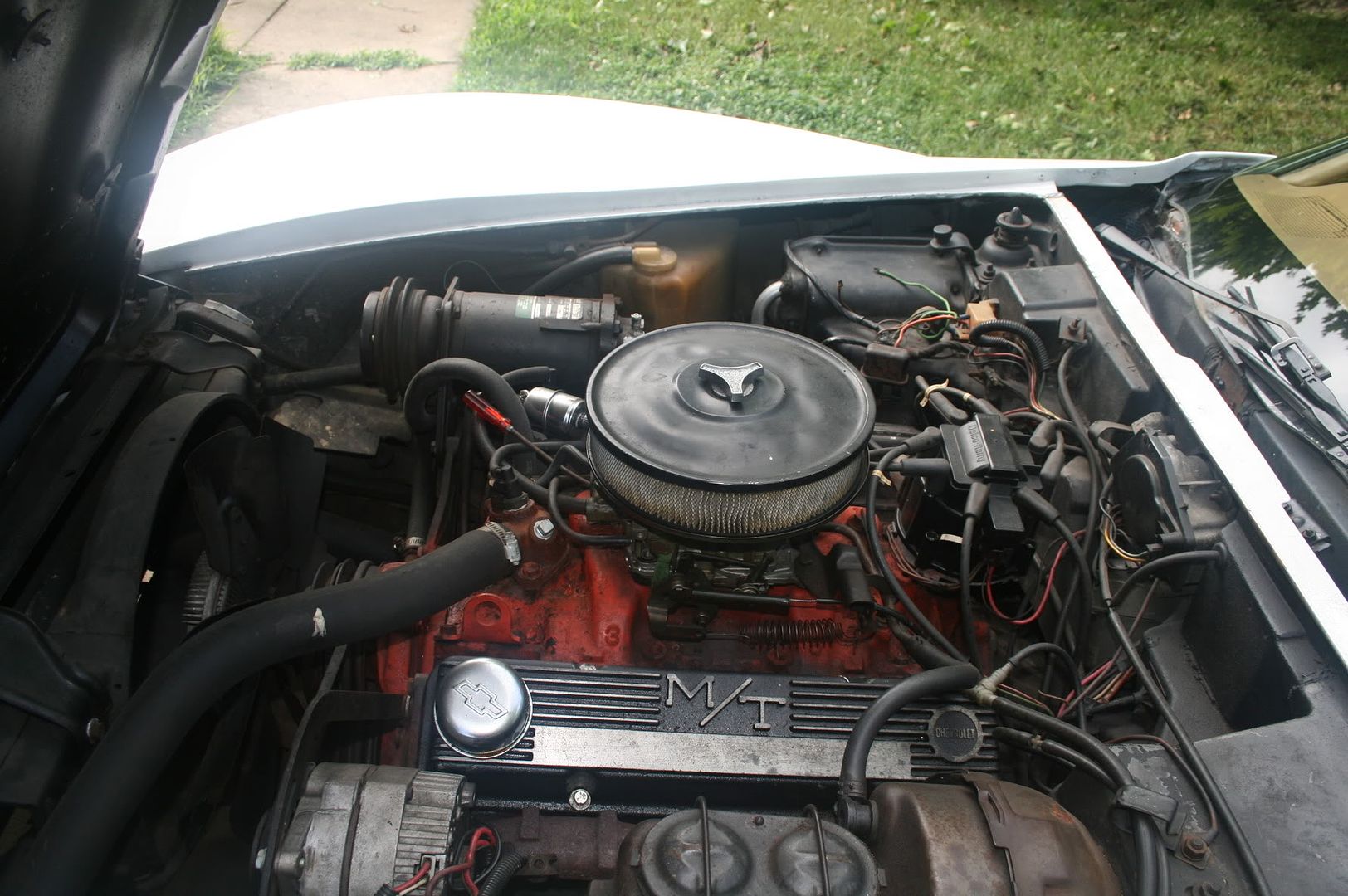
Not a carb expert, but I am pretty sure that screwdriver shouldn't be sticking out of the baseplate.
I notice it has a cannister fuel filter, which is not a bad idea, but keep in mind that there is a filter IN the carb, in that big hex head thing that says "FILTER". If that gets clogged, the car will run lean and hot.
I notice it has a cannister fuel filter, which is not a bad idea, but keep in mind that there is a filter IN the carb, in that big hex head thing that says "FILTER". If that gets clogged, the car will run lean and hot.
Last edited by Fastguy; Jul 16, 2010 at 02:14 PM.


Senior Member
Joined: Jan 2008
Posts: 12,146
Likes: 2,038
From: Easton, PA
St. Jude Donor '10
Okay, first of all great shots of the engine area, you are doing the right thing here to start by documenting where you are starting. Good advice from those down this path previously is to take lots of pictures and buy yourself zip lock style bags in various sizes. If you remove something from the engine label it, photograph it, and bag it. I know it is a lot of work to do this but having lost parts and gotten confused in the past I can tell you this will save you lots of time later, honest.
Also, and this may sound odd, but you can use your finger as a pointer when you have a question about a part on the car. Point, take that picture, post it and ask your question.
I see a fair number of wires that have either been cut or pulled out of place on the passenger side of the engine bay. Missing A/C belt tells me your A/C is not working or may not have been for the previous owner. All things to write down and document. Have never seen an in-line filter and the carb filter used at the same time, interesting.
I would think it valuable to have the up close and personal inspection of the car by another Corvette owner with knowledge of the 75. This will help you to document what they see. Safety first. Engine important but brakes and steering for control are top of the list in my book. Both should be looked at in addition to the engine.
How much information did you receive from the seller about the car?
Any documentation to tell you what it was originally?
If you have the VIN we can learn from that as well as the stainless plate on the drivers side of the car. The more you learn about what it was new the more you can begin to see what you want to do with it next.
You are in for the adventure of a life time and I forgot to mention earlier, welcome to the C-3 newbie club, we were all there at one time.
David
Also, and this may sound odd, but you can use your finger as a pointer when you have a question about a part on the car. Point, take that picture, post it and ask your question.
I see a fair number of wires that have either been cut or pulled out of place on the passenger side of the engine bay. Missing A/C belt tells me your A/C is not working or may not have been for the previous owner. All things to write down and document. Have never seen an in-line filter and the carb filter used at the same time, interesting.
I would think it valuable to have the up close and personal inspection of the car by another Corvette owner with knowledge of the 75. This will help you to document what they see. Safety first. Engine important but brakes and steering for control are top of the list in my book. Both should be looked at in addition to the engine.
How much information did you receive from the seller about the car?
Any documentation to tell you what it was originally?
If you have the VIN we can learn from that as well as the stainless plate on the drivers side of the car. The more you learn about what it was new the more you can begin to see what you want to do with it next.
You are in for the adventure of a life time and I forgot to mention earlier, welcome to the C-3 newbie club, we were all there at one time.
David

Cruising
Joined: Dec 2009
Posts: 11
Likes: 0
I just finished restoring my wifes 75 and cabin heat was the major issue.
I bought FAT MAT off of ebay the 80mil stuff, the guy who sells it had it to me the next day. It will stick real good if you make sure everything is clean. I covered the whole interior tops back space everything. The car is real cool inside now without air. No more hot feet.
The fat mat is the cheapest and best stuff you can use. Ive used dynomat, cost to much.
Im no expert on the vettes as I restore antique cars, 48 on back. But if you need any help let me know and I will tell you what I went through.
Welcome to the forum, great place for info and lots of people that are willing to help.
I bought FAT MAT off of ebay the 80mil stuff, the guy who sells it had it to me the next day. It will stick real good if you make sure everything is clean. I covered the whole interior tops back space everything. The car is real cool inside now without air. No more hot feet.
The fat mat is the cheapest and best stuff you can use. Ive used dynomat, cost to much.
Im no expert on the vettes as I restore antique cars, 48 on back. But if you need any help let me know and I will tell you what I went through.
Welcome to the forum, great place for info and lots of people that are willing to help.
Thread Starter
Advanced
Joined: Jul 2010
Posts: 82
Likes: 0
From: Jackson MS
Ok just did the oil change. Found an spark plug wire, labeled 7, just dangling down by the oil filter, and pulled the dipstick out and now i cant find where to put it back in, haha. Help

Race Director


Joined: Oct 2000
Posts: 12,661
Likes: 3,118
From: Shamong, NJ
Did the tube come out with the dip stick? The hole for the dip stick is in the left side of the block, between the 3rd and 4th spark plug, though closer to the 4th plug. It is right next to a head bolt.
Where abouts in Jersey are you? We have quite a few Corvette Clubs (always helpful), Corvette Shows, Corvette repair shops and parts shops and there are a large number of Forum members in the area too.
Where abouts in Jersey are you? We have quite a few Corvette Clubs (always helpful), Corvette Shows, Corvette repair shops and parts shops and there are a large number of Forum members in the area too.

Race Director
Joined: Oct 2000
Posts: 12,661
Likes: 3,118
From: Shamong, NJ
Here's a picture of the dip stick tube hole location. This is a junk 67 283 I have laying around, but the hole location is the same.

That's the tube hole, just above the ball stud for the clutch "Z" bar.
That's the tube hole, just above the ball stud for the clutch "Z" bar.