




body mount replacement

Racer


Joined: Aug 2005
Posts: 355
Likes: 18
From: Corona Ca

#7 above is one of the best postings on body bolt removal I have read. Will need to do this, was dreading it, now I know that cutting the heads off is OK. Thank you DUB, your input and insight is much appreciated.
Best,
Tom
Best,
Tom
Burning Brakes


Joined: Oct 2010
Posts: 1,192
Likes: 7
From: Wentzville MO
Good info from DUB. I went through this last year on my 78. Fortunately my cage nuts didn't spin but had to cut both 1 and 4. Don't jack it up to high from frame, just enough to get your hand in and block for safety.
You risk cracking the inner fender well. Don't ask how I know.
You risk cracking the inner fender well. Don't ask how I know.

Cruising
Joined: May 2014
Posts: 12
Likes: 1
*****PROFESSIONAL ADVICE*****
First off. the way the body mounts are numbered is as follows:
The body mount in front by the fire wall that takes the nut is NUMBER 1 (left and right)
The body mount in the hinge post is NUMBER 2 (left and right)
The body mount if front of your rear wheel is NUMBER 3 (left and right)
The body mount behind your wheel is NUMBER 4 (left and right)
The mount that often times has the caging break is NUMBER 4. And that is not a big deal to worry about. Unless you are worried about being judged for points . The caged nut is only there for ease of assembly and a large washer and nut can be used in its place and be just as effective. Tightening up this nut may take a bit of help or ingenuity if you do it all by yourself....but it CAN be done. I am more worried about the condition of eh steel gusset plate at NUMBER 4 body mount. Often times they are badly rusted and they are FUN to get in correctly.
NO...there is NO bushing on the inside of the car at NUMBER 4 mount.
AS for getting out the body bolts...here is my take. And I do not break off bolts or spin caged nuts at NUMBER 2 and 3 body mounts. Use a SIX POINT socket. If you use a 12 point socket...you only have yourself to blame when and if you round off the head and a socket can not be used.
If I can not "feel" that I am turning the bolts at NUMBER 2 and 3 mount locations...I STOP.
Get my cut off wheel and grind off the head(s). If NUMBER 4 mount seems to be a pain in the backside and not come out...I cut the head off also. Use CORRECT EYE PROTECTION along with an approved particle mask and gloves, protective clothing...gosh I hate writing the OBVIOUS...but some members just love to point out any flaw in a post. Oh...by the way...be careful due to the sparks you will make...and have a fire extinguisher right near you...and do not do this with any flammable solvents around....and if you smell gas from your fuel tank area...be aware of it and take appropriate precautions.
When the head(s) are off the bolts that need to be cut. I remove the bushing and washer.
You CAN NOT lift the body with ONLY one side of the body bolts removed. The other side has to be loosened. If you try to jack up the body with one side still tight...you are making a BIG MISTAKE
With ALL other appropriate connections removed so the body can be lifted on one side...I lift the body and then I can get to the where the rusted or stubborn bolt is in the caged nut in the frame and NUMBER 2 and 3 and use heat and/or penetrating oil/wax to get them to come out.
If NUMBER 4 mount bolt spins...cut off the head...remove the bushing and washer and I drive the bolt upwards with a hammer to break the caging and get it out. The caging is weak and more than likely will come right out without a lot of effort. You can feel inside to determine its condition. 90+% of the time...I feel them and they are rusted and weak...and with the caged nut already spun...it usually breaks one of the rivets that holds the caging in place anyway.
When you get the body tilted...if you plan to do it that way...one side at a time...make sure you fabricate some safety support device to make sure you are 100% safe...because if your arms are in there installing lines...and the body falls down ...you will wish you has done something...OBVIOUSLY.
DUB
First off. the way the body mounts are numbered is as follows:
The body mount in front by the fire wall that takes the nut is NUMBER 1 (left and right)
The body mount in the hinge post is NUMBER 2 (left and right)
The body mount if front of your rear wheel is NUMBER 3 (left and right)
The body mount behind your wheel is NUMBER 4 (left and right)
The mount that often times has the caging break is NUMBER 4. And that is not a big deal to worry about. Unless you are worried about being judged for points . The caged nut is only there for ease of assembly and a large washer and nut can be used in its place and be just as effective. Tightening up this nut may take a bit of help or ingenuity if you do it all by yourself....but it CAN be done. I am more worried about the condition of eh steel gusset plate at NUMBER 4 body mount. Often times they are badly rusted and they are FUN to get in correctly.
NO...there is NO bushing on the inside of the car at NUMBER 4 mount.
AS for getting out the body bolts...here is my take. And I do not break off bolts or spin caged nuts at NUMBER 2 and 3 body mounts. Use a SIX POINT socket. If you use a 12 point socket...you only have yourself to blame when and if you round off the head and a socket can not be used.
If I can not "feel" that I am turning the bolts at NUMBER 2 and 3 mount locations...I STOP.
Get my cut off wheel and grind off the head(s). If NUMBER 4 mount seems to be a pain in the backside and not come out...I cut the head off also. Use CORRECT EYE PROTECTION along with an approved particle mask and gloves, protective clothing...gosh I hate writing the OBVIOUS...but some members just love to point out any flaw in a post. Oh...by the way...be careful due to the sparks you will make...and have a fire extinguisher right near you...and do not do this with any flammable solvents around....and if you smell gas from your fuel tank area...be aware of it and take appropriate precautions.
When the head(s) are off the bolts that need to be cut. I remove the bushing and washer.
You CAN NOT lift the body with ONLY one side of the body bolts removed. The other side has to be loosened. If you try to jack up the body with one side still tight...you are making a BIG MISTAKE
With ALL other appropriate connections removed so the body can be lifted on one side...I lift the body and then I can get to the where the rusted or stubborn bolt is in the caged nut in the frame and NUMBER 2 and 3 and use heat and/or penetrating oil/wax to get them to come out.
If NUMBER 4 mount bolt spins...cut off the head...remove the bushing and washer and I drive the bolt upwards with a hammer to break the caging and get it out. The caging is weak and more than likely will come right out without a lot of effort. You can feel inside to determine its condition. 90+% of the time...I feel them and they are rusted and weak...and with the caged nut already spun...it usually breaks one of the rivets that holds the caging in place anyway.
When you get the body tilted...if you plan to do it that way...one side at a time...make sure you fabricate some safety support device to make sure you are 100% safe...because if your arms are in there installing lines...and the body falls down ...you will wish you has done something...OBVIOUSLY.
DUB

Thread Starter
Pro


Joined: Feb 2013
Posts: 572
Likes: 61
I started the body lift today. It lifted no problem. There was some slight groaning sounds as it released but no major cracking sounds or anything like that. Had to drop it back down and take apart the parking brake cable. I thought that there would be enough slack but no go. I cut a piece of 2x8 wood and used that to support the rocker channel and then I used a bottle jack to lift the wood. The only problem is that I have to figure out what to use to keep the body supported so that I can remove the 2x8 to get access to the frame from the side of the car instead of trying to work underneath. I was going to slide some short 4x4's in between the frame and the body but I can't fit them in from underneath. I don't want to go too high with the body because the mounts on the other side are loose and not yet removed. Any suggestions?

Race Director


Joined: Apr 2009
Posts: 19,294
Likes: 2,754
From: Charlotte NC
teamo,
I need to ask you something. Are you planning on doing a frame restoration??? Such and sand blasting and or dipping to remove the rust???
OR...are you planning on keeping the frame in its current state of condition and only fixing what is bad.
I would appreciate it if you would post a photo of the condition of your frame that is current raised up. And how good does under side of the rocker channels look?
I am NOT trying to 'burst your bubble'...but I also do not want to 'possibly' give you a false sense of security either.
Seeing how much rust in some of your photo's has got me REALLY concerned. I have had Corvettes whose frames were so badly rusted...that when the frame was checked...the amount of steel that is remaining in the frame was HALF of what it was from the factory. Then when my customers are given that information...I only have one route to advise...and that is "REPLACE the frame". And if they do not choose to do so....they get their Corvette back and I will not touch it. So...just be careful. I am worried if it is strong enough...and if it is not...and you keep moving on with it...I then am worried about you or someone innocent that may get hurt if it fails and bends or breaks.
Have you possibly taken your "pinky" finger and put it in the holes in the bottom of the frame in front of your rear tires and feel for rust debris laying on top of the internal area of the frame???? I have had Corvettes that have had these holes covered by rust scale that has fallen off the inside of the frame rail.
AS for your dilemma on how to support your body while working on the mounts. I have made metal supports ( much like a jack stand) that will hold the rocker channel up...and that was IF the structural integrity of the rocker channel allowed it. BUT...then again...I have body jigs that can hold the body and I usually remove it completely.
DUB
I need to ask you something. Are you planning on doing a frame restoration??? Such and sand blasting and or dipping to remove the rust???
OR...are you planning on keeping the frame in its current state of condition and only fixing what is bad.
I would appreciate it if you would post a photo of the condition of your frame that is current raised up. And how good does under side of the rocker channels look?
I am NOT trying to 'burst your bubble'...but I also do not want to 'possibly' give you a false sense of security either.
Seeing how much rust in some of your photo's has got me REALLY concerned. I have had Corvettes whose frames were so badly rusted...that when the frame was checked...the amount of steel that is remaining in the frame was HALF of what it was from the factory. Then when my customers are given that information...I only have one route to advise...and that is "REPLACE the frame". And if they do not choose to do so....they get their Corvette back and I will not touch it. So...just be careful. I am worried if it is strong enough...and if it is not...and you keep moving on with it...I then am worried about you or someone innocent that may get hurt if it fails and bends or breaks.
Have you possibly taken your "pinky" finger and put it in the holes in the bottom of the frame in front of your rear tires and feel for rust debris laying on top of the internal area of the frame???? I have had Corvettes that have had these holes covered by rust scale that has fallen off the inside of the frame rail.
AS for your dilemma on how to support your body while working on the mounts. I have made metal supports ( much like a jack stand) that will hold the rocker channel up...and that was IF the structural integrity of the rocker channel allowed it. BUT...then again...I have body jigs that can hold the body and I usually remove it completely.
DUB

Instructor
Joined: Oct 2013
Posts: 222
Likes: 4
From: Cameron Park California
DUB,
Can you share what your body jigs look like?
I lifted my body using a 1.5 ton engine hoist and the straps sold by the Corvette parts vendors that are specifically for lifting the body. I modified the straps with ratchets as they were too long. This C3 isn't mine but it's a better photo than the one I took of my body being removed. I did construct the body dolly shown as well.
Others have put knots in the straps to shorten them. Ideal and what I am considering for reinstalling the body is the either purchase a used gantry or build one from wood.
Can you share what your body jigs look like?
I lifted my body using a 1.5 ton engine hoist and the straps sold by the Corvette parts vendors that are specifically for lifting the body. I modified the straps with ratchets as they were too long. This C3 isn't mine but it's a better photo than the one I took of my body being removed. I did construct the body dolly shown as well.
Others have put knots in the straps to shorten them. Ideal and what I am considering for reinstalling the body is the either purchase a used gantry or build one from wood.
Thread Starter
Pro
Joined: Feb 2013
Posts: 572
Likes: 61
Hi Dub,
My plan is to fix everything that needs attention, get the car running and driving good, and of course safe. I do want to do a full frame off some day but that will have to wait until much further down the road, maybe after I retire (10-15 years). The areas that I can see on the sides and underside of the center section of the frame look pretty good to me. When you refer to the rocker channels is that the steel pieces that run between the wheel wells or the area up above where the body sits on the frame? The steel looks like it is excellent shape but I'll send some pictures so that you can have a look. I have yet to get the body up high enough to see the top side of the frame rails so that will tell more of the story. I will get some good pictures later int the week of that area also when I get some time to work on the car so that you can take a look at them and tell me what you think.
My plan is to fix everything that needs attention, get the car running and driving good, and of course safe. I do want to do a full frame off some day but that will have to wait until much further down the road, maybe after I retire (10-15 years). The areas that I can see on the sides and underside of the center section of the frame look pretty good to me. When you refer to the rocker channels is that the steel pieces that run between the wheel wells or the area up above where the body sits on the frame? The steel looks like it is excellent shape but I'll send some pictures so that you can have a look. I have yet to get the body up high enough to see the top side of the frame rails so that will tell more of the story. I will get some good pictures later int the week of that area also when I get some time to work on the car so that you can take a look at them and tell me what you think.
Corvette Stories
The Best of Corvette for Corvette Enthusiasts

Top 10 Most Expensive Corvettes Ever Sold on Bring A Trailer
Brett Foote
10 Things Every Corvette Owner Needs (2026 Edition)
Michael S. Palmer
8 Most "Only Corvette Owners Understand" Quirks and Problems
Pouria Savadkouei
10 Reasons the C6 Z06 is Still A Performance Benchmark After 20 Years
Joe Kucinski
How Much Horsepower Every Corvette Engine "LOST" in 1972
Joe Kucinski
Top 10 DOs and DON'Ts for Protecting Your Convertible Top!
Michael S. Palmer
Top 10 Most Explosive Corvettes Ever Made: Power-to-Weight Ratio Ranked!
Joe Kucinski
150 hp to 1,250 hp: Every Corvette Generation Compared by the Specs That Matter
Joe Kucinski
8 Coolest Corvette Pace Cars (and Replicas) of All Time
Verdad Gallardo
Race Director
Joined: Apr 2009
Posts: 19,294
Likes: 2,754
From: Charlotte NC
mmesa005,
I have 3 that look like the one under the blue Corvette you posted a photo of.
I have a steel one that allows the body to be much higher and bolted to it and tires that hold air so I can roll it out into my parking lot which is gravel. The steel one puts the floor pans about 3 feet off the ground....so I can get under it easy and work.
teamo,
YES...the rocker channels is just that...the steel portion of the body that is between the front and rear wheelhousings and it goes over the frame. Your door sill actually screws to it.
I did not mean to throw you off the project...but I just was concerned. Like I wrote...I have encountered many frames that were junk due to rust. Knowing the frame is the foundation of your car. If it is not all it can be...then....all of those parts attached to it can possibly be effected. Much like your house.....if your foundation is moving all around and not SOLID....then why would you go in and re-sheet rock your interior....knowing that the sheet rock is going to crack. If you are happy with it...then I hope everything goes well.
DUB
I have 3 that look like the one under the blue Corvette you posted a photo of.
I have a steel one that allows the body to be much higher and bolted to it and tires that hold air so I can roll it out into my parking lot which is gravel. The steel one puts the floor pans about 3 feet off the ground....so I can get under it easy and work.
teamo,
YES...the rocker channels is just that...the steel portion of the body that is between the front and rear wheelhousings and it goes over the frame. Your door sill actually screws to it.
I did not mean to throw you off the project...but I just was concerned. Like I wrote...I have encountered many frames that were junk due to rust. Knowing the frame is the foundation of your car. If it is not all it can be...then....all of those parts attached to it can possibly be effected. Much like your house.....if your foundation is moving all around and not SOLID....then why would you go in and re-sheet rock your interior....knowing that the sheet rock is going to crack. If you are happy with it...then I hope everything goes well.
DUB
Thread Starter
Pro
Joined: Feb 2013
Posts: 572
Likes: 61
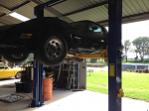
Well I was going to wait until tomorrow or the next day but I couldn't wait so I went out and did some work tonight. Nice and humid up here today in MA so I am good and soaked. The frame looks pretty good at least on the right side. I am just jacking one side at a time so later on I will see about the other side. Looks like they painted the frame silver at some point in the past at least the mid section where the rocker channels go over. The pictures are a little dark so it looks more rusty than it really is. The first picture with the rubber mount cushion was taken without the flash. I turned on the flash and the second picture of the cage and bolt is the same area that shows the actual condition which I think looks okay. I wire brushed a little of the top and side of a small area of the frame and it looks pretty solid. Felt around inside some of the holes and it feels like just some surface rust. Now for the real problem. The #2 cage nut is just spinning away. I tried to hold the nut with a couple of screw drivers while I used vise grips on the bolt but it just keeps moving. Used some pb blaster and I heated up the bolt with a mapp gas torch but it still isn't going anywhere. I really don't want to cut off the cage and weld a new one on if at all avoidable. I will keep trying to loosen it and maybe I will get lucky. I thought that back side of the cage might be open to put a wrench on the nut and then slide a new nut into the cage without removing it but it looks like the back has a welded piece of steel over the nut. I was throwing around the thought that I could use a drill bit and destroy the nut, drill a hole through the frame, and use a longer bolt on that body mount cushion. There is a slot in the side of the frame that I could slip a new nut and washer through. I really don't want to do it this way though so hopefully the bolt will come loose. The other pictures are of the wheel stands that I built out of 4x4's and plywood. I used construction adhesive between each layer of plywood and 4x4's and 10 inch timber lock screws through the top and bottom to lock it all together. I saw somewhere on this forum that someone had built them out of 2x4's and they were fine but I am nervous working under the car.
Last edited by teamo; Sep 21, 2018 at 07:19 PM.
Race Director
Joined: Apr 2009
Posts: 19,294
Likes: 2,754
From: Charlotte NC
You are aware that you have to heat up the nut....right???? Heating the bolt is useless. SO...if you can get into the access area that you can see the nut..and get the tip of your torch on it and begin to heat it up. TRY THAT. And remember...like I show people quite often. what you are looking for is 1/1,000,000th of an inch of movement in regards to the bolt and nut. If you feel the bolt move and CAN SEE that it is moving...even that 1/1,000,000th of an inch. YOU HAVE WON...and knowing that it is no longer seized...now it is time and patience in getting it out the rest of the way. I remove so many broken studs in cast iron manifolds that way with customers standing there watching me.
I would also get that rubber body mount out of the way because you can get to the nut from that area also...but you will also be applying heat to the bolt. the idea ..as you know is to heat and expand the nut but the bolt stays the same. In some cases...I have to get both hot...but I am also very careful. I also use wax...and it will work into the threads. Also get it hot...and then cool it with water and shock and freeze the nut....also I will weld a nut on the bolt if it has no nut for a socket...and then use an impact and lightly use the hammering effect on the bolt...not to break it free...but to shock the assembly and get it to free up by adding more trigger and watch what is going on.
DUB
I would also get that rubber body mount out of the way because you can get to the nut from that area also...but you will also be applying heat to the bolt. the idea ..as you know is to heat and expand the nut but the bolt stays the same. In some cases...I have to get both hot...but I am also very careful. I also use wax...and it will work into the threads. Also get it hot...and then cool it with water and shock and freeze the nut....also I will weld a nut on the bolt if it has no nut for a socket...and then use an impact and lightly use the hammering effect on the bolt...not to break it free...but to shock the assembly and get it to free up by adding more trigger and watch what is going on.
DUB


Thread Starter
Pro
Joined: Feb 2013
Posts: 572
Likes: 61
Thanks Dub,
I tried to get the torch onto the nut but it is really tight getting the flame through the slot. I'll keep working it. As for welding a nut on I don't have a welder but I have been recently doing a little research and was thinking of buying one. I did some basic stick welding in high school but haven't done any since then (31 years). I was thinking of getting a small wire feed mig welder for small projects such as this one.
I tried to get the torch onto the nut but it is really tight getting the flame through the slot. I'll keep working it. As for welding a nut on I don't have a welder but I have been recently doing a little research and was thinking of buying one. I did some basic stick welding in high school but haven't done any since then (31 years). I was thinking of getting a small wire feed mig welder for small projects such as this one.
Race Director
Joined: Apr 2009
Posts: 19,294
Likes: 2,754
From: Charlotte NC
You can braze a nut on the bolt if possible. If not ....getting that welder might work also because you can cut out the cage and weld it back in after you install a new nut...which are available.
DUB
DUB
Thread Starter
Pro
Joined: Feb 2013
Posts: 572
Likes: 61
I might get a welder soon. I was at Harbor Freight today looking at some of the small wire feed welders. Anyone have any recommendations for a specific model/type? I don't need anything elaborate as I will only be using it for small repairs and such. Looking to get into it for not too much cash.
Racer
Joined: Aug 2005
Posts: 355
Likes: 18
From: Corona Ca
I would not get a welder that is "flux core" only. There will be a day when you will wish to weld better than flux core can support.
Also, not against buying a cost effective (inexpensive) welder, but do buy the best/largest you can, as you will be VERY surprised at how much you will use it, and how quickly you will run up against its maximum duty cycle/weld capacity.
Tom
Also, not against buying a cost effective (inexpensive) welder, but do buy the best/largest you can, as you will be VERY surprised at how much you will use it, and how quickly you will run up against its maximum duty cycle/weld capacity.
Tom
Race Director
Joined: Apr 2009
Posts: 19,294
Likes: 2,754
From: Charlotte NC
I would not get a welder that is "flux core" only. There will be a day when you will wish to weld better than flux core can support.
Also, not against buying a cost effective (inexpensive) welder, but do buy the best/largest you can, as you will be VERY surprised at how much you will use it, and how quickly you will run up against its maximum duty cycle/weld capacity.
Tom
Also, not against buying a cost effective (inexpensive) welder, but do buy the best/largest you can, as you will be VERY surprised at how much you will use it, and how quickly you will run up against its maximum duty cycle/weld capacity.
Tom

Many people do not take into account the duty cycle. And if your welder you choose to buy does not have the power to weld thick metals. One tip I can write is to preheat the metal you plan on welding after to lightly tack it in place. I have a 110V Miller 'sidekick. I KNOW what it can do without any preheating. But on some thick gauges of steel...I know if I go in with my oxygen/acetylene torch and get the area to be welded really hot..and then weld it immediately...I get a weld with great penetration and the welds look great.
In this area of the frame for the caged nuts....I would not have any problem with my 110 V welder and a little preheating. I know my welder could do it on its own...but getting the steel a bit hot first just adds to the integrity of the weld.
Also I know how to prep the steel to fill in the gap where it was cut. Many tricks and tips when ti comes to cutting off factory brackets and such...so when they are re-installed...they do not look all botched up.
DUB
Thread Starter
Pro
Joined: Feb 2013
Posts: 572
Likes: 61
Dub,
What is the other choice if it is not flux core only? Is it a mig welder that also runs with the gas bottle? I know that you said you use
oxy acetylene to preheat the metal but would propane or mapp gas throw enough heat to pre heat it prior to welding?
I am thinking that this #2 cage mount is probably going to have to be cut off and a new one welded in it's place. What is the best way to cut it off nice and clean and not do any damage to the frame?
What is the other choice if it is not flux core only? Is it a mig welder that also runs with the gas bottle? I know that you said you use
oxy acetylene to preheat the metal but would propane or mapp gas throw enough heat to pre heat it prior to welding?
I am thinking that this #2 cage mount is probably going to have to be cut off and a new one welded in it's place. What is the best way to cut it off nice and clean and not do any damage to the frame?
Last edited by teamo; Jun 27, 2014 at 08:37 PM.
Race Director
Joined: Apr 2009
Posts: 19,294
Likes: 2,754
From: Charlotte NC
Dub,
What is the other choice if it is not flux core only? Is it a mig welder that also runs with the gas bottle? I know that you said you use
oxy acetylene to preheat the metal but would propane or mapp gas throw enough heat to pre heat it prior to welding?
I am thinking that this #2 cage mount is probably going to have to be cut off and a new one welded in it's place. What is the best way to cut it off nice and clean and not do any damage to the frame?
What is the other choice if it is not flux core only? Is it a mig welder that also runs with the gas bottle? I know that you said you use
oxy acetylene to preheat the metal but would propane or mapp gas throw enough heat to pre heat it prior to welding?
I am thinking that this #2 cage mount is probably going to have to be cut off and a new one welded in it's place. What is the best way to cut it off nice and clean and not do any damage to the frame?
I do not know how hot your torch can get the steel. Does it get metal as thick as the cage red hot???? if it does...then it is OK. Chances are you will not need to get it cheery red...but close to it....and that all depends on what welder you buy or rent. So it is hard to say....too many variables to be for certain.
I would use a cut-off wheel. A thin one...about .035 " thick....and cut it. I ...personally would not cut the cage entire off...but you can if you want. I would cut off the top on 3 sides and bend the top of the cage up and get the nut out and put a new nut in and heat and bend the top of the cage back down and weld up the 3 sides I cut.
Now..I can not tell if that is what is needed because I am not there....but from what I can see in the photo...it seems plausible.
After getting the top back down and the gap is equal to the cut-off wheel you used. I would tack it lightly in place and then take the cut off wheel and "V" groove the gap...so your wire will get all the way to the bottom of the cut you made with the cut-off wheel. I do not want to widen the gap a lot....just "V" notch it a bit so the wire can get in there.
ALSO...be aware. If you are practicing welding...to get the hang of it. And when you are practicing...you are welding downwards (horizontally)....so GRAVITY is pulling your weld into your weld. When you go and weld this cage...you are welding on the side (vertically)....and thus GRAVITY is NOT helping you out in getting good penetrating. KEEP THIS IN MIND. So if you have some steel that is as thick as the cage...and your are practicing...practice it vertically so you can find the wire speed and your travel speed and heat range tat will work.
DUB
Thread Starter
Pro
Joined: Feb 2013
Posts: 572
Likes: 61
Made a little progress tonight. I got the nut out of the cage. I had to destroy the nut by drilling through it repeatedly with different sized bits. I bought some cheap harbor freight bits that I didn't mind ruining and sure enough I broke about 8 of them. After much effor the nut finally fell apart and I was able to knock the remnants of the bolt out the back of the cage which I had punched out earlier. So the cage itself is still attached to the frame and is in good shape. The innards of the cage are a little messed up. I was thinking I could make a small plate with 4 sides on it out of angle iron or something similar. Then I would only have to weld the one side of the plate to the back of the open cage and it will work the same as the original, keeping the nut from spinning. Still have to order the body mount kit and my fuel and brake line clips and bolts.