When you click on links to various merchants on this site and make a purchase, this can result in this site earning a commission. Affiliate programs and affiliations include, but are not limited to, the eBay Partner Network.
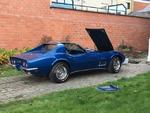
Yesterday was an unusually warm spring day for Belgium: 85 F.
The lump of iron in the engine bay is a nondescript rebuild.
Nonetheless, at idle, it was getting hot. I shut things down when getting to the stripe after 210. It also seemed slow to cool down at 55 MPH.
I have:
A stock looking mechanical fan on there; and a cheap auxiliary fan which probably doesn't pull much;
A water pump looks new-ish and is clearly aftermarket aluminum;
The radiator looks OEM as well and in good condition;
The car seems to have the correct air dam under the front;
The fan shroud, however... looks awful. It looks like stainless steel rattle-canned black. I believe it is not OEM. It also seems to have rather large gaps between it and the radiator;
The thermostat is new.
Will tossing the electric fan and installing a well-sealed, OEM-style fan shroud solve my woes? I was a bit surprised to see that it took so long for the temp to drop at speed.
I am trying to make my ride into a daily driver. I tend to be trusting of OEM engineering and tend to think that if something is not working well, someone monkeyed with it. I guess I could install a DeWitt rad plus a good electric fan and shroud but honestly, that expense would delay other projects and I am not a fan (pun intended) of electrical relays for something as critical as cooling.
What are your thoughts?
Last edited by DorianC3; Apr 20, 2018 at 03:19 AM.
Reading other threads and beginning to think that the cheap electric fan I have may be a source of restriction as well. Solution at this point seems to be:
toss cheap electric fan
replace all the seals around the rad and core support (where are the locations?)
confirm that the steel shroud is of stock design and should be effective...
Last edited by DorianC3; Apr 20, 2018 at 05:00 AM.
My experience of an early 427 powered C3 is that the OEM system is adequate cooling wise IF (and only IF) all OEM parts are in place. You need to make sure ALL cooling air ONLY come through the front grille area. So that means that all the rubber seals around the radiator, radiator surround and under the hood MUST be in place. For the same reason the OEM shroud MUST be in place. Radiator - is it working correctly?, it may not leak but are some of the gills blocked? - engine waterways and galleries, simple flushing may not remove years of compacted crud - a chemical flush may be needed. That can bring its own issues then with leaks from potentially dodgy freeze plugs. Hoses - are you 100% sure these are OK, that the springs within them are in place to prevent hoses collapsing?
I went through all of the above with mine - every improvement I made dropped the temperature by a degree or so. You only need to make 3 or 4 'improvements' to bring temperatures down to a suitable level. And back then I did use Water Wetter - and it did reduce temperatures by a further degree or two.......
Ultimately I bought a De Witt radiator - and now it runs 175/180 degrees on average - 190 on hot days perhaps. (and that's with 570 hp 489 - OEM shroud and fan)
Last edited by roscobbc; Apr 20, 2018 at 05:02 AM.
The "weak link" in your cooling system is likely the [old] radiator. The stock radiator was adequate when new; but years of collecting mineral deposits on the inside of the cooling fins can greatly reduce cooling efficiency. Use an LED light to look down into the radiator (if it has a cap). If you see brownish deposits on all of the inside walls, that may be your problem. You can use radiator CLEANER (not radiator flush) to remove those deposits, but you must follow the directions on the label.
Or you can install a new, aluminum radiator (3 or 4 row type) which will likely solve your problem.
P.S. If that aftermarket water pump is the "high volume" type, it is not helping with your issues. Forcing more water through the same system is only adding heat, due to the extra (and unnecessary) work that the pump is doing. The water pump and the radiator are the two most important elements of your cooling system...and their capabilities need to be matched. Throwing a hi-volume water pump in with a stock radiator is not necessarily an improvement. However, that pump might be fine with a new, higher capacity radiator.
Last edited by 7T1vette; Apr 20, 2018 at 07:05 AM.
For non AC, standard shift small block cars. AC and/or AT and big blocks usually got the fiberglass shroud. For applicable model years, the AIM shows both installations.
I would call the stock cooling system 'marginal'. From the 1971 owner's manual:
During normal operation, gauge will indicate around the 210 dgr mark. Hard driving, heavy traffic with stop and go, or prolonged idling in hot weather will produce a gauge reading around the 230 dgr mark.
That does not sound like a great cooling system to me.
I've modified my cooling system and I rarely run above 180 dgrs (454 BBC). I used an aluminum radiator and spal electric fans. Also switched the expansion tank for the later overflow tank instead.
I won't dispute any of the possible causes mentioned. I will reiterate the issue of properly directed airflow to the radiator. The dealer failed to attach the rubber air-dam extension onto the integrated front bumper/spoiler on my 1980. I didn't know it supposed to be there until sometime later and didn't bother with it until 6 or 7 years after that. The car routinely ran in the 210 deg range without that 1.5 wide strip of rubber. After I put it on, 180 to 190 was the norm.
I would call the stock cooling system 'marginal'. From the 1971 owner's manual:
During normal operation, gauge will indicate around the 210 dgr mark. Hard driving, heavy traffic with stop and go, or prolonged idling in hot weather will produce a gauge reading around the 230 dgr mark.
That does not sound like a great cooling system to me.
I've modified my cooling system and I rarely run above 180 dgrs (454 BBC). I used an aluminum radiator and spal electric fans. Also switched the expansion tank for the later overflow tank instead.
Don't forget though that by 71 they were starting to run retarded timing for emissions reasons and of course this made the engine run hotter than before.
First thing I would do is establish exactly what the temp is with an IR gun because I found in my car the gauge was reading 20 deg too high. Mysteriously when I machined the sender down from 5/8 to 3/8 to fit new intake the gauge now reads correctly.
I guess my first question is, why two fans? GM didn't need two fans for over 40 yrs, why now?
You say the electric fan is not pulling much. How can it pull? You mean push don't you? The mechanical belt driven fan is a puller. A auxilliary electric fan in front of the Rad is a pusher. They need to work together if you insist on this unusual set-up.
Putting a electric fan in front of the Rad is likely blocking more air than actually pushing air.
And here is another common mistake with two fans. Standing in front of the car, the mechanical / belt fan turns clockwise. Which way is the electric fan spinning? If its not also turning clockwise you will have more turbulance than you know what to do with.
Either one or the other, not both.
Electric fan as a puller, no mech fan / belt.
Or mech fan no elect aux.
Actually my 80 has two fans - the pulley driven clutch fan and a second electric fan. That was only 27 years after the vette was born. The second fan's temperature switch was apparently set very high. The only time I ever heard it come on was when after some particularly hard driving to avoid getting a ticket (I know, dumb move - but I was around 22 or 23 - and it worked) while I was sitting in the car, behind a barn, with the engine off, I heard it come to life. The obvious takeaway if there is both a mechanical fan and an electric one, the electric is most likely there only for times when the mechanical fan fails or there is a lot of heat in the engine block and the engine is off thus preventing any airflow through the radiator. The cooling effect of the fan in the latter situation would encourage some circulation of the coolant via convection.
Nobody has mentioned fan clutch. Get your car up to temperature and shut it off and try to spin the fan. If it spins more than two revolutions it maybe your problem.
Actually my 80 has two fans - the pulley driven clutch fan and a second electric fan. That was only 27 years after the vette was born. The second fan's temperature switch was apparently set very high. The only time I ever heard it come on was when after some particularly hard driving to avoid getting a ticket (I know, dumb move - but I was around 22 or 23 - and it worked) while I was sitting in the car, behind a barn, with the engine off, I heard it come to life. The obvious takeaway if there is both a mechanical fan and an electric one, the electric is most likely there only for times when the mechanical fan fails or there is a lot of heat in the engine block and the engine is off thus preventing any airflow through the radiator. The cooling effect of the fan in the latter situation would encourage some circulation of the coolant via convection.
Yup!
As soon as saw your comment, I looked up your car and sure enough an L-82. The 79/80 L-82's ran both the mechanical and an auxiliary electric fan since the later L-82's ran hot as Hades...................My 78 L-82 ran 225 normally and up to 240 with AC on a hot humid day...GM added the electric fan INSIDE the fan shroud on the engine side in 79 to address the heat issue AND the heavy duty spoiler extension:
First thing I would do is establish exactly what the temp is with an IR gun because I found in my car the gauge was reading 20 deg too high. Mysteriously when I machined the sender down from 5/8 to 3/8 to fit new intake the gauge now reads correctly.
ASSUMING that your temp sender is doing its job correctly can be a big mistake.
I know that I have seen someone on the forum a good while back who put up a chart for all of the temp senders and the ohm readings for the temperatures that will be seen on the particular gauge.
I am NOT saying that all of the previous useful advice is not warranted.
As soon as saw your comment, I looked up your car and sure enough an L-82. The 79/80 L-82's ran both the mechanical and an auxiliary electric fan since the later L-82's ran hot as Hades...................My 78 L-82 ran 225 normally and up to 240 with AC on a hot humid day...GM added the electric fan INSIDE the fan shroud on the engine side in 79 to address the heat issue AND the heavy duty spoiler extension:
Heavy Duty cooling L-82's got this ^^^^^^^^^^^^
Here's a question then on the heavy duty cooling. What that include a triple core radiator vs double core on others. Back in the 90's my original radiator was leaking and I ordered a replacement. It was only a double core. I called the company that I ordered it from and they said their book (not yet much internet at the time) showed that was correct, but they had a triple core with the same other dimensions. So they sent that. So, with what I'm seeing on this thread it brings me to ask if this was another advantage of the L-82, 50% more cooling surface in the radiator?






 How effective is stock cooling