When you click on links to various merchants on this site and make a purchase, this can result in this site earning a commission. Affiliate programs and affiliations include, but are not limited to, the eBay Partner Network.
Your way over estimating. Under braking and deceleration the front end would weigh more than the static 4 corner static weight. The idea is to brake, start lifting the brake and turn causing the car to rotate. then you are back to partial throttle at mid turn and back to as much throttle as possible past halfway. which again would lift the front end again x-ferring weight to the rear.
Lets say that you are running 550# front springs. using your 85% on the outside tire of 2023# you would be compressing the spring nearly 4 inches with a small sway bar. It just doesn't happen. My nose and front chin spoiler would have been ground away being under 2 inches off the ground sitting static.
Just unbolt the the two bolts from the a-arm the spring will push the inner a-arm down. The spring is @ 1/2 way on the a-arm and it is taking the load not the bushings.
I respect your driving and building experience Gkull. I recognize your driving expertise in many of the comments you make. I have much less car building experience than you, but I did drive at a high level and beat National Champions on any given Sunday. So I understand that side very well. I also came to realize a long time ago I was one of a very few drivers who also understand all the Physics, almost up to the level of an engineer. But I rarely saw one of them who can drive worth a darn. LOL We would both show them our rear bumpers!
I am sure the math is correct. Well within 5 or 10% anyway, maybe better, no promises there. We were talking about horizontal forces weren't we? Not vertical tire loadings? That's a whole different story..... I put all of those vertical tire and suspension loading formulas into the spreadsheet I wrote. (Not the horizontal ones). 1 G generates about 1.5" of suspension compression (spring/sway bar dependent) and yes the inside tire(s) get very very light, under 250 #. Somewhere around 1.2G or so they should weigh zero and go airborne. Probably the front first. Earlier if you hit a bump.
Last edited by leigh1322; Oct 20, 2021 at 11:08 PM.
Brief side track question please...that comes from the that data. With this comment in mind:
This 2023# is the force generated sideways at the tire contact patch, of the outside tire.
How does one ensure a given aftermarket wheel is suitable for the task of slinging & sliding a C3 around the track at ~1G?
Most of the aftermarket wheels I've looked give at most 1500 to 1800 general weight rating but not much else.
Thank you.
One corner of a C3 weighs about 900# when still. In a corner the vertical load increases to about 1500# That's how the wheels are rated. I would make sure any wheel you put on the car is rated for about 1500# or more. 900# won't cut it. Same with tires. There is enough reserve built in there to account for normal horizontal cornering loads. I have seen wheels (of too light weight) fail in racing, and it is not pretty.
Gkulls comments about the 61 lb to rotate the a-arm got me to thinking. It doesn't seem that heavy to me either. And those numbers were extrapolated from a research graph. Maybe they are too high? Maybe the size of the bushing matters for that value? Maybe theirs was a big bushing and corvette bushings are small? After all it was the only value expressed as a total force, not a rate. So size might matter.
I realized that one would also be very easy for me to measure.
So I just did. It only took 30 min.
My frame is bare with fresh a-arms on it, and brand-new fresh rubber bushings. No coil springs yet. The spindle and the wheel hub are there. I have weighed these parts before, they weigh 66# all together. Each a-arm is 23#. The spindle is 13.7# and the hub is 6.6#
I weighed the assembly as bolted to the car, at the ball joint, and the unsprung weight is 27#. The frame carries the rest of the weight.
My bushings were not torqued yet. It only took a couple lbs extra to rotate the arms upward, while the bolts were loose. Maybe 2-3? I could not measure that more accurately with my scale. It only appeared while moving.
I then torqued the bushings down to 55#, with the front suspension at a simulated ride height, (Z = 2.5")
When I let go of the a-arms they would only drop about 1.0" to 1.5" At that point they held up their own weight (the 27# unsprung wt.)
I then used my digital 100# scale, tared it to zero and raised the a-arm, with the rubber bushings now torqued down tight.
The rubber bushings had to "twist" to let me raise the a-arm. The extra weight stayed for quite some time. It acted like a spring.
I was actually shocked it took this much force to rotate a rubber bushed a-arm assembly. (Well it is 4 bushings). 1.5" to 2.0" would be about the normal amount of suspension movement in a turn, depending on your spring rates. Now mind you my rubber bushings are brand new. Never been used yet. I do not know how long they would hold up like this. Old worn rubber bushings, which are more than likely at least partly worn out, would most likely be much easier to rotate.
Now the part that shocked me is this actually has a pretty significant effect on the spring rate you would feel at the wheel.
The spring rate at the same BJ from a stock SB 250# coil spring is 97# per inch, due to the motion ratio.
The spring rate that the rubber bushings would add to the same BJ would be another 30# per inch. That's what I measured directly.
That's a 30% increase in wheel spring rate!
Now my thought was when someone substitutes the smooth easy rotating Poly or Delrin bushings, for the original stiff rotating rubber bushings, you are actually decreasing the spring rate at the wheel by 30%! WOAH!
Cut the spring rate of a 550# front coil by 30% and you wind up with 385#. 30% is a big change.
I have felt and heard several people say that the poly/delrin bushings actually ride smoother than rubber. Huh? How is that possible? Well this may be the reason why. The spring rate actually goes down by a decent amount.
And it is enough of a change in the spring rate that it may also need a corresponding change in shock valving also!
A standard fixed valved shock could potentially ride either worse, or better, all depending on how well the old valving pairs-up with the "New" wheel spring rate.
And an adjustable shock, well it might actually require an adjustment, to compensate for the spring change.
I didn't see that result coming at all! But it makes perfect sense now. Based on both the math, and driver's comments over the years.
Last edited by leigh1322; Oct 21, 2021 at 10:24 PM.
Had a chance to do some more measuring. I'll start with ride height. This is what I found:
Observations:
The Z height as described in the AIM is from the flat on bottom of the spindle, to the center of the a-arm bolt.
A stock 2.5" Z height positions the a-arms exactly in the center of their travel.
The 63 Stingray paper mentions 4" of travel in bump and rebound. That is exactly what I found.
However that is when the A-Arms hit the frame, metal on metal.
There is 2.5" of travel in each direction until the a-arms hit the bump stops.
Dynamic chassis calculations show the wheel moves 1.6" when the chassis rolls 3 degrees, on a stock non-F41 SBC C3.So it almost contacts the bump stop, to within 0.9"
The chassis also drops 1.7" on the brakes at 1G.
The turn drop and the braking drop are exactly the same, which creates consistency when trail braking into a corner, and better feel for the driver.
New Paragon bump stops measure 1-13/16" (lower) and 7/8" (upper). The lower one appears to be the same size as my original.
The F-41 front springs spec is a 1" lower Z height.
This would only leave 1.5" of travel until the tall lower a-arm hits the frame, and that is not enough for normal suspension movements.
Does anyone know if the F41 cars used different / shorter lower bump stops?
Both the prior Z heights are at curb weight, no driver.
With the stronger F41 550# springs and the 1.125" 1980 sway bar, those numbers decrease to 0.7" left, 0.7" front and 1.7 degree roll. Giving more clearance until the bump stop hits. There may be 0.8" clearance remaining.
The Chevy Powerbook recommends an even lower Z height for racing, 1.25", but with driver.
The powerbook also recommends cutting the lower bump stop to 0.6", or removing it entirely.
A 1" lowered stock sprung car would leave 1.5" of travel before touching the stock bump stop, which might not be OK. A cut down bump stop would work better.
With the F41 springs, 1" lowered car and the cut down bump stop that should give 1.5" of clearance remaining after compression and should be OK.
Extra clearance is necessary in case you hit a bump while under full braking or cornering. You need some extra movement available. You do not want to suddenly contact the bump stop or the frame during maneuvers. That would cause extreme frame stress as well as squirrelly handling when the tire suddenly loads and then unloads.
Lowering your C3 an inch would require the same treatment, cutting an inch out of the lower bump stop.
My recommendation is to confirm the clearance remaining above the lower bump stop on your car. With your ride height, springs, and fully loaded. Then decide if you need to cut the lower bump stops or not.
If you have a stock sprung car, allow for 1.7" movement at the wheel, (20% less at the bump stop, say 1.35").
If you have a 550# sprung car, allow for 0.7" movement at the wheel. (20% less at the bump stop, say 0.56").
In both cases you should ensure you have at least another 1/2" - 3/4" clearance available before the bump stops hits the frame.
If you are going to lower the car 1" with stock springs, you will need to cut the bump stops, and that may still not be enough.
Stronger front springs are almost mandatory if you want to lower the car.
That is the main reason GM put 550# springs on the race package, so you could lower it 1" and still not bottom out.
Last edited by leigh1322; Nov 11, 2021 at 10:26 PM.
Reason: updated ride height
Once you start doing suspension mods, researching threads and talking with some manufacturers it will.
I’m no guru on suspension.
I’ve had to go back and read through all this several times and it’s just starting to sink in.
I’m sure once my new upgraded suspension is going in this will become great reference material.
More measurements: Here is the Caster change with bump. Observations:
It is very linear.
For every 1" of bump, the a-arms add about 1 degree of positive caster.
This is almost exactly how much the car rotates when on the brakes. 1.7" down in front at 1G with soft stock springs. Which is almost exactly 2 degrees.
The 1G braking scenario above would cause the chassis to roll 1.9 degrees, while the geometry would add back 1.5 degrees positive caster,. So you only lose 0.4 degrees positive caster on the brakes.
If you had a manual steering car, with only 0 or .2 pos caster, it would go into negative caster on the brakes, and that would get squirrelly.
The upper a-arm is tilted downward in the rear by 10 degrees, which causes this.
It also causes anti-dive, which I have not calculated yet.
This car uses production 58-62 Impala spindles and a-arms, just the upper one is strongly tilted, unlike the Impala. Completely changing the geometry.
The car has fair amount of anti-dive, so the braking drops previously calculated do not take that into account, and it would actually drop less than the 1.7" quoted because of the anti-dive geometry.
Could you put this in Layman's terms?
Too much for me to grasp!
R
Sure! Good idea!
Stronger front springs are almost mandatory if you want to lower the car, soft stock ones will not work well, you never want the front end to bottom out, or run out of travel. Either in a turn or on the brakes.
That is the main reason GM put 550# springs on the race package, so they could lower it 1" and still not bottom out.
And you will still need to cut the bump stops down
Last edited by leigh1322; Nov 2, 2021 at 03:06 PM.
This whole poly vs Delrin vs rubber bushing conversation got me to thinking. How much difference is there really?
It took me a little while to do some research:
Notes:
1 Lowest Coefficient of friction of all known materials
2 Rigid, strong and low friction. Superior creep resistance and dimensional stability
3 Poly has almost as much sliding friction as rubber in some cases. There are many different grades of hardness available. Urethanes can be loaded beyond conventional limits for rubber, even at equivalent 80A or 90A durometer hardness.
4 Rubber is much more pliable than poly, and better at isolating noise and vibration. It is designed to move up to 1/16” at up to 60 HZ as you drive. Rubber suspension bushings are bonded to the shells and do not slide, so friction coefficient is irrelevant. It does however take a few lbs to rotate the a-arm vertically, and it should compress 1/16”+ very quickly under handling load forces, causing very measureable camber and toe-in changes. On a C3, having rear-steer tie rods, this leads to front end understeer, even at normal street force levels.
Conclusions:
So after some on-car measurements I came to a few conclusions:
The amount of rubber bushing in the radial / corner loading direction is only .15" thick. It is so thin how can it be a problem?
There is about 2000# of force on each lower control arm bushing in a 1 G corner.
I found some charts that say this load could easily cause 30% compression, in a rubber control arm bushing, or .045" compression. How bad can 45 thousandths movement be?
.045" Rubber Bushing Compression in all 4 a-arm bushings would cause 0.5 Degrees more Positive Camber in the outside, heavily loaded tire. This increases understeer.
.045" Rubber Bushing Compression would cause 3/16" toe-in in the outside, heavily loaded tire, since the steering arm is rear mounted and solid and does not flex. This increases understeer.
Poly bushings would cut this change approximately in half, or 50% of the original rubber values.
Delrin bushings would cut this approximately six times less, or 16% of the original rubber values.
There is a version of Delrin called Delrin AF. I was under the impression that it's Delrin impregnated with Teflon. A machinist friend was working with it to make low friction lead screws.
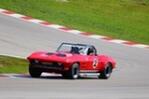
So... I finally got back to the track this past weekend after a few months off with all events cancelled over here due to the dreaded 'rona. I was trying a few new things - and they didn't work out so well! I tried running a bit more camber and caster on the front, and at least for camber I've gone past the point of diminishing returns. With 3.5 degrees neg camber on my car, and the additional camber gain under brakes, I killed my braking. Lots of front lockups under relatively (for me) mild braking. I also decided to try running the shocks set softer, after thinking some more about Leigh's comments about my lifted wheels - that also did not work well, the car was very sloppy, I stiffened them through the day and by the end of the day I had the shocks set back to where I had them previously. And finally, I went to an electric power steering pump a few months ago, and it's been brilliant on the street - more consistent feel than the mechanical pumps, no issues with belts or low assist at low rpm (due to underdrive pulleys to help keep belts on it). But it couldn't keep up on the track. I ended up opening my Heidts bypass valve and just driving it without power steering - way too heavy, but at least it was consistent and not constantly and randomly changing between assist and no assist. Meant I had to compromise my lines a lot though, as I couldn't throw it into the corner as I normally would, it was just too heavy. Still managed 5th outright though, behind 4 dedicated race cars on slicks, and definitely would have done better if the steering had been working correctly...
Popped that inside front a couple of times again:..
And I finally worked out getting the data logger data overlaid with my in car video.
This is this past Sunday:
And this is earlier in the year, with working power steering.:
Oh, also Leigh, I had some thoughts about your talk on bushings - I don't think that the toe change to toe in on the front matters that much in and of itself, as you are steering the car on the outside tyre anyway, and adjusting it with the steering wheel. However the fact that it slows response and can result in change/play not controlled by the steering wheel or damped by shocks, and can result in binding, these things are a problem. So is the lost camber. Just some thoughts.
Also, on the bumpstop conversation - I was 100% hitting the bumpstops previously. Once removed I have no witness marks at all to suggest that I am reaching hitting the frame.
Also, on the bumpstop conversation - I was 100% hitting the bumpstops previously. Once removed I have no witness marks at all to suggest that I am reaching hitting the frame.
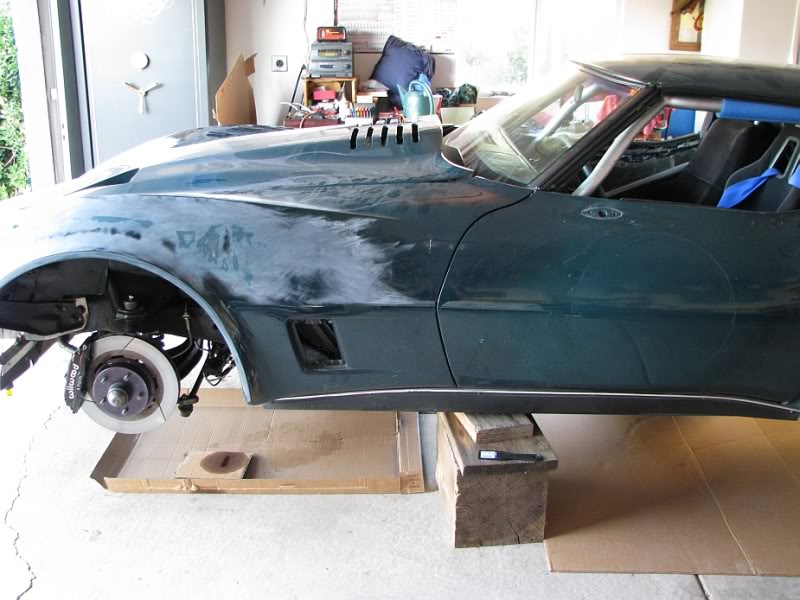
We both have 79s. I removed all the heavy metal out of the front including the head lights assembly. I can't remember ever touching front or rear bump stops. They looked new when I removed them as excess weight.
What is your spring weight and sway? I also have my shocks set on 15 or 16 compression out of 18 being the highest. Rebound is 5 to 9 out of 18.
Wasn't thinking about QA-1 dual adjust being 18 possibilities on each ****. I will look at my rear setting when I get back to town.
As to front camber. CheckIng with accurate thermal gun by a friend when you roar into the pits will tell you what is your best camber
We both have 79s. I removed all the heavy metal out of the front including the head lights assembly. I can't remember ever touching front or rear bump stops. They looked new when I removed them as excess weight.
What is your spring weight and sway? I also have my shocks set on 8 or 9 compression out of 10 being the highest. Rebound is 3 to 5 out of 10.
As to front camber. CheckIng with accurate thermal gun by a friend when you roar into the pits will tell you what is your best camber
Admittedly the bump stop removal was before I stripped weight out of the front, and I have not gone as far as you in that, but I was able to remove ~80lb from the nose regardless, while retaining the pop-up headlights (with electric motors) and urethane bumper. But I was hitting the bumpstops in the rear as well.
Interesting you have your shocks set up so stiff in compression, implies that maybe you could run a bit more spring or something. As I posted earlier, I am running factory gymkhana springs and sway bars, though with a coil or a bit more removed in front and the rear main leaf shortened, both stiffening the springs a bit. I'm running Ridetech/Fox single (rebound) adjustable shocks. Running them around 16-18 out of 24 settings. I started the day on Sunday with them down around 10, and the car was a wallowing mess! I suspect that the above pictures might have been in the early runs while I still had the shocks set too soft.
I'm afraid I don't agree with the temp gun as the best test for camber, though it's a popular method. It's probably the way to get best tyre wear, but I don't believe that it's the best way to get maximum speed. Temp readings are useful for tyre pressures. Here's the thing - your front tyres need to work best for cornering (especially turn in) and braking, and you need to reach a compromise between the two. Turning requires camber for best performance, the outside wheel in a turn will generate more grip and side force if it is still negatively cambered relative to the road when in the turn - the amount varies depending on the tyre, but within reason, more camber works better. This is proven, and will be in any proper tyre data (admittedly hard to come by often) and is in many texts. However, obviously braking is compromised by too much camber, because you reduce your contact patch, especially if you also have camber gain due to dive under brakes. Now the problem with tyre temps is that through much of your lap you are going straight, and the tyre (with static negative camber) is running on the inside edge. Thus you would expect the inside edge to be hotter because it's being heated, at a time when the front tyres really aren't important... The outside edge should be significantly cooler, because it's doing little on the straights, and even in a turn should be doing less than the inside edge for maximum cornering traction. If you shoot for even temps then you will end up with significantly less negative camber than I think you will find ideal, but... You also have to consider braking performance, which would be best with no camber at all. So it's a compromise. That's one of the reasons caster is your friend - you can keep the tyre more upright for braking and still get dynamic negative camber on the outside tyre in a turn, as well as reducing negative camber on the inside tyre (also as desired). Not to mention the jacking effect helping turn in... On the rear much the same is true, except if you do relatively short standing start events then you need to consider straight line traction off the line too. For higher speed events without a standing start, cornering traction on the rear is everything and significant rear camber is a good idea - you can maintain more corner speed, and traction on the straights should not be a problem. For slower standing start events this will kill your starts and compromise is needed. Braking is less important as the vast majority of braking is done by the front of the car due to weight transfer.
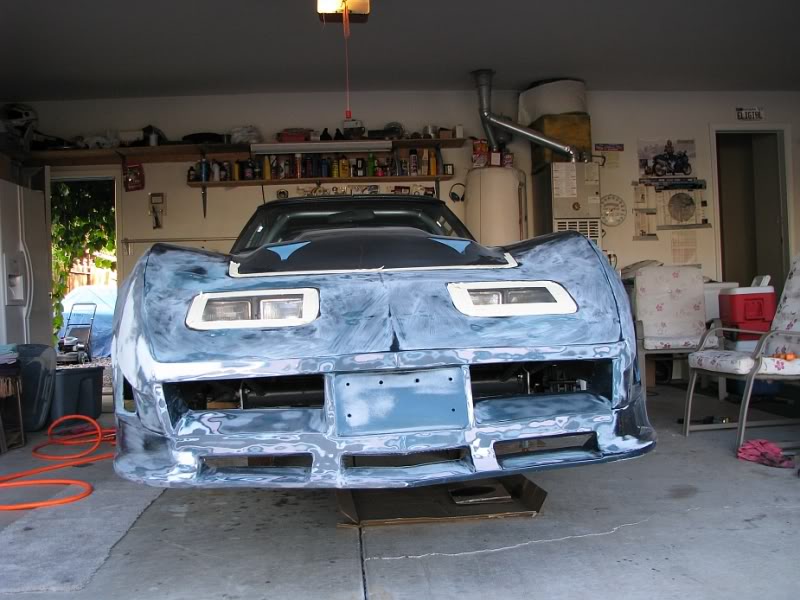
My long low to the ground front end dictates spring and shock weights and settings. At the shop we used the F1 idea of using titanium blocks that throw off a ton of bright sparks when bottoming out on any point you want to watch. I occasionally ground the nose of my car. Bad thing! So I glued on about one cm nylon blocks so I could see abrasion or out right missing blocks. I drove around with the VB&P one inch shorter 550# front springs and 1 1/8 sway bar with spring end links for 20 plus years before upgrading to QA-1 dual adjust semi coil overs. So I knew that 550# just wasn't enough. These blue springs used to be $50 a pair so I just bought a whole range 600, 650,700, and 750#. I have a very light front end less than 1400 pounds for approximately sub 700 on each front tire. Rule limited to 3000 pounds with driver. So lets say that I was total of 3050 . 1650 rear and 1400 front. Real race cars are very heavy rear weight biased and I tried to attain that. cars never achive braking that transfers 100 % to the front tires like a motorcycle. Just to use round numbers. let's say I transfer 2600 pounds to the front tires under braking with big wide slicks and at the time had 650# springs up front. My front end would compress 2 inches. So my stactic nose in the pits has to be above two inches because it's out in front of my tire centerline quite a bit. Higher compression settings resists front end dive. So racing I found 650 and 700 pound ideal for my situation. Big block historic GT1 vettes we generally had 850# front springs.
Tire ware is kind of a long term indicator. Where if you have zero toe in which I found to be best compromise. good tire pressure and always using nitrogen to fill. That the touch tire temp gauges that record or the gun type work very well for determining camber. Of which I use a minimum of even on track weekends.
The sway spring end links front and rear are open enough to allow some vertical travel before the sway come in.
After repairing the nose from hitting parts from another car.