









Cam lobe damage: Possible source?

Team Owner


Joined: Jan 2006
Posts: 37,637
Likes: 3,118
From: Crossville TN

There is a process called cryogenic hardening. I don't know if any cam manufacturer is using that to get to the hardness levels required for a cam. But, I have witnessed gear teeth which had that process applied. Interestingly, there were occasional instances of the hardened surface layer just 'popping off', all on its own. Curiously similar...but I have no idea how your cam was processed.
I think it unlikely that it is a cryo part. More likely micro-erosion due to overloading or insufficient lube (for the work being done). Have you checked out the other lobes on that cam?
I think it unlikely that it is a cryo part. More likely micro-erosion due to overloading or insufficient lube (for the work being done). Have you checked out the other lobes on that cam?

Pro

Joined: Jul 2021
Posts: 719
Likes: 156
Now, in addition to cryo (post-machining), there's triboconditioning. It's a newer in-process machining technology.
But, at this stage, neither can assuage OP's dilemma; perhaps in future.
http://appliednanosurfaces.com/produ...oconditioning/
But, at this stage, neither can assuage OP's dilemma; perhaps in future.
http://appliednanosurfaces.com/produ...oconditioning/
Pro
Joined: Jul 2021
Posts: 719
Likes: 156
One of GM's important partners (SRC/SRC Holding at Springfield MO USA) produces New crate & Remanufactured engines; offering options including cryogenic treatment of said engines' cylinder heads (reduced crack/warp/wear)

Thread Starter
Tech Contributor


Joined: Jun 2004
Posts: 20,952
Likes: 962
From: I tend to be leery of any guy who doesn't own a chainsaw or a handgun.
Hey guys, thanks for all the comments and suggestions. They're greatly appreciated. 
Spent the last couple days reading this thread, and working on a suspension change while digesting the contents here. While I have no idea how many miles or years ago this little defect showed up, I'm going to go the safe (and adult, for a change) route and replace the cam. I had hoped to make another track day this fall, but I would really kick myself if I knowingly ran this cam and it destroyed itself and dumped a bunch of debris into the rotating parts.
Just some background info on the engine and its treatment on the track. My preference is a reasonably light car that will brake and corner well. With a lighter car (it's currently about 2700# with a quarter tank of fuel) I can get a pretty decent power to weight ratio using a reasonably well mannered engine. A milder engine should require less maintenance, and also require less fuel volume/weight during track sessions. As such, I'm not really running a lot of cam lift or valve spring pressure, and I rarely need to rev this thing that high between shifts.
As I mentioned previously, when I was assembling this engine a dozen years ago I saw too many stories about (aftermarket) roller cam/lifter failures, and decided to stay with a flat tappet hydraulic setup, as I had always had good reliability with them. But, it looks like it's perhaps time to consider changing to a roller setup. I'll pull the engine, as I just find it easier to work on it outside the car. I guess I've got all winter to educate myself on what detail issues I need to consider with this swap, and what parts I need to change out. I invite additional posts here with any helpful suggestions and advice.
Thanks again,
Mike
Spent the last couple days reading this thread, and working on a suspension change while digesting the contents here. While I have no idea how many miles or years ago this little defect showed up, I'm going to go the safe (and adult, for a change) route and replace the cam. I had hoped to make another track day this fall, but I would really kick myself if I knowingly ran this cam and it destroyed itself and dumped a bunch of debris into the rotating parts.
Just some background info on the engine and its treatment on the track. My preference is a reasonably light car that will brake and corner well. With a lighter car (it's currently about 2700# with a quarter tank of fuel) I can get a pretty decent power to weight ratio using a reasonably well mannered engine. A milder engine should require less maintenance, and also require less fuel volume/weight during track sessions. As such, I'm not really running a lot of cam lift or valve spring pressure, and I rarely need to rev this thing that high between shifts.
As I mentioned previously, when I was assembling this engine a dozen years ago I saw too many stories about (aftermarket) roller cam/lifter failures, and decided to stay with a flat tappet hydraulic setup, as I had always had good reliability with them. But, it looks like it's perhaps time to consider changing to a roller setup. I'll pull the engine, as I just find it easier to work on it outside the car. I guess I've got all winter to educate myself on what detail issues I need to consider with this swap, and what parts I need to change out. I invite additional posts here with any helpful suggestions and advice.
Thanks again,
Mike

Race Director


Joined: Mar 2018
Posts: 10,814
Likes: 2,230
From: Golden Colorado
Here's just a quick note for disassembly. If you go with a roller cam, and If you have a Mark IV block, (with the 2 piece rear main seal), some of them were drilled and tapped behind the timing gear with 2 holes at 3 o'clock and 9 o'clock position. If your block has these, you can run the later GM stepped nose design cam with a retainer plate and eliminate the need for a thrust button.

Team Owner

Joined: Apr 1999
Posts: 21,953
Likes: 1,445
From: Reno Nevada
2024 C3 of the Year Finalist- Modified
I've only had Roller lifter failure and rocker failure in the distant past. before they came out with quality parts and understanding the need for max oiling systems. You need to use oil Like VR1 racing oil.
SR lifters have gone out of sight on price. I have sets of the best. The Crane Pros. Light weight stable valve train is the key. It's a little tougher with big block valve weights
SR lifters have gone out of sight on price. I have sets of the best. The Crane Pros. Light weight stable valve train is the key. It's a little tougher with big block valve weights
Thread Starter
Tech Contributor
Joined: Jun 2004
Posts: 20,952
Likes: 962
From: I tend to be leery of any guy who doesn't own a chainsaw or a handgun.
Here's just a quick note for disassembly. If you go with a roller cam, and If you have a Mark IV block, (with the 2 piece rear main seal), some of them were drilled and tapped behind the timing gear with 2 holes at 3 o'clock and 9 o'clock position. If your block has these, you can run the later GM stepped nose design cam with a retainer plate and eliminate the need for a thrust button.
Thanks.
Corvette Stories
The Best of Corvette for Corvette Enthusiasts

5 Best & 5 Worst Corvette Daily Drivers
Joe Kucinski
The Headlights of Every Corvette Generation Explained
Joe Kucinski
5 Best & 5 Most Overrated Corvette Track Packages of All Time!
Joe Kucinski
Every 2027 Corvette Engine Explained
Joe Kucinski
Designer Imagines A Corvette That Looks More Like a Corvette Than the Corvette
Verdad Gallardo
10 Ugly Corvettes That We Still Kinda Love
Joe Kucinski
Top 10 Most Expensive Corvettes Ever Sold on Bring A Trailer
Brett Foote
10 Things Every Corvette Owner Needs (2026 Edition)
Michael S. Palmer
8 Most "Only Corvette Owners Understand" Quirks and Problems
Pouria Savadkouei
Drifting

Joined: Aug 2015
Posts: 1,939
Likes: 477
From: NSW, Australia
C3 of Year Finalist (track prepared) 2019
I still have a hydraulic roller in my car, that's an option for you too if you don't want the maintenance and possibly risk of a solid roller. I run the Crane hydraulic roller lifters, and my little 388 (0.060 over, 3.75" stroke) sbc sees over 7000rpm every time I get behind the wheel, it loves it. Clocks up a lot of street and track miles every year. Like gkull, I use a billet cam with an iron gear.
Last edited by Metalhead140; Oct 7, 2021 at 11:48 PM.
Team Owner
Joined: Apr 1999
Posts: 21,953
Likes: 1,445
From: Reno Nevada
2024 C3 of the Year Finalist- Modified
I'm not terribly familiar with that retainer plate setup. Is a special cam sprocket needed to clear that thing? Reason I ask is that I currently have a special Cloyes sprocket with a machined area for a roller thrust bearing to keep the gear from chewing up the block. I just need to figure out if and where any sprocket to block wear might be involved.
Thanks.
Thanks.
So I got to talking to the race shop that just does solid roller motors and they said that they don't do timing cover buttons at all. Just think how hard it is to even install super billet timing gears and chains. The chain is so stiff side to side that the crank gear has to be lined up with the final position of the cam gear. You can't generate enough "G" force under braking to cause the cam to ever come forward enough to touch some button. All my motors since have just used stamped covers without any issue and I have water pump clearance for aftermarket racing pumps to be able to run high rpm without cavitating.
Cloyes thick timing covers are a pure waste of time and money to make them even fit on the front of the block.
Race Director
Joined: Mar 2018
Posts: 10,814
Likes: 2,230
From: Golden Colorado
I'm not terribly familiar with that retainer plate setup. Is a special cam sprocket needed to clear that thing? Reason I ask is that I currently have a special Cloyes sprocket with a machined area for a roller thrust bearing to keep the gear from chewing up the block. I just need to figure out if and where any sprocket to block wear might be involved.
Thanks.
Thanks.
Older timing gears will not work as the three bolt holes in the stepped nose cam are in a smaller diameter circle because of the step nose.
Here is a thread with a good picture of the setup and some discussion. I have done this on 3 Mark IV blocks and they all work perfectly.
https://www.corvetteforum.com/forums...am-button.html
Last edited by Vette5311; Oct 8, 2021 at 12:15 AM.

Safety Car


Joined: May 2001
Posts: 4,761
Likes: 1,648
From: Fairfax Virginia
One can learn a lot about big block quirks by reading the posts! I too went with hydraulic lifters as the roller parts had not quite proved themselves in Prime Time yet 25 years ago.
My 427 was balanced out to 7000 rpm but I found very little reason to be that high in the RPM range. I did go with all new parts when I rebuilt the valve train. I will shift at 5500-6000 rpm and that really gets me going in a hurry.
I LOVE my big block Corvette! There is NO substitute! Torque Talks!
My 427 was balanced out to 7000 rpm but I found very little reason to be that high in the RPM range. I did go with all new parts when I rebuilt the valve train. I will shift at 5500-6000 rpm and that really gets me going in a hurry.
I LOVE my big block Corvette! There is NO substitute! Torque Talks!
Thread Starter
Tech Contributor
Joined: Jun 2004
Posts: 20,952
Likes: 962
From: I tend to be leery of any guy who doesn't own a chainsaw or a handgun.
I still have a hydraulic roller in my car, that's an option for you too if you don't want the maintenance and possibly risk of a solid roller. I run the Crane hydraulic roller lifters, and my little 388 (0.060 over, 3.75" stroke) sbc sees over 7000rpm every time I get behind the wheel, it loves it. Clocks up a lot of street and track miles every year. Like gkull, I use a billet cam with an iron gear.
Thread Starter
Tech Contributor
Joined: Jun 2004
Posts: 20,952
Likes: 962
From: I tend to be leery of any guy who doesn't own a chainsaw or a handgun.
You won't need any of that with the GM OEM setup. There is really no thrust to speak of on a roller cam setup, as it is not ground with a taper like a flat tappet cam. The taper is to keep the lifters rotating, rollers obviously don't need that.
Older timing gears will not work as the three bolt holes in the stepped nose cam are in a smaller diameter circle because of the step nose.
Here is a thread with a good picture of the setup and some discussion. I have done this on 3 Mark IV blocks and they all work perfectly.
https://www.corvetteforum.com/forums...am-button.html
Older timing gears will not work as the three bolt holes in the stepped nose cam are in a smaller diameter circle because of the step nose.
Here is a thread with a good picture of the setup and some discussion. I have done this on 3 Mark IV blocks and they all work perfectly.
https://www.corvetteforum.com/forums...am-button.html
Thanks again for the info here.
Team Owner
Joined: Apr 1999
Posts: 21,953
Likes: 1,445
From: Reno Nevada
2024 C3 of the Year Finalist- Modified
But anyway this has been my experience with BBC factory and aftermarket rebuilt 454's. I don't know the year that GM came out with the 454 H-roller sold in all big heavy duty trucks and Suburbans. The problem is BBC big heavy valves and big heavy roller lifters. I had originally bought Comp Cams H-rollers for a 427 SBC project until I had to rebuild a few 454's. GM used pretty quality cam cores and they knew that heavy valve trains required heavy duty valve springs to last without recalls. Like make them last to when every the warranty was out for the power train.
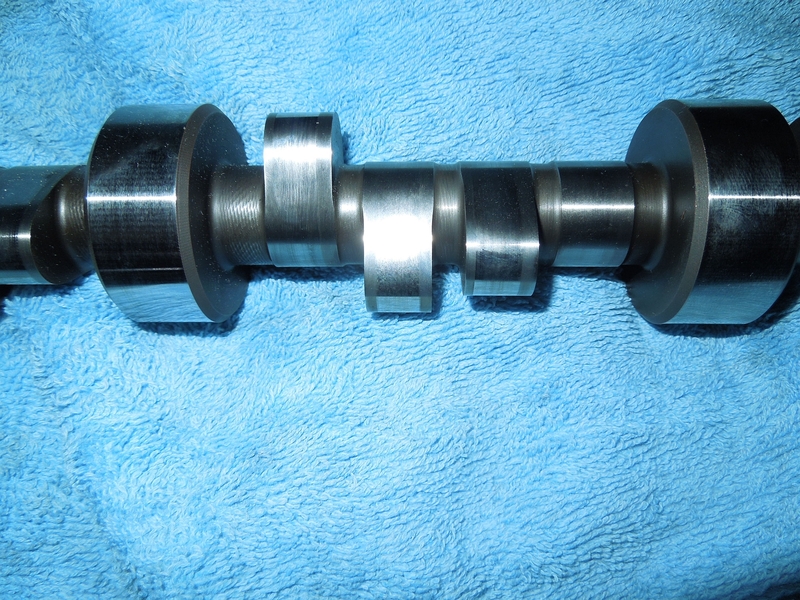
I wish that I had pictures of the cams, but they all had roller tracks really deep over the nose of the cam lobes. Like .030 to .050 deep. So as time went by you had a .450 lift cam instead of .500. You would only know if you rebuilt the engine.
At the time I was doing the 427 H-roller all the car rags were talking about valve float around sub 6500 rpm for SBC and sub 6000 with BBC even with the best springs being brand new. So I called comp cams and they told me that I could run S-rollers on my XE242/248 Hr cam or some name like that. I sold my best CC h-roller to a fellow forum member for about 50%.
As to maintenance. Nill on SR setups. You buy the low lash lobes. .012/.014 like mine. It doesn't beat the crud out of the rocker and lifter wheels and it is no where near the noise of some old 30/30 mechanical cam from yesteryear.
This is the 3rd rebuild on my billet cam and it's super aggressive lobes from the CC lobe book.
Look how long the valves are held at or near max valve lift with nearly straight up and down ramps.
Actually more gentil on the down so the valves don't bounce on the seats.
Last edited by gkull; Oct 9, 2021 at 12:25 PM.
Pro
Joined: Jul 2021
Posts: 719
Likes: 156
Hey guys, thanks for all the comments and suggestions. They're greatly appreciated.
Spent the last couple days reading this thread, and working on a suspension change while digesting the contents here. While I have no idea how many miles or years ago this little defect showed up, I'm going to go the safe (and adult, for a change) route and replace the cam. I had hoped to make another track day this fall, but I would really kick myself if I knowingly ran this cam and it destroyed itself and dumped a bunch of debris into the rotating parts.
Just some background info on the engine and its treatment on the track. My preference is a reasonably light car that will brake and corner well. With a lighter car (it's currently about 2700# with a quarter tank of fuel) I can get a pretty decent power to weight ratio using a reasonably well mannered engine. A milder engine should require less maintenance, and also require less fuel volume/weight during track sessions. As such, I'm not really running a lot of cam lift or valve spring pressure, and I rarely need to rev this thing that high between shifts.
As I mentioned previously, when I was assembling this engine a dozen years ago I saw too many stories about (aftermarket) roller cam/lifter failures, and decided to stay with a flat tappet hydraulic setup, as I had always had good reliability with them. But, it looks like it's perhaps time to consider changing to a roller setup. I'll pull the engine, as I just find it easier to work on it outside the car. I guess I've got all winter to educate myself on what detail issues I need to consider with this swap, and what parts I need to change out. I invite additional posts here with any helpful suggestions and advice.
Thanks again,
Mike
Spent the last couple days reading this thread, and working on a suspension change while digesting the contents here. While I have no idea how many miles or years ago this little defect showed up, I'm going to go the safe (and adult, for a change) route and replace the cam. I had hoped to make another track day this fall, but I would really kick myself if I knowingly ran this cam and it destroyed itself and dumped a bunch of debris into the rotating parts.
Just some background info on the engine and its treatment on the track. My preference is a reasonably light car that will brake and corner well. With a lighter car (it's currently about 2700# with a quarter tank of fuel) I can get a pretty decent power to weight ratio using a reasonably well mannered engine. A milder engine should require less maintenance, and also require less fuel volume/weight during track sessions. As such, I'm not really running a lot of cam lift or valve spring pressure, and I rarely need to rev this thing that high between shifts.
As I mentioned previously, when I was assembling this engine a dozen years ago I saw too many stories about (aftermarket) roller cam/lifter failures, and decided to stay with a flat tappet hydraulic setup, as I had always had good reliability with them. But, it looks like it's perhaps time to consider changing to a roller setup. I'll pull the engine, as I just find it easier to work on it outside the car. I guess I've got all winter to educate myself on what detail issues I need to consider with this swap, and what parts I need to change out. I invite additional posts here with any helpful suggestions and advice.
Thanks again,
Mike
Team Owner
Joined: Apr 1999
Posts: 21,953
Likes: 1,445
From: Reno Nevada
2024 C3 of the Year Finalist- Modified
It's been my experience that having a higher rpm motor with power band 4000 rpm wide really come in handy because you don't have to shift as often going around a track. Generally every track once you moving you never use first gear again. So even with a 4 speed 5 speed, and 6 speed you use about 3 gears around the track when lapping.
The value of have higher rpm motor is not having to shift say from 3-4th gear just before hitting the braking zone. It upsets the balance doing that extra 3-4 and 4-3 and then even to 2nd if it's a slower turn. More rpm to play with and just set your rev limiter to what ever you call max rpm. Go to a pro race and they change all the gears for each track, but they can't always get every turn optimized so you will hear them into the rev limiter just before the braking zone just so they don't have to do the extra shiftingh
The value of have higher rpm motor is not having to shift say from 3-4th gear just before hitting the braking zone. It upsets the balance doing that extra 3-4 and 4-3 and then even to 2nd if it's a slower turn. More rpm to play with and just set your rev limiter to what ever you call max rpm. Go to a pro race and they change all the gears for each track, but they can't always get every turn optimized so you will hear them into the rev limiter just before the braking zone just so they don't have to do the extra shiftingh
Thread Starter
Tech Contributor
Joined: Jun 2004
Posts: 20,952
Likes: 962
From: I tend to be leery of any guy who doesn't own a chainsaw or a handgun.
It's been my experience that having a higher rpm motor with power band 4000 rpm wide really come in handy because you don't have to shift as often going around a track. Generally every track once you moving you never use first gear again. So even with a 4 speed 5 speed, and 6 speed you use about 3 gears around the track when lapping.
The value of have higher rpm motor is not having to shift say from 3-4th gear just before hitting the braking zone. It upsets the balance doing that extra 3-4 and 4-3 and then even to 2nd if it's a slower turn. More rpm to play with and just set your rev limiter to what ever you call max rpm. Go to a pro race and they change all the gears for each track, but they can't always get every turn optimized so you will hear them into the rev limiter just before the braking zone just so they don't have to do the extra shiftingh
The value of have higher rpm motor is not having to shift say from 3-4th gear just before hitting the braking zone. It upsets the balance doing that extra 3-4 and 4-3 and then even to 2nd if it's a slower turn. More rpm to play with and just set your rev limiter to what ever you call max rpm. Go to a pro race and they change all the gears for each track, but they can't always get every turn optimized so you will hear them into the rev limiter just before the braking zone just so they don't have to do the extra shiftingh
Regarding transmissions, a few years back I pulled the five speed out and put the original Muncie back in. I only used the top two or three gears with either transmission, and with the weight I've got the car down to, I really don't need the extra gears to get me going anymore.
Thread Starter
Tech Contributor
Joined: Jun 2004
Posts: 20,952
Likes: 962
From: I tend to be leery of any guy who doesn't own a chainsaw or a handgun.

Le Mans Master

Joined: Mar 2001
Posts: 6,241
Likes: 1,014
From: Watkinsville, GA and Glen Cove, NY
Mike, I did a solid roller in my mostly street 502 powered 69. My engine builder, a highly respected race engine builder, actually preferred the mild solid roller setup than a hydraulic roller. This was provided that top notch parts were used. So I used a billet cam, bushed Morel lifters and some Isky circle track springs. I don’t have a ton of miles on it yet, but absolutely love the feel of the engine. I previously ran a solid flat tappet. My roller is slightly larger but has great manners and makes 50 more horsepower than the flat tappet. Best part was break in was easy. Love how quick the engine revs. Builder is confident the cam will last every bit as long as the hydraulic roller as long as I keep an eye on lash.
Bill
Bill