When you click on links to various merchants on this site and make a purchase, this can result in this site earning a commission. Affiliate programs and affiliations include, but are not limited to, the eBay Partner Network.
Is it worth trying to get tripower to work on a non match car or just go to four barrel for reliability...68 vette came with new 454 engine and had the tripower system with it...should I go with Edelbrock or Holley Or what...got to hear my engine try to crank today but then had a fire on top when it back fired...put out with baking soda...already had new kits put in..front flooded..ordered neoprine float..solved that..now the center carb pumps out one side...need suggestions..thanks....need info to talk to Lars?..THANKS ..Malcolm
From: At my Bar drinking and wrenching in Lafayette Colorado
Here is some info I have previously published about this topic:
During my interviews and research for tech articles at GM back in the late 70's, I had several discussions with GM design engineers regarding Tripower (aka "Triple Power Pak") versus 4-barrel. Here are the key comments that came from this:
Originally, the multiple carb setups (2x4 and 3x2) were used due to the limited cfm capacity of then-available single 4-barrels (since the Rochester 4GC and the Carter AFB were the only things the auto makers had going in the 50s and early 60s). Thus, the Tripower became associated with performance.
With the advent of large-cfm 4-barrels (Holley & Q-Jet), there was no technical justification for multi-carb setups.
Marketing liked Tripowers and could sell a performance image. Tripowers in the late 60s were marketing tools - not engineering performance tools.
A Tripower (3 2-barrel carbs) cannot feed 8 cylinders as uniformly as a single 4-barrel. Given equal cfm flow through a Tripower and a 4-barrel, the 4-barrel actually has the advantage due to more even fuel distribution.
Tripowers utilizing individual air cleaners have severe cfm flow restrictions due to air filter size. Single large air cleaners for the entire setup flow much better than individual air cleaners for each of the carbs.
Tuning is cumbersome due to the inaccessibility of the center and end carb float bowls on the Holley carbs. This makes quick track tuning almost impossible. But Tripowers still look cool and sound great...
With regards to total cfm airflow through the Tripower, the cfm flow numbers and ratings on the Tripower cannot be directly compared to the cfm ratings of a 4-barrel carb, and there are some other factors to consider as well, making the “1200 cfm” rating questionable and somewhat irrelevant.
First, keep in mind that the SAE standard for testing and rating 4-barrel carbs is at 1.5 inches of Mercury, while the test pressure for 1-barrel and 2-barrel carbs is 3 inches of Mercury. This higher delta test pressure (twice the delta pressure) for the 2-barrel carb makes the 2-barrel appear to flow much higher, and the numbers for the 4-barrel cannot be compared to the numbers for the 2-barrel. The reason for this pressure difference in the rating is that it is assumed that a 2-barrel carb is used on a modest passenger car, which will pull vacuum even at WOT, whereas a 4-barrel carb used in a performance application will pull very little vacuum at WOT. For racing purposes, the flow ratings get even worse, since a properly-sized carb for a racing engine will pull almost no vacuum at WOT. On the other end of the spectrum, the little 390 NASCAR carbs, used at extreme rpm, pull so much vacuum at WOT that the carb actually flows about 3 times its "rated" flow rating. The large 2-barrels on the low-rev'ing 427 will not be exposed to anywhere close to 3" Hg vacuum at WOT, and will not, therefore, flow anywhere close to the 1200-cfm rating.
To add a little more confusion to the whole "cfm rating" thing, most flow benches in the racing industry (such as those used by Holley and Demon) measure dry air at low pressure drops (about 10 inches of water) one venturi at a time. This result is multiplied by a factor to arrive at what that bore would flow at a higher vacuum (i.e. 1-1/2 or 3 inches of mercury), then that figure is multiplied by the number of barrels to get the C.F.M. rating. This rating is usually much higher than it actually is, since the interaction between the barrels prevents them from achieving their individual flows once they are working together, so use of the manufacturer's "rating" is not a reliable yardstick for running the common "carb sizing" calculators: The calculators usually end up showing that the engine needs a very small carb, when, in fact, the engine, when used in a performance application, can make good use of a carb significantly larger that what the "calculators" would indicate.
So knowing all this, let's take an educated look at the 2-barrel carbs on the 427 Tripower: The center carb on a tripower is rated at 350 cfm. The end carbs are rated at 466 cfm, for a total advertised cfm rating of 1282 cfm… Wow.
Now, consider that those carbs achieved that rating with twice the test pressure of a 4-barrel carb. The flow through the carb is not linear with pressure, so the 350 carb will probably flow a little over half that at half the delta-P, so give it the benefit of doubt and say it will flow roughly 75% of its 3-inch rating when tested at 1.5" of Hg. In fact, the actual conversion factor to convert the 2-barrel flow rating to the equivalent 4-barrel standard (with a very small percentage of error) is to simply use the square root of 2 (1.414).
Thus to convert a two-barrel rating into a four-barrel rating, divide the two-barrel rating by 1.414.
To convert the four-barrel rating to a two-barrel rating, multiply the four-barrel rating by 1.414.
That puts the center carb at a "4-barrel equivalent comparative flow" of 247 cfm. The end carbs flow a 4-barrel equivalent of 329. Add it all up, and you get roughly 900 cfm... 900 cfm with vacuum secondaries on a performance 427 sounds just about right.
To create additional disadvantage to the Tripower, the low-profile air cleaner, fitting tightly over the carbs, creates additional flow restriction and decrease in total cfm flow. Also, 6 barrels simply cannot feed 8 cylinders as evenly as a single center-mounted 4-barrel: The Tripower manifold creates a difference in cylinder-to-cylinder filling, putting the manifold at a disadvantage to a good 4-barrel intake. So although the Tripower looks fantastic, and was a great marketing tool for the Corvette Performance image, fact is that a single 850 cfm 4-barrel will outperform the "1200 cfm" Tripower when set up correctly on a good manifold.
Lars
From: At my Bar drinking and wrenching in Lafayette Colorado
Here is some info I have previously published about this topic:
During my interviews and research for tech articles at GM back in the late 70's, I had several discussions with GM design engineers regarding Tripower (aka "Triple Power Pak") versus 4-barrel. Here are the key comments that came from this:
Originally, the multiple carb setups (2x4 and 3x2) were used due to the limited cfm capacity of then-available single 4-barrels (since the Rochester 4GC and the Carter AFB were the only things the auto makers had going in the 50s and early 60s). Thus, the Tripower became associated with performance.
With the advent of large-cfm 4-barrels (Holley & Q-Jet), there was no technical justification for multi-carb setups.
Marketing liked Tripowers and could sell a performance image. Tripowers in the late 60s were marketing tools - not engineering performance tools.
A Tripower (3 2-barrel carbs) cannot feed 8 cylinders as uniformly as a single 4-barrel. Given equal cfm flow through a Tripower and a 4-barrel, the 4-barrel actually has the advantage due to more even fuel distribution.
Tripowers utilizing individual air cleaners have severe cfm flow restrictions due to air filter size. Single large air cleaners for the entire setup flow much better than individual air cleaners for each of the carbs.
Tuning is cumbersome due to the inaccessibility of the center and end carb float bowls on the Holley carbs. This makes quick track tuning almost impossible. But Tripowers still look cool and sound great...
With regards to total cfm airflow through the Tripower, the cfm flow numbers and ratings on the Tripower cannot be directly compared to the cfm ratings of a 4-barrel carb, and there are some other factors to consider as well, making the “1200 cfm” rating questionable and somewhat irrelevant.
First, keep in mind that the SAE standard for testing and rating 4-barrel carbs is at 1.5 inches of Mercury, while the test pressure for 1-barrel and 2-barrel carbs is 3 inches of Mercury. This higher delta test pressure (twice the delta pressure) for the 2-barrel carb makes the 2-barrel appear to flow much higher, and the numbers for the 4-barrel cannot be compared to the numbers for the 2-barrel. The reason for this pressure difference in the rating is that it is assumed that a 2-barrel carb is used on a modest passenger car, which will pull vacuum even at WOT, whereas a 4-barrel carb used in a performance application will pull very little vacuum at WOT. For racing purposes, the flow ratings get even worse, since a properly-sized carb for a racing engine will pull almost no vacuum at WOT. On the other end of the spectrum, the little 390 NASCAR carbs, used at extreme rpm, pull so much vacuum at WOT that the carb actually flows about 3 times its "rated" flow rating. The large 2-barrels on the low-rev'ing 427 will not be exposed to anywhere close to 3" Hg vacuum at WOT, and will not, therefore, flow anywhere close to the 1200-cfm rating.
To add a little more confusion to the whole "cfm rating" thing, most flow benches in the racing industry (such as those used by Holley and Demon) measure dry air at low pressure drops (about 10 inches of water) one venturi at a time. This result is multiplied by a factor to arrive at what that bore would flow at a higher vacuum (i.e. 1-1/2 or 3 inches of mercury), then that figure is multiplied by the number of barrels to get the C.F.M. rating. This rating is usually much higher than it actually is, since the interaction between the barrels prevents them from achieving their individual flows once they are working together, so use of the manufacturer's "rating" is not a reliable yardstick for running the common "carb sizing" calculators: The calculators usually end up showing that the engine needs a very small carb, when, in fact, the engine, when used in a performance application, can make good use of a carb significantly larger that what the "calculators" would indicate.
So knowing all this, let's take an educated look at the 2-barrel carbs on the 427 Tripower: The center carb on a tripower is rated at 350 cfm. The end carbs are rated at 466 cfm, for a total advertised cfm rating of 1282 cfm… Wow.
Now, consider that those carbs achieved that rating with twice the test pressure of a 4-barrel carb. The flow through the carb is not linear with pressure, so the 350 carb will probably flow a little over half that at half the delta-P, so give it the benefit of doubt and say it will flow roughly 75% of its 3-inch rating when tested at 1.5" of Hg. In fact, the actual conversion factor to convert the 2-barrel flow rating to the equivalent 4-barrel standard (with a very small percentage of error) is to simply use the square root of 2 (1.414).
Thus to convert a two-barrel rating into a four-barrel rating, divide the two-barrel rating by 1.414.
To convert the four-barrel rating to a two-barrel rating, multiply the four-barrel rating by 1.414.
That puts the center carb at a "4-barrel equivalent comparative flow" of 247 cfm. The end carbs flow a 4-barrel equivalent of 329. Add it all up, and you get roughly 900 cfm... 900 cfm with vacuum secondaries on a performance 427 sounds just about right.
To create additional disadvantage to the Tripower, the low-profile air cleaner, fitting tightly over the carbs, creates additional flow restriction and decrease in total cfm flow. Also, 6 barrels simply cannot feed 8 cylinders as evenly as a single center-mounted 4-barrel: The Tripower manifold creates a difference in cylinder-to-cylinder filling, putting the manifold at a disadvantage to a good 4-barrel intake. So although the Tripower looks fantastic, and was a great marketing tool for the Corvette Performance image, fact is that a single 850 cfm 4-barrel will outperform the "1200 cfm" Tripower when set up correctly on a good manifold.
Lars
Thanks fpr the info Lars...do I need a 600...650..750 carb..engine is a 71 454..2 bolt main..11-1 pistons...not what I would build but was overhauled by round track driver and came with car when I bought it...been 6 years now..ready to crank and paint
The 450HP LS6came with a 780cfm vac secondary Holley. Other than that you would need to know cam / rpm specs.
Although your bigger issue is do you want it to fit under a flat hood, or an L88 hood? What intake do you want to run?
AFAIK there are only 2 current BBC Holley intakes that fir under a stock hood, the LS6 dual plane one and a Torker II single plane.
This is the 3963569 that is reproduced.
It is rather "flat" but on a BBC it still needs a deep drop air cleaner. And it still barely fits under the hood.
FYI I saw at least one C3 with this setup and a stock base engine flat hood, not even the LT1/BB version.
Last edited by leigh1322; Nov 10, 2021 at 05:47 PM.
2020 Corvette of the Year Finalist (performance mods)
2019 C3 of Year Winner (performance mods)
2016 C3 of Year Finalist
it is but it needs lots of lovin to get it running right. It will never be as easy as a 4 barrel and it wont make as much power. Engine masters have done multiple shows on multi carb intakes as well as Richard Holdner. All the dyno test show top end power is always going to be the 4 barrel unless you get into tunnel rams. But the tri power is still the king of cool in the looks dept...
One of the main issues with them leaking is the carbs, base plates and metering plates on them warp. They need to be trued and the metering blocks replaced.
What would you do with the tri power?
Last edited by Rescue Rogers; Nov 10, 2021 at 07:18 PM.
From: At my Bar drinking and wrenching in Lafayette Colorado
Originally Posted by 68 beginner
Thanks for the info Lars...do I need a 600...650..750 carb..engine is a 71 454..
As a reference point, Chevy (GM) put 750 cfm Q-Jets on all the 350 small block Vettes. They put a 780 Holley on the 302. They also ran the 780 on the LS6. I just told you that the Tripower is 900 cfm, which is what you were thinking about running. Now you're asking if you should use a 600 cfm carb..? Why would you even consider or think about anything less than 750 on a 454 with any reasonable level of performance..? I usually run 830-850 cfm Holleys on street-driven performance big blocks, and they run really well. But if your mom is going to drive the car, the 600 might be a good choice...
Lars
Lars has a lot of good input regarding 4-bbl vs. 3x2-bbl from a performance perspective. But, for normal driving, the story is a bit different. If properly set up, the center carb on a 3x2 intake is the ONLY operating carb during normal operation. And I suspect that a single 2-bbl carb at the center of the intake does a pretty good job of providing balanced flow to all cylinders. You basically are running a 2-bbl. system until you stab the pedal.
3x2 setup is more expensive to procure and more effort to install and set up; but it sure looks a lot cooler than a single 4-bbl. when you open the hood.
And you get a bunch more folks willing to stop and chat about it with you.
So far, only performance in HP is mentioned for both setups.
But if fuel consumption plays a role, here what I experienced with my 68 with the 427 CI BB
650 CFM double pumper, average consumption 20 Liters / 100 km
750 CFM double pumper, around 25
850 CFM double pumper, around 30
Tripower , around 18
I didn't realy feel any power differences , but did not race or run endless times at high RPM.
Guess using a vacuum operated secondary 4 barrels reduces the consumption a bit , but for me, I stay now with the tripower.
I loved my 427/400......it was a fun time machine......but if the car wasn't built that way, I wouldn't mess with it........
It sure stopped them in their tracks here at car shows.......crowds around the engine all day.....
I was going to promote the 'economy' side of the tri-power system. And, with exception to the Quadra-Jet, I'm confident that the tri-power system is more economical than other 4-bbl carbed engines. The Q-jet has those little primary venturi and it is as economical as anything else you could put on an engine, if set up properly.
If I could afford it and it would fit well under the hood, I would put a tri-power on about any 'muscle'-type vehicle.
My Younger brother had a fascination for Porsche 914's. His last one had four single-barrel carburetors built by Webber. He asked me to help clean his carburetors so I carefully measured the number of turns in each screw was at. Then I disassembled them and soaked them in carburetor cleaner for about 24 hours. I then re-assembled them and re-installed the carburetors. Once the fuel pump had filled the bowls it started on the very first crank and "ran like a clock". I installed a vacuum fitting on each barrel and used my Motorcycle Carburetor Synchronize to ensure they were all happily running together.
I was glad he only had four cylinders to get balanced, I used to be a Motorcycle mechanic back in the early 1970's and how I dreaded issues with multiple Carburetors of the day and getting them all synchronized. I am sure glad I don't have a CBX....
I have a 1968 that started life as an L71 Corvette. I never got the carburetors or manifold but I found a man who actually owned a 1968 L88 that he purchased from the factory. He had wrecked the car years before and he was selling the remaining parts he had. I bought the hood and he mailed me the intake parts. I currently have One 4 barrel Throttle Body on top of my 427. It is part of a Holley Sniper EFI system. The hood and intake system gets the coldest air into the engine and that really helps the high compression 427 run ping free.
I'm sure that driven equally A. the stock tri-power engine and B. the single quad engine, irrespective of cfm (and whether vac or mech secondary) if jetted and optimised for economy and driven accordingly would come up with very similar economy figures.........burying your right foot in the carpeting might yield differing results.........






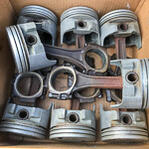
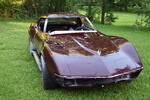




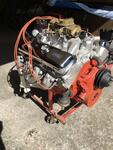












 tripower or four barrel


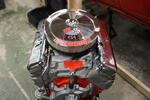












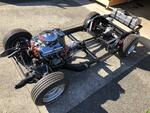

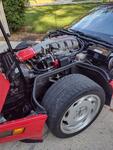


 than a single 4-bbl. when you open the hood.