



What engine temp to run?

Safety Car


Joined: Nov 2009
Posts: 3,973
Likes: 341
From: Adelaide South Australia
Melting Slicks


Joined: Dec 2009
Posts: 2,236
Likes: 286

Thread Starter
Team Owner


Joined: Aug 2004
Posts: 21,543
Likes: 3,216
From: Park City Utah


Huh? Isn't there a 20˚ difference between the two?

Le Mans Master


Joined: Aug 2017
Posts: 6,942
Likes: 1,490
From: New Jersey
Melting Slicks
Joined: Dec 2009
Posts: 2,236
Likes: 286
The Lt has a lower rated stat because the coolant goes through the heads first and then the block as you know. They call that a reverse cooling system, when the stat opens it actually lets coolant into the engine from the lower hose. If it had a 195 stat, an Lt engine would run pretty hot going down the road. I'd bet it would run 210.
Thread Starter
Team Owner
Joined: Aug 2004
Posts: 21,543
Likes: 3,216
From: Park City Utah
The Lt has a lower rated stat because the coolant goes through the heads first and then the block as you know. They call that a reverse cooling system, when the stat opens it actually lets coolant into the engine from the lower hose. If it had a 195 stat, an Lt engine would run pretty hot going down the road. I'd bet it would run 210.
But so to all the other cars I've had, with conventional cooling; Install a 180 stat...they run around 185-190ish. I'm not "seeing" the diff...

Safety Car

Joined: Sep 2001
Posts: 4,157
Likes: 554
From: Glenbeulah Wi
I'm not following. My LT1 has a 180 stat...it typically runs in the 185-190 range...right down "against the stat". If I climb a hill, then decent a long hill temps can go as low as low 170's due to the delayed effect of the stat closing and cold water in the radiator. Anyway, it runs just above it's rated temp.
But so to all the other cars I've had, with conventional cooling; Install a 180 stat...they run around 185-190ish. I'm not "seeing" the diff...
But so to all the other cars I've had, with conventional cooling; Install a 180 stat...they run around 185-190ish. I'm not "seeing" the diff...
The whole point of the Lt1 was to cool the heads first so you could make more power by increasing compression and reducing detonation. Kind of flies in the face of run it hot for more power and economy. The fact that GM increased compression for better power and economy while cooling the heads to a lower temp should make people question the notion to run the engine hot. As demonstrated by GM adding compression and keeping it cool more then offsets lower compression and running it hot.
Last edited by bjankuski; May 27, 2018 at 11:23 PM.
Corvette Stories
The Best of Corvette for Corvette Enthusiasts

Top 10 Most Expensive Corvettes Ever Sold on Bring A Trailer
Brett Foote
10 Things Every Corvette Owner Needs (2026 Edition)
Michael S. Palmer
8 Most "Only Corvette Owners Understand" Quirks and Problems
Pouria Savadkouei
10 Reasons the C6 Z06 is Still A Performance Benchmark After 20 Years
Joe Kucinski
How Much Horsepower Every Corvette Engine "LOST" in 1972
Joe Kucinski
Top 10 DOs and DON'Ts for Protecting Your Convertible Top!
Michael S. Palmer
Top 10 Most Explosive Corvettes Ever Made: Power-to-Weight Ratio Ranked!
Joe Kucinski
150 hp to 1,250 hp: Every Corvette Generation Compared by the Specs That Matter
Joe Kucinski
8 Coolest Corvette Pace Cars (and Replicas) of All Time
Verdad Gallardo
Melting Slicks

Joined: Apr 2007
Posts: 2,616
Likes: 111
I have been running a 165 degree thermostat in mine for 14 years...engine still runs around 180 degrees most of the time...especially sitting in traffic.....short trips in mine too.......allowed me to throw 36 degrees of total timing at it for optimal performance at WOT w/o detonation with 10.6:1 compression ratio (static).
0 issues........
0 issues........

Supporting Vendor

Joined: Oct 2004
Posts: 761
Likes: 68
You are correct, the idea it run farther above the t-stat temp with a hotter 195 t-stat makes no logical sense.
The whole point of the Lt1 was to cool the heads first so you could make more power by increasing compression and reducing detonation. Kind of flies in the face of run it hot for more power and economy. The fact that GM increased compression for better power and economy while cooling the heads to a lower temp should make people question the notion to run the engine hot. As demonstrated by GM adding compression and keeping it cool more then offsets lower compression and running it hot.
The whole point of the Lt1 was to cool the heads first so you could make more power by increasing compression and reducing detonation. Kind of flies in the face of run it hot for more power and economy. The fact that GM increased compression for better power and economy while cooling the heads to a lower temp should make people question the notion to run the engine hot. As demonstrated by GM adding compression and keeping it cool more then offsets lower compression and running it hot.

Team Owner
Joined: Dec 2000
Posts: 90,675
Likes: 304
From: SE NY
Cruise-In II Veteran
Guys, the engine made 10 less hp and 7.7 less tq at 205˚ than it did at 135˚.
First "mod" to my current '88 was to install a 160deg T-stat...

Melting Slicks

Joined: Jul 2005
Posts: 2,649
Likes: 863
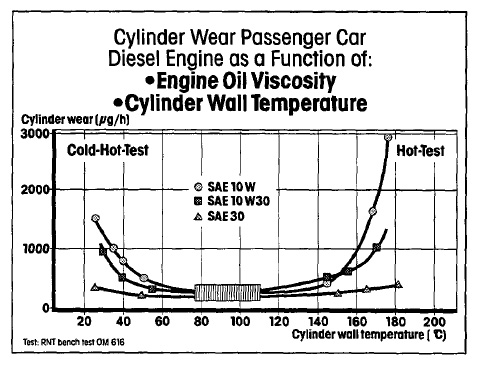
IMHO - I try to run the engine at around 180 - 190 degrees. I did see a graph in some publication years ago that showed less cylinder bore wear at around 175 - 180 degrees. More temp than that didn't seem to help much. (Ill try to find that graph.)
Old school drag racers used to use "cool cans" literally full of ice - and ran the fuel lines thru these cans to try to keep the fuel and the carb cool - thus allowing a bit more dense air and a bit cooler carb to allegedly allow a touch more timing / compression.... How much was gained is obviously debatable.
I tend to think with modern oils, the difference in cylinder wall wear at 160 vs. 180 will be difficult to measure after a 100K mile life, but I do tend to like warm oil before I put heavy loads on engines. I try to get to 180 F oil temp before I start high RPM stuff (but I'm using pretty thick oil in my track stuff so I have to be a bit more careful than if I was using 10W-30)...
The factory thermostat setting is a compromise between many factors including emissions, heater performance in very cold climates, operation is very hot climates, and fuel economy. Just because the factory engineers made one set of tradeoffs - does not make it right for everyone. I'll stick with 180 - for my uses - but part of that is based on that graph I saw well over a decade ago - and as I said that may be OBE by modern synthetic oils.....
Old school drag racers used to use "cool cans" literally full of ice - and ran the fuel lines thru these cans to try to keep the fuel and the carb cool - thus allowing a bit more dense air and a bit cooler carb to allegedly allow a touch more timing / compression.... How much was gained is obviously debatable.
I tend to think with modern oils, the difference in cylinder wall wear at 160 vs. 180 will be difficult to measure after a 100K mile life, but I do tend to like warm oil before I put heavy loads on engines. I try to get to 180 F oil temp before I start high RPM stuff (but I'm using pretty thick oil in my track stuff so I have to be a bit more careful than if I was using 10W-30)...
The factory thermostat setting is a compromise between many factors including emissions, heater performance in very cold climates, operation is very hot climates, and fuel economy. Just because the factory engineers made one set of tradeoffs - does not make it right for everyone. I'll stick with 180 - for my uses - but part of that is based on that graph I saw well over a decade ago - and as I said that may be OBE by modern synthetic oils.....
Thread Starter
Team Owner
Joined: Aug 2004
Posts: 21,543
Likes: 3,216
From: Park City Utah
I have been running a 165 degree thermostat in mine for 14 years...engine still runs around 180 degrees most of the time...especially sitting in traffic.....short trips in mine too.......allowed me to throw 36 degrees of total timing at it for optimal performance at WOT w/o detonation with 10.6:1 compression ratio (static). 0 issues
Thread Starter
Team Owner
Joined: Aug 2004
Posts: 21,543
Likes: 3,216
From: Park City Utah
Based on my own experience, I agree that the diff in wear between 160 coolant temps and 180 coolant temps is meaningless. Worryin' about chit that ain't worth worryin' about.

Melting Slicks
Joined: Jul 2005
Posts: 2,649
Likes: 863
Melting Slicks
Joined: Jul 2005
Posts: 2,649
Likes: 863
No - the charts are consistent. Note that one chart is on Deg F and one is in Deg C. The First chart (the one for non-diesel) doesn't go beyond 200F (roughly 100C). The Diesel chart shows hat as you get way hot - wear goes back up again.... That makes sense! Much above 300F even synthetic oil is starting to throw in the towel.