



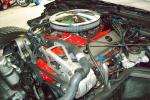


What engine temp to run?

Thread Starter
Team Owner


Joined: Aug 2004
Posts: 21,543
Likes: 3,216
From: Park City Utah
 What engine temp to run?
Let's clarify something first: I don't GAF what temp people run their engine at. However, there are a lot of claims on forums and elsewhere, about how coolant temps and the consequences.
Enter Engine Masters latest episode, "If accessories could kill". They tested a variety of water pumps/drives, added an alternator....then dyno'ed the engine, (4 times) starting the pull at ~135˚f and then 4 more following pulls, starting at ~205˚f. Guess what happened?
Common lore that you hear includes claims that the at the cooler temp, the engine will wear out, it will make excessive emissions, get poor fuel economy, the oil pan will fill up with water....and for all those dire draw backs, it won't make any more power anyway, so it's not worth it.
Guys, the engine made 10 less hp and 7.7 less tq at 205˚ than it did at 135˚. That's a meaningful amount of power...and it certainly didn't lose power. But what is even more noteworthy here, is that Engine Masters didn't even exploit the real advantage to lower op (head) temps in this test!: The potential of more ignition advance, or more compression w/o detonation. More timing is where you can really pull some extra power w/o detonation issues, with lower operating temps...but they didn't change the timing for this test. Only change was coolant temp.
My take away? The sky isn't falling if you chose to run a 160˚ stat, and likewise, neither is it falling if you run at 220˚F either. Also, that those who claim that lower temps don't help power anyway...that's erroneous.
Enter Engine Masters latest episode, "If accessories could kill". They tested a variety of water pumps/drives, added an alternator....then dyno'ed the engine, (4 times) starting the pull at ~135˚f and then 4 more following pulls, starting at ~205˚f. Guess what happened?
Common lore that you hear includes claims that the at the cooler temp, the engine will wear out, it will make excessive emissions, get poor fuel economy, the oil pan will fill up with water....and for all those dire draw backs, it won't make any more power anyway, so it's not worth it.
Guys, the engine made 10 less hp and 7.7 less tq at 205˚ than it did at 135˚. That's a meaningful amount of power...and it certainly didn't lose power. But what is even more noteworthy here, is that Engine Masters didn't even exploit the real advantage to lower op (head) temps in this test!: The potential of more ignition advance, or more compression w/o detonation. More timing is where you can really pull some extra power w/o detonation issues, with lower operating temps...but they didn't change the timing for this test. Only change was coolant temp.
My take away? The sky isn't falling if you chose to run a 160˚ stat, and likewise, neither is it falling if you run at 220˚F either. Also, that those who claim that lower temps don't help power anyway...that's erroneous.

Race Director


Joined: Apr 2003
Posts: 17,700
Likes: 1,667
From: moraga ca
The problem I see with running low engine temperatures is engine wear from lack of lubrication. It is known that at low oil temperatures, oil doesn't flow as well. Many auto manufactures have computers programmed to allow only part throttle with drive by wire systems unless the oil temperature is over a set amount. I have heard that 150 degrees or more is the safe threshold. At the track, I wait until my oil temperature is 150 degrees before a run. Shaving a hundreth or two isn't as important to me as engine longevity.
Thread Starter
Team Owner
Joined: Aug 2004
Posts: 21,543
Likes: 3,216
From: Park City Utah
Maybe. I've heard 100˚ is fine. I don't think it is...but you "hear" all kinds of crap. What really WORKS?
IDK...but 160 stats aren't going to hurt anything...that's for sure. My boat's been running @ 150-160˚F for 26 years. Still runs like new.
IDK...but 160 stats aren't going to hurt anything...that's for sure. My boat's been running @ 150-160˚F for 26 years. Still runs like new.

Le Mans Master


Joined: Aug 2017
Posts: 6,940
Likes: 1,490
From: New Jersey
It's mainly the emissions for high temps. I like 180 but in these cars especially, lower than 180 on a warm day isn't really possible, you're constrained by heat transfer values of the system as a whole. Now if you let it cool off... sure, that's what racers do.
Funny thing is about the boat, I bet you run something along the lines of 15w40 in there right? But that would be too thick at a lower temp... my boat runs 140 raw water cooled and 185 on the closed diesels. Hell my ski doesn't even have a thermostat. The sump gets plenty warm on boats because of the extra load on the drivetrain. As long as your oil gets warm enough to flash off water vapor and the rings and piston expand enough so that you get proper cylinder sealing, you can run whatever temp satisfies that. I like the higher stat because my heat would suck otherwise.
Funny thing is about the boat, I bet you run something along the lines of 15w40 in there right? But that would be too thick at a lower temp...
my boat runs 140 raw water cooled and 185 on the closed diesels. Hell my ski doesn't even have a thermostat. The sump gets plenty warm on boats because of the extra load on the drivetrain. As long as your oil gets warm enough to flash off water vapor and the rings and piston expand enough so that you get proper cylinder sealing, you can run whatever temp satisfies that. I like the higher stat because my heat would suck otherwise.

Safety Car


Joined: Nov 2009
Posts: 3,973
Likes: 341
From: Adelaide South Australia
The big question with computer controlled EFI engines is what temp does it go into closed loop ?
The L98 runs on a rich setting in open loop until it goes into closed loop at about 160 F.
At that temp and above it starts chasing a set AFR.
Tuners often set several tunes in line with coolant temp. My fastchip has 3 different stages and final tune comes in at 180 F.
The coolant system and the thermostat control the ultimate running temps - the c4's were usually fitted with 195 F thermostats.
From what Ive heard and read over the years is that the sweet spot for the chev sbc is between 180 to 200 F.
The GM engineers had to meet emissions and mileage targets - and the cars ended up with a 195 F thermostat in them.
The L98 runs on a rich setting in open loop until it goes into closed loop at about 160 F.
At that temp and above it starts chasing a set AFR.
Tuners often set several tunes in line with coolant temp. My fastchip has 3 different stages and final tune comes in at 180 F.
The coolant system and the thermostat control the ultimate running temps - the c4's were usually fitted with 195 F thermostats.
From what Ive heard and read over the years is that the sweet spot for the chev sbc is between 180 to 200 F.
The GM engineers had to meet emissions and mileage targets - and the cars ended up with a 195 F thermostat in them.

Safety Car

Joined: Sep 2001
Posts: 4,157
Likes: 554
From: Glenbeulah Wi
The big question with computer controlled EFI engines is what temp does it go into closed loop ?
The L98 runs on a rich setting in open loop until it goes into closed loop at about 160 F.
At that temp and above it starts chasing a set AFR.
Tuners often set several tunes in line with coolant temp. My fastchip has 3 different stages and final tune comes in at 180 F.
The coolant system and the thermostat control the ultimate running temps - the c4's were usually fitted with 195 F thermostats.
From what Ive heard and read over the years is that the sweet spot for the chev sbc is between 180 to 200 F.
The GM engineers had to meet emissions and mileage targets - and the cars ended up with a 195 F thermostat in them.
The L98 runs on a rich setting in open loop until it goes into closed loop at about 160 F.
At that temp and above it starts chasing a set AFR.
Tuners often set several tunes in line with coolant temp. My fastchip has 3 different stages and final tune comes in at 180 F.
The coolant system and the thermostat control the ultimate running temps - the c4's were usually fitted with 195 F thermostats.
From what Ive heard and read over the years is that the sweet spot for the chev sbc is between 180 to 200 F.
The GM engineers had to meet emissions and mileage targets - and the cars ended up with a 195 F thermostat in them.

Supporting Vendor

Joined: Oct 2004
Posts: 761
Likes: 68
I like to run whatever temp can be maintained year round, i.e., not likely you can maintain 160F during the summer months with ambient of 80+F. That typically equates to a 180F stat (not counting you boat guys !). I could expound but feeling lazy but suffice to say I do not agree with TV dyno !!!
Corvette Stories
The Best of Corvette for Corvette Enthusiasts

Top 10 Most Expensive Corvettes Ever Sold on Bring A Trailer
Brett Foote
10 Things Every Corvette Owner Needs (2026 Edition)
Michael S. Palmer
8 Most "Only Corvette Owners Understand" Quirks and Problems
Pouria Savadkouei
10 Reasons the C6 Z06 is Still A Performance Benchmark After 20 Years
Joe Kucinski
How Much Horsepower Every Corvette Engine "LOST" in 1972
Joe Kucinski
Top 10 DOs and DON'Ts for Protecting Your Convertible Top!
Michael S. Palmer
Top 10 Most Explosive Corvettes Ever Made: Power-to-Weight Ratio Ranked!
Joe Kucinski
150 hp to 1,250 hp: Every Corvette Generation Compared by the Specs That Matter
Joe Kucinski
8 Coolest Corvette Pace Cars (and Replicas) of All Time
Verdad Gallardo
Le Mans Master
Joined: Feb 2005
Posts: 6,479
Likes: 565
From: Clearwater Florida
..... Engine output is influenced as much by ambient air temps ... intake air temp ... as it is by operating temps ... my bracket drag car is more consistent ET-wise when I leave the starting line between 170-180 degrees ... but my setup keeps the IAT in the same ballpark for the first 1.5 - 2 seconds on purpose ... with a cold air (ambient) intake , you will chase your dial-in with any change of air temp/humidity ..... This is 1/8th mile ET dyno stuff ! .....
Thread Starter
Team Owner
Joined: Aug 2004
Posts: 21,543
Likes: 3,216
From: Park City Utah
I get off the highway, get into stop/go...temp goes up to 230° (fan on temp). Am I producing "low emissions" now? High economy? That car came stock with a whopping 50°F operating temp range. Which is "right"? None. Neither. All of it. Any of it.


Thread Starter
Team Owner
Joined: Aug 2004
Posts: 21,543
Likes: 3,216
From: Park City Utah
..... Engine output is influenced as much by ambient air temps ... intake air temp ... as it is by operating temps ... my bracket drag car is more consistent ET-wise when I leave the starting line between 170-180 degrees ... but my setup keeps the IAT in the same ballpark for the first 1.5 - 2 seconds on purpose ... with a cold air (ambient) intake , you will chase your dial-in with any change of air temp/humidity ..... This is 1/8th mile ET dyno stuff ! .....
 with both posts.
 Let me reiterate that the original post was NOT to convince people to start running their cars at 130°F. I'm not going to do that....and I don't think it's possible with any radiator that will fit in a Corvette. Any Bracket racer's main priority WRT temps should be a consistent temp...not necessarily the lowest temp.
.
Last edited by Tom400CFI; May 26, 2018 at 12:12 PM.

Melting Slicks

Joined: Nov 2013
Posts: 3,451
Likes: 336
From: Greater Cincinnati Area.
I asked this question once before altering the temps on mine.
Got a lot of different responses. It's nice to see some data.
Oddly, it's some of the simple things where hard data is lacking. It's like it was taken for granted and ignored?
PS: I noticed it let me run a little more timing, because it would ping when the fans came on. That was part of the incentive to change it.
Got a lot of different responses. It's nice to see some data.
Oddly, it's some of the simple things where hard data is lacking. It's like it was taken for granted and ignored?
PS: I noticed it let me run a little more timing, because it would ping when the fans came on. That was part of the incentive to change it.
Last edited by confab; May 26, 2018 at 12:24 PM.

Safety Car


Joined: May 2001
Posts: 4,757
Likes: 1,647
From: Fairfax Virginia
One thing about lower (cooler engine) temperatures is that they don't get rid of the moisture in the oil. You do get condensation in your engine and specifically in your oil.
What would happen to an engine that ran so cool that the water was not boiled off during regular driving around? Eventually it would have a bad effect on the engine, do you agree? A boat is no different in this regard.
You have told us the story about your boat before and I still know that even boat power-train people are trained to keep an engine warm enough to boil out the water.
I bought a Perkins 4-236 (4 cylinder, 236 cubic inches) engine that I personally installed in my 36' boat. I first ran it with a "raw-water cooling" system. This for you landlubbers this is when a boat takes in water (from below/around it) and circulates it throughout the engine to cool the engine down and is then expelled frequently thru the exhaust. This is a good way to rust out an engine, gas or diesel when used in salt water.
I lived in Florida at the time and was surprised at how my engine blew a lot of black diesel smoke even after cruising for hours. I spoke to a tech at Perkins at they asked me about my cooling system and what temperatures I was running, the quality of the fuel and so on.
It turned out that I was using the wrong type of cooling system, I was running the diesel too cool even though I ran it hard I thought. So I followed the advice and then switched over the cooling system to what is more like a car type cooling system. I used a "closed loop" in the engine and the heat was transferred to the water in a large round heat exchanger which acted like a radiator does. The engine got a second water pump that pulled in seawater and ran it through the main cooler and then through both an oil and transmission cooler before exiting through a large exhaust adapter. Using this system my engine would run at 180* all day long and not smoke.
The change in the cooling system worked nicely. My diesel was right in the middle of its normal operating temperature range and I didn't have a cloud of diesel smoke following me. That little boat and I made it all the way home to Virginia via the Inter-coastal Waterway at 12 mph. 1500 miles of adventure is what the trip was, if you ever get a chance to experience the Inter-coastal waterways take it, it was the most beautiful way to see the east coast of our beautiful country!
Engine temperatures are very important to the longevity and fuel economy of your engine. Running it too cool or too hot will end up costing you something! Know the engine and what it needs to live a long life in whatever vehicle you use it in and you will save money.
I wish you all the very best Memorial Day weekend!
What would happen to an engine that ran so cool that the water was not boiled off during regular driving around? Eventually it would have a bad effect on the engine, do you agree? A boat is no different in this regard.
You have told us the story about your boat before and I still know that even boat power-train people are trained to keep an engine warm enough to boil out the water.
I bought a Perkins 4-236 (4 cylinder, 236 cubic inches) engine that I personally installed in my 36' boat. I first ran it with a "raw-water cooling" system. This for you landlubbers this is when a boat takes in water (from below/around it) and circulates it throughout the engine to cool the engine down and is then expelled frequently thru the exhaust. This is a good way to rust out an engine, gas or diesel when used in salt water.
I lived in Florida at the time and was surprised at how my engine blew a lot of black diesel smoke even after cruising for hours. I spoke to a tech at Perkins at they asked me about my cooling system and what temperatures I was running, the quality of the fuel and so on.
It turned out that I was using the wrong type of cooling system, I was running the diesel too cool even though I ran it hard I thought. So I followed the advice and then switched over the cooling system to what is more like a car type cooling system. I used a "closed loop" in the engine and the heat was transferred to the water in a large round heat exchanger which acted like a radiator does. The engine got a second water pump that pulled in seawater and ran it through the main cooler and then through both an oil and transmission cooler before exiting through a large exhaust adapter. Using this system my engine would run at 180* all day long and not smoke.
The change in the cooling system worked nicely. My diesel was right in the middle of its normal operating temperature range and I didn't have a cloud of diesel smoke following me. That little boat and I made it all the way home to Virginia via the Inter-coastal Waterway at 12 mph. 1500 miles of adventure is what the trip was, if you ever get a chance to experience the Inter-coastal waterways take it, it was the most beautiful way to see the east coast of our beautiful country!
Engine temperatures are very important to the longevity and fuel economy of your engine. Running it too cool or too hot will end up costing you something! Know the engine and what it needs to live a long life in whatever vehicle you use it in and you will save money.
I wish you all the very best Memorial Day weekend!

Thread Starter
Team Owner
Joined: Aug 2004
Posts: 21,543
Likes: 3,216
From: Park City Utah
One thing about lower (cooler engine) temperatures is that they don't get rid of the moisture in the oil. You do get condensation in your engine and specifically in your oil.
What would happen to an engine that ran so cool that the water was not boiled off during regular driving around? Eventually it would have a bad effect on the engine, do you agree?
What would happen to an engine that ran so cool that the water was not boiled off during regular driving around? Eventually it would have a bad effect on the engine, do you agree?
The question then becomes; am I evap'ing water fast enough, in my driving cycle? Really, am I evap'ing water faster than I introduce it? Depends on your driving. If you drive 2 miles a day, you'll never eliminate water from oil no matter what T-stat you chose....ya need to change your oil more ("severe conditions"). If you drive 50 miles each way to work every day....worrying about water in your oil is pointless and worthless worrying. It's, as I like to say: Worryin' about **** that ain't worth worryin' about. Pull samples if you're that concerned and get some facts about your oil for your operating conditions. A "160 stat" or a 180 stat isn't going to be the CAUSE of water in oil. Your driving habits/patterns are. FYI, My boat has it's factory, original T-stat in it...it runs precisely the temp Indmar/Mastercraft wants it to -which is about the same temp as most any other Inboard comp boats, or I/O...even outboards. Nothing special about my particular boat except that it's evidence that 150° temps aren't going to kill your engine...and it's a gasoline V8 like the engines in our cars.
 :
:.
Last edited by Tom400CFI; May 26, 2018 at 02:24 PM.
Safety Car
Joined: Nov 2009
Posts: 3,973
Likes: 341
From: Adelaide South Australia
We should be careful to not start comparing apples with oranges here.
What a carbureted sbc does on a dyno shouldnt be compared with running a (mostly)EFI sbc in a 3100+ lb car.
Yes engines can make good power at lower temps on a dyno - but will your computer or your radiator or your water pump or the ambient temp you are driving in let you - No.
could those elements be changed to greatly reduce running temp, yes (and people do it)
engine temp is important in a road car in two main ways - the EGR combined with reasonable coolant temps is what lowers emissions - it isnt the high coolant temp on its own that does it.
Engine efficiency is also affected by coolant temp - thats why I sd before that 180 - 200 is the sweet spot, because it affects how much fuel you need to burn (thermal efficiency) to drive down the highway at 70 mph. You can rev the **** out a carb engine on the dyno at a lower coolant temp and make good power - but its not really comparable to the real world needs of a road driven EFI engine.
That's why the engineers were concerned with coolant temp - because combined with EGR they can lower emissions, and the engine will be running efficiently and getting the 25 mpg it needs to while cruising at part throttle on the highway so the cars didnt get slugged the gas guzzler tax. How much horsepower a cold running carbed engine makes on the dyno probably wasnt even on their minds.
But is a cooler temp a good idea for our cars (I think thats the question here ?) - yeah, as long as you arent off to the testing station for your annual smog check !
What a carbureted sbc does on a dyno shouldnt be compared with running a (mostly)EFI sbc in a 3100+ lb car.
Yes engines can make good power at lower temps on a dyno - but will your computer or your radiator or your water pump or the ambient temp you are driving in let you - No.
could those elements be changed to greatly reduce running temp, yes (and people do it)
engine temp is important in a road car in two main ways - the EGR combined with reasonable coolant temps is what lowers emissions - it isnt the high coolant temp on its own that does it.
Engine efficiency is also affected by coolant temp - thats why I sd before that 180 - 200 is the sweet spot, because it affects how much fuel you need to burn (thermal efficiency) to drive down the highway at 70 mph. You can rev the **** out a carb engine on the dyno at a lower coolant temp and make good power - but its not really comparable to the real world needs of a road driven EFI engine.
That's why the engineers were concerned with coolant temp - because combined with EGR they can lower emissions, and the engine will be running efficiently and getting the 25 mpg it needs to while cruising at part throttle on the highway so the cars didnt get slugged the gas guzzler tax. How much horsepower a cold running carbed engine makes on the dyno probably wasnt even on their minds.
But is a cooler temp a good idea for our cars (I think thats the question here ?) - yeah, as long as you arent off to the testing station for your annual smog check !
Thread Starter
Team Owner
Joined: Aug 2004
Posts: 21,543
Likes: 3,216
From: Park City Utah
We should be careful to not start comparing apples with oranges here.
What a carbureted sbc does on a dyno shouldnt be compared with running a (mostly)EFI sbc in a 3100+ lb car.
Yes engines can make good power at lower temps on a dyno - but will your computer or your radiator or your water pump or the ambient temp you are driving in let you - No.
could those elements be changed to greatly reduce running temp, yes (and people do it)
engine temp is important in a road car in two main ways - the EGR combined with reasonable coolant temps is what lowers emissions - it isnt the high coolant temp on its own that does it.
Engine efficiency is also affected by coolant temp - thats why I sd before that 180 - 200 is the sweet spot, because it affects how much fuel you need to burn (thermal efficiency) to drive down the highway at 70 mph. You can rev the **** out a carb engine on the dyno at a lower coolant temp and make good power - but its not really comparable to the real world needs of a road driven EFI engine.
That's why the engineers were concerned with coolant temp - because combined with EGR they can lower emissions, and the engine will be running efficiently and getting the 25 mpg it needs to while cruising at part throttle on the highway so the cars didnt get slugged the gas guzzler tax. How much horsepower a cold running carbed engine makes on the dyno probably wasnt even on their minds.
But is a cooler temp a good idea for our cars (I think thats the question here ?)
What a carbureted sbc does on a dyno shouldnt be compared with running a (mostly)EFI sbc in a 3100+ lb car.
Yes engines can make good power at lower temps on a dyno - but will your computer or your radiator or your water pump or the ambient temp you are driving in let you - No.
could those elements be changed to greatly reduce running temp, yes (and people do it)
engine temp is important in a road car in two main ways - the EGR combined with reasonable coolant temps is what lowers emissions - it isnt the high coolant temp on its own that does it.
Engine efficiency is also affected by coolant temp - thats why I sd before that 180 - 200 is the sweet spot, because it affects how much fuel you need to burn (thermal efficiency) to drive down the highway at 70 mph. You can rev the **** out a carb engine on the dyno at a lower coolant temp and make good power - but its not really comparable to the real world needs of a road driven EFI engine.
That's why the engineers were concerned with coolant temp - because combined with EGR they can lower emissions, and the engine will be running efficiently and getting the 25 mpg it needs to while cruising at part throttle on the highway so the cars didnt get slugged the gas guzzler tax. How much horsepower a cold running carbed engine makes on the dyno probably wasnt even on their minds.
But is a cooler temp a good idea for our cars (I think thats the question here ?)
there are a lot of claims on forums and elsewhere, about how coolant temps and the consequences.
Common lore that you hear includes claims that the at the cooler temp, the engine will wear out, it will make excessive emissions, get poor fuel economy, the oil pan will fill up with water....and for all those dire draw backs, it won't make any more power anyway, so it's not worth it.
Common lore that you hear includes claims that the at the cooler temp, the engine will wear out, it will make excessive emissions, get poor fuel economy, the oil pan will fill up with water....and for all those dire draw backs, it won't make any more power anyway, so it's not worth it.
I know years ago, I could run faster in the 1/4 mile with my car if I ran a cooler engine temp and exploited that temp with more timing. I could prove it, repeat it...it was obvious. EFI car too, BTW. Now you got guys on these forums claiming "thermal efficiency" blah, blah, blah....it's all unsubstantiated rhetoric, spread around. BS. I start to wonder if maybe it's true. Maybe. It's been 15 years since I could prove hp with my old car. Maybe I'm wrong. Maybe my memory isn't right. Maybe it was just that particular car. Maybe.... Then Engine masters gains 10 hp with cooler temps...and no timing change! Huh. Nope, I wasn't wrong.
Carb or EFI makes little to no diff when you're talking about hp. You're right that WOT on the dyno is different than cruising highway with your car....but who here doesn't "floor it", in their car? Everyone here cares about hp. At WOT, the engine does't care if it's EFI'ed, carb'ed in a car, on a bench...it don't care, w/regard to cooling temps. The effects will be similar. EGR works just as fine at 160˚ as it does at 230˚. EGR don't care.
.
Last edited by Tom400CFI; May 26, 2018 at 07:25 PM.
Melting Slicks
Joined: Nov 2013
Posts: 3,451
Likes: 336
From: Greater Cincinnati Area.
Probably somewhat unrealted, but I tried googling this and got some Koreans testing ethanol blended fuels under very low temperatures..
They claim emissions went UP with coolant temperature?
https://www.ripublication.com/ijaer1...rv11n16_50.pdf
They claim emissions went UP with coolant temperature?
https://www.ripublication.com/ijaer1...rv11n16_50.pdf
Safety Car
Joined: Sep 2001
Posts: 4,157
Likes: 554
From: Glenbeulah Wi
No. That wasn't the question. Not mine, anyway. My point was (and it wasn't a question):
Then Engine Masters throws an engine on the dyno and makes 1.4 hp for every 10 degrees cooler. It's a point of data that contradicts the myriad of "I read somewhere", "I heard from may paw's friend...", "this guy told me...." We aren't often privy to real data about this stuff....and here is some.
I know years ago, I could run faster in the 1/4 mile with my car if I ran a cooler engine temp and exploited that temp with more timing. I could prove it, repeat it...it was obvious. EFI car too, BTW. Now you got guys on these forums claiming "thermal efficiency" blah, blah, blah....it's all unsubstantiated rhetoric, spread around. BS. I start to wonder if maybe it's true. Maybe. It's been 15 years since I could prove hp with my old car. Maybe I'm wrong. Maybe my memory isn't right. Maybe it was just that particular car. Maybe.... Then Engine masters gains 10 hp with cooler temps...and no timing change! Huh. Nope, I wasn't wrong.
Carb or EFI makes little to no diff when you're talking about hp. You're right that WOT on the dyno is different than cruising highway with your car....but who here doesn't "floor it", in their car? Everyone here cares about hp. At WOT, the engine does't care if it's EFI'ed, carb'ed in a car, on a bench...it don't care, w/regard to cooling temps. The effects will be similar. EGR works just as fine at 160˚ as it does at 230˚. EGR don't care.
.
Then Engine Masters throws an engine on the dyno and makes 1.4 hp for every 10 degrees cooler. It's a point of data that contradicts the myriad of "I read somewhere", "I heard from may paw's friend...", "this guy told me...." We aren't often privy to real data about this stuff....and here is some.
I know years ago, I could run faster in the 1/4 mile with my car if I ran a cooler engine temp and exploited that temp with more timing. I could prove it, repeat it...it was obvious. EFI car too, BTW. Now you got guys on these forums claiming "thermal efficiency" blah, blah, blah....it's all unsubstantiated rhetoric, spread around. BS. I start to wonder if maybe it's true. Maybe. It's been 15 years since I could prove hp with my old car. Maybe I'm wrong. Maybe my memory isn't right. Maybe it was just that particular car. Maybe.... Then Engine masters gains 10 hp with cooler temps...and no timing change! Huh. Nope, I wasn't wrong.
Carb or EFI makes little to no diff when you're talking about hp. You're right that WOT on the dyno is different than cruising highway with your car....but who here doesn't "floor it", in their car? Everyone here cares about hp. At WOT, the engine does't care if it's EFI'ed, carb'ed in a car, on a bench...it don't care, w/regard to cooling temps. The effects will be similar. EGR works just as fine at 160˚ as it does at 230˚. EGR don't care.
.
Spot on.

Race Director

Joined: Jan 2002
Posts: 12,263
Likes: 86
From: O'Fallon Missouri
I've ran a 160* stat in my LT1 for over 15 years. Most of my trips are less than 10 miles. No adverse reactions from the low stat. How many years does it take for the low temps to take its toll? 