



 so I played with this and sure enough every time I hit the brakes it goes away.
E-Force?

Safety Car


Joined: Sep 2007
Posts: 3,502
Likes: 82
Le Mans Master


Joined: Oct 2007
Posts: 6,149
Likes: 11
From: Greater Detroit Metro MI, when I'm not travelling.

I have no idea. That's why I didn't speculate on it. It could be that under deceleration the gear lash / rotor gap gets taken out by the constant load, but if that was the case the blower would go quiet when he downshifted and took his foot of the gas pedal. I just don't have enough information here to do any kind of diagnosis.

Le Mans Master


Joined: Dec 2005
Posts: 6,999
Likes: 1,685
From: Southeast TX
I have my brand new front drive Maggie TVS2300 sitting on my kitchen counter. It came in while I was out of town. I can put my hand in the t'body opening and hold on to the rotors while trying to turn the drive pulley. There's absolutely no slack in the drive system. Nothing like the earlier Maggies. If the EForce's drive is similar, I can't see where there would be any rotor knock from a rough running cam.
Safety Car
Joined: Sep 2007
Posts: 3,502
Likes: 82
I have my brand new front drive Maggie TVS2300 sitting on my kitchen counter. It came in while I was out of town. I can put my hand in the t'body opening and hold on to the rotors while trying to turn the drive pulley. There's absolutely no slack in the drive system. Nothing like the earlier Maggies. If the EForce's drive is similar, I can't see where there would be any rotor knock from a rough running cam.


Thread Starter
Pro


Joined: Jul 2010
Posts: 722
Likes: 2
From: Odessa FL
OK, here it is. The sound quality is not the best from my phone but you can here it. I am in my driveway, you will hear it stop and start again. When it stops i am hitting the brake.
http://www.youtube.com/watch?v=daOLrLkkRug
http://www.youtube.com/watch?v=daOLrLkkRug

Drifting

Joined: Nov 2005
Posts: 1,629
Likes: 15
OK, here it is. The sound quality is not the best from my phone but you can here it. I am in my driveway, you will hear it stop and start again. When it stops i am hitting the brake.
http://www.youtube.com/watch?v=daOLrLkkRug
http://www.youtube.com/watch?v=daOLrLkkRug
Thread Starter
Pro
Joined: Jul 2010
Posts: 722
Likes: 2
From: Odessa FL
ok this is from the engine bay. I do not hear it as much brom this area. At the end I also went behind the exhaust with the M2W
http://www.youtube.com/watch?v=Ndgg2bObARU
http://www.youtube.com/watch?v=Ndgg2bObARU
Corvette Stories
The Best of Corvette for Corvette Enthusiasts

Top 10 Most Expensive Corvettes Ever Sold on Bring A Trailer
Brett Foote
10 Things Every Corvette Owner Needs (2026 Edition)
Michael S. Palmer
8 Most "Only Corvette Owners Understand" Quirks and Problems
Pouria Savadkouei
10 Reasons the C6 Z06 is Still A Performance Benchmark After 20 Years
Joe Kucinski
How Much Horsepower Every Corvette Engine "LOST" in 1972
Joe Kucinski
Top 10 DOs and DON'Ts for Protecting Your Convertible Top!
Michael S. Palmer
Top 10 Most Explosive Corvettes Ever Made: Power-to-Weight Ratio Ranked!
Joe Kucinski
150 hp to 1,250 hp: Every Corvette Generation Compared by the Specs That Matter
Joe Kucinski
8 Coolest Corvette Pace Cars (and Replicas) of All Time
Verdad Gallardo
Safety Car
Joined: Sep 2007
Posts: 3,502
Likes: 82
I'm not going to be of any help from the videos. I can't pull any specific unusual sounds from the two clips....not enough fidelity for me. If I put my ear ON my supercharger head unit I can hear most of the same sounds that I hear in your videos.
If I force myself to listen closely I can almost convince myself I hear a header/exhaust leak but I wouldn't put any money on that.
I do like the sound beginning at about minute 1:45 in the second clip....sounds wicked!
If I force myself to listen closely I can almost convince myself I hear a header/exhaust leak but I wouldn't put any money on that.
I do like the sound beginning at about minute 1:45 in the second clip....sounds wicked!
Last edited by Motorhead-47; Dec 11, 2010 at 09:08 AM.
Drifting
Joined: Nov 2005
Posts: 1,629
Likes: 15
If I remember correctly, wasn't it one of your friends who installed the unit? Perhaps he can detect where it's coming from.
Le Mans Master
Joined: Dec 2005
Posts: 6,999
Likes: 1,685
From: Southeast TX
Yes, I knew the rotors were the same, just wasn't sure about the drive. On the older Maggies, there's actually some slack between the drive pulley/input shaft and the drive gears. There doesn't seem to be anything like that on the TVS units though. It's amazing how slow you can turn the pulley and still feel air moving.
Le Mans Master
Joined: Oct 2007
Posts: 6,149
Likes: 11
From: Greater Detroit Metro MI, when I'm not travelling.
Yes, I knew the rotors were the same, just wasn't sure about the drive. On the older Maggies, there's actually some slack between the drive pulley/input shaft and the drive gears. There doesn't seem to be anything like that on the TVS units though. It's amazing how slow you can turn the pulley and still feel air moving.
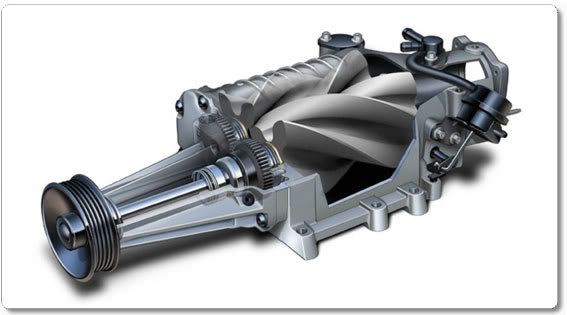
The slack comes from the drive gears. There has to be some there since they need to expand to accomodate for thermal expansion, and it has a tendency to increase as the unit wears in... Those gears synchronize the rotors and keep them turning at the same speed and same relative spot to one another so that the lobes do not make contact.
Here is what they look like. This is on the back of an MP112, but all roots blowers look similar. You can actually see the gap where the teeth mesh, although it is the tooth-to-tooth clearance that you hear rattling:

This is a bit OT. I still do not understand why applying the brakes would have any effect on blower noise when the car is idling. Makes no sense to me.
Last edited by PowerLabs; Dec 11, 2010 at 02:59 PM.
Le Mans Master
Joined: Dec 2005
Posts: 6,999
Likes: 1,685
From: Southeast TX
The pulley is pressed and keyed into the shaft, which is in turn pressed and keyed into the gears. There can't be any slack there since those are parts that do not move relative to one another, ever.
The slack comes from the drive gears. There has to be some there since they need to expand to accomodate for thermal expansion, and it has a tendency to increase as the unit wears in... Those gears synchronize the rotors and keep them turning at the same speed and same relative spot to one another so that the lobes do not make contact.
Here is what they look like. This is on the back of an MP112, but all roots blowers look similar. You can actually see the gap where the teeth mesh, although it is the tooth-to-tooth clearance that you hear rattling:
This is a bit OT. I still do not understand why applying the brakes would have any effect on blower noise when the car is idling. Makes no sense to me.
The slack comes from the drive gears. There has to be some there since they need to expand to accomodate for thermal expansion, and it has a tendency to increase as the unit wears in... Those gears synchronize the rotors and keep them turning at the same speed and same relative spot to one another so that the lobes do not make contact.
Here is what they look like. This is on the back of an MP112, but all roots blowers look similar. You can actually see the gap where the teeth mesh, although it is the tooth-to-tooth clearance that you hear rattling:
This is a bit OT. I still do not understand why applying the brakes would have any effect on blower noise when the car is idling. Makes no sense to me.
Le Mans Master
Joined: Oct 2007
Posts: 6,149
Likes: 11
From: Greater Detroit Metro MI, when I'm not travelling.
Last edited by PowerLabs; Dec 11, 2010 at 05:00 PM.

Melting Slicks

Joined: Apr 2005
Posts: 3,418
Likes: 1
From: Chicagoland Area IL
Not saying that is the case, but have seen cammed cars rattle supercharger gears pretty good.
Just food for thought.

Mike

Melting Slicks
Joined: Mar 2003
Posts: 3,116
Likes: 10
From: Macomb MI

3rd Gear

Joined: Apr 2010
Posts: 3
Likes: 0
From: Indiana
Coolhand,
Place your palm on the center of the unit and press down. Does the noise dissipate? I thought mine was chattering too much so stopped by Lingenfelter and had them give a listen. The folks thought the sound was normal but may be magnified by resonnance from the cover (I put mine on in February so they may have modified since). Lingenfelter had another in the shop and it sounded the same, just less pronounced. My sound may be different than yours though, can't hear it untiil car is warm and has no relation to braking (6 spd). Edelbrock said they considered a center stud. Anxious to see what you find out.
dw
Place your palm on the center of the unit and press down. Does the noise dissipate? I thought mine was chattering too much so stopped by Lingenfelter and had them give a listen. The folks thought the sound was normal but may be magnified by resonnance from the cover (I put mine on in February so they may have modified since). Lingenfelter had another in the shop and it sounded the same, just less pronounced. My sound may be different than yours though, can't hear it untiil car is warm and has no relation to braking (6 spd). Edelbrock said they considered a center stud. Anxious to see what you find out.
dw
Le Mans Master
Joined: Oct 2007
Posts: 6,149
Likes: 11
From: Greater Detroit Metro MI, when I'm not travelling.
A Mechanics' Stethoscope is an inexpensive way of identifying where noises are coming from... Might be worth a try; most auto parts stores carry one:

Fifteen bucks... Touch the probe on various parts of the engine and blower and you may be able to narrow down the general direction the noise is coming from
Fifteen bucks... Touch the probe on various parts of the engine and blower and you may be able to narrow down the general direction the noise is coming from