



Why do Corvettes run so hot?

Safety Car


Joined: Jul 2007
Posts: 4,333
Likes: 6
From: Louisville Kentucky

Okay guys, I've been searching for the answer to my question and when I read the first post of this thread I was lost. You all are so far over my head that I am looking up to this conversation. I can control satellites in space with my computer but I don't know squat about car engines.
What I need to know is, what is the normal engine operating temperature for a 2001 C5 on the freeway, in normal road traffic, and in heavy stop and go during the summer months with high humidity (like in southern Florida)? The car has no mods that I know of. It once overheated due to a bad thermostat, but my mechanic changed it. I don't know what temperature thermostat he used but now my C5 runs at about 200 on the freeway, and anywhere from 210-230 anytime else. When it gets to 230, the fans kick on and it will cool to around 210-220. I don't remember it running this hot before I had the thermostat problem.
I'm thinking I need to put a lower temperature thermostat in the car but I'm not sure if my temps are considered hot. The car doesn't over heat but man, that seems like a pretty high operating temperature.
But hey, like I said before, I don't know crap about car engines. Anyone want free satellite TV?
What I need to know is, what is the normal engine operating temperature for a 2001 C5 on the freeway, in normal road traffic, and in heavy stop and go during the summer months with high humidity (like in southern Florida)? The car has no mods that I know of. It once overheated due to a bad thermostat, but my mechanic changed it. I don't know what temperature thermostat he used but now my C5 runs at about 200 on the freeway, and anywhere from 210-230 anytime else. When it gets to 230, the fans kick on and it will cool to around 210-220. I don't remember it running this hot before I had the thermostat problem.
I'm thinking I need to put a lower temperature thermostat in the car but I'm not sure if my temps are considered hot. The car doesn't over heat but man, that seems like a pretty high operating temperature.
But hey, like I said before, I don't know crap about car engines. Anyone want free satellite TV?

Drifting


Joined: Sep 2004
Posts: 1,912
Likes: 33
From: S.D. CA
Okay guys, I've been searching for the answer to my question and when I read the first post of this thread I was lost. You all are so far over my head that I am looking up to this conversation. I can control satellites in space with my computer but I don't know squat about car engines.
What I need to know is, what is the normal engine operating temperature for a 2001 C5 on the freeway, in normal road traffic, and in heavy stop and go during the summer months with high humidity (like in southern Florida)? The car has no mods that I know of. It once overheated due to a bad thermostat, but my mechanic changed it. I don't know what temperature thermostat he used but now my C5 runs at about 200 on the freeway, and anywhere from 210-230 anytime else. When it gets to 230, the fans kick on and it will cool to around 210-220. I don't remember it running this hot before I had the thermostat problem.
I'm thinking I need to put a lower temperature thermostat in the car but I'm not sure if my temps are considered hot. The car doesn't over heat but man, that seems like a pretty high operating temperature.
But hey, like I said before, I don't know crap about car engines. Anyone want free satellite TV?
What I need to know is, what is the normal engine operating temperature for a 2001 C5 on the freeway, in normal road traffic, and in heavy stop and go during the summer months with high humidity (like in southern Florida)? The car has no mods that I know of. It once overheated due to a bad thermostat, but my mechanic changed it. I don't know what temperature thermostat he used but now my C5 runs at about 200 on the freeway, and anywhere from 210-230 anytime else. When it gets to 230, the fans kick on and it will cool to around 210-220. I don't remember it running this hot before I had the thermostat problem.
I'm thinking I need to put a lower temperature thermostat in the car but I'm not sure if my temps are considered hot. The car doesn't over heat but man, that seems like a pretty high operating temperature.
But hey, like I said before, I don't know crap about car engines. Anyone want free satellite TV?
I don't know anything about the C5 but I do know when my C6 was stock, it didn't run that hot (normal driving). IMHO your car is running hot.

Team Owner

Joined: Jun 2005
Posts: 46,295
Likes: 2,596
From: Northern, VA
St. Jude Donor '15
"In honor of jpee"
Changing to a lower temp stat will not make the engine run cooler. It will only allow the coolant to start flowing through the engine at a cooler temperature. If you are stuck in traffic with no airflow through the radiator, the engine temp will climb regardless of thermostat. The only way to have the engine run cooler without modifying the entire cooling system is to have the fans turn on sooner.
Team Owner
Joined: Jun 2005
Posts: 46,295
Likes: 2,596
From: Northern, VA
St. Jude Donor '15
"In honor of jpee"
Okay guys, I've been searching for the answer to my question and when I read the first post of this thread I was lost. You all are so far over my head that I am looking up to this conversation. I can control satellites in space with my computer but I don't know squat about car engines.
What I need to know is, what is the normal engine operating temperature for a 2001 C5 on the freeway, in normal road traffic, and in heavy stop and go during the summer months with high humidity (like in southern Florida)? The car has no mods that I know of. It once overheated due to a bad thermostat, but my mechanic changed it. I don't know what temperature thermostat he used but now my C5 runs at about 200 on the freeway, and anywhere from 210-230 anytime else. When it gets to 230, the fans kick on and it will cool to around 210-220. I don't remember it running this hot before I had the thermostat problem.
I'm thinking I need to put a lower temperature thermostat in the car but I'm not sure if my temps are considered hot. The car doesn't over heat but man, that seems like a pretty high operating temperature.
But hey, like I said before, I don't know crap about car engines. Anyone want free satellite TV?
What I need to know is, what is the normal engine operating temperature for a 2001 C5 on the freeway, in normal road traffic, and in heavy stop and go during the summer months with high humidity (like in southern Florida)? The car has no mods that I know of. It once overheated due to a bad thermostat, but my mechanic changed it. I don't know what temperature thermostat he used but now my C5 runs at about 200 on the freeway, and anywhere from 210-230 anytime else. When it gets to 230, the fans kick on and it will cool to around 210-220. I don't remember it running this hot before I had the thermostat problem.
I'm thinking I need to put a lower temperature thermostat in the car but I'm not sure if my temps are considered hot. The car doesn't over heat but man, that seems like a pretty high operating temperature.
But hey, like I said before, I don't know crap about car engines. Anyone want free satellite TV?
It is possible that your car overheated for more than one reason. It is possible that it still has issues, such as the fact that the fans are not coming on at the right temp or running long enough.
When was the last time the coolant was completely changed? And the system cleaned out? Was it simultaneous with the thermo replace? What's the condition of the radiator?
There is a step by step process to be followed and your mechanic will know about it. Or not. Ask him.

Burning Brakes


Joined: Jun 2007
Posts: 877
Likes: 142
From: Little Egypt, USA
The # stamped on the t stat indicates the temp at which it starts to open.
They generally are fully open 15 to 20 deg later.
160 + 15 = 170
180 + 15 = 195
195 + 15 = 210
The # on the stat only indicates the min temp the engine will operate at when fully warmed up.
It does not control the temp the engine operates at once it is all the way open. That is determined by rad size, cooling sys capacity, fan capability, vehicle air flow, engine heat output, etc. All stats flow the same volume when wide open.
When a vette is bumper to bumper in traffic, AC on, high summer temps etc all three examples above will be running the same temp say 210 deg plus. When the vette is cruising down the highway at 70 mph with good air flow through the rad and low engine heat out put it will probably operate some where in that 15 deg range depending on the stat installed.
In the bumper to bumper example the 160 stat will not run cooler than a 195. At most other lower heat load demands it will run cooler. The ? is how much cooler do you want it to run.
In the 1960's engineers determined that a 180 stat gave the best engine wear and power compromise for US V8's. In the 70's the emission requirements required higher combustion temps to help reduce pollutants so 195 stats became standard.
Engineers determined that temps below 180 increase engine wear. I would not run my engine at less than that after it was fully warmed up, not even if it meant a little extra power. In my case power is not the only factor I consider when deciding how to care for my vette.
I would try to find other ways of reducing IAT's than running ECT's less than 180.
Min engine coolant temps affect other things besides power such as heating system performance. I don't see how any one would want to run a 160 in the northern states in the winter. IMHO of course.
They generally are fully open 15 to 20 deg later.
160 + 15 = 170
180 + 15 = 195
195 + 15 = 210
The # on the stat only indicates the min temp the engine will operate at when fully warmed up.
It does not control the temp the engine operates at once it is all the way open. That is determined by rad size, cooling sys capacity, fan capability, vehicle air flow, engine heat output, etc. All stats flow the same volume when wide open.
When a vette is bumper to bumper in traffic, AC on, high summer temps etc all three examples above will be running the same temp say 210 deg plus. When the vette is cruising down the highway at 70 mph with good air flow through the rad and low engine heat out put it will probably operate some where in that 15 deg range depending on the stat installed.
In the bumper to bumper example the 160 stat will not run cooler than a 195. At most other lower heat load demands it will run cooler. The ? is how much cooler do you want it to run.
In the 1960's engineers determined that a 180 stat gave the best engine wear and power compromise for US V8's. In the 70's the emission requirements required higher combustion temps to help reduce pollutants so 195 stats became standard.
Engineers determined that temps below 180 increase engine wear. I would not run my engine at less than that after it was fully warmed up, not even if it meant a little extra power. In my case power is not the only factor I consider when deciding how to care for my vette.
I would try to find other ways of reducing IAT's than running ECT's less than 180.
Min engine coolant temps affect other things besides power such as heating system performance. I don't see how any one would want to run a 160 in the northern states in the winter. IMHO of course.

Drifting
Joined: Jul 2005
Posts: 1,533
Likes: 0
From: az
The # stamped on the t stat indicates the temp at which it starts to open.
They generally are fully open 15 to 20 deg later.
160 + 15 = 170
180 + 15 = 195
195 + 15 = 210
The # on the stat only indicates the min temp the engine will operate at when fully warmed up.
It does not control the temp the engine operates at once it is all the way open. That is determined by rad size, cooling sys capacity, fan capability, vehicle air flow, engine heat output, etc. All stats flow the same volume when wide open.
When a vette is bumper to bumper in traffic, AC on, high summer temps etc all three examples above will be running the same temp say 210 deg plus. When the vette is cruising down the highway at 70 mph with good air flow through the rad and low engine heat out put it will probably operate some where in that 15 deg range depending on the stat installed.
In the bumper to bumper example the 160 stat will not run cooler than a 195. At most other lower heat load demands it will run cooler. The ? is how much cooler do you want it to run.
In the 1960's engineers determined that a 180 stat gave the best engine wear and power compromise for US V8's. In the 70's the emission requirements required higher combustion temps to help reduce pollutants so 195 stats became standard.
Engineers determined that temps below 180 increase engine wear. I would not run my engine at less than that after it was fully warmed up, not even if it meant a little extra power. In my case power is not the only factor I consider when deciding how to care for my vette.
I would try to find other ways of reducing IAT's than running ECT's less than 180.
Min engine coolant temps affect other things besides power such as heating system performance. I don't see how any one would want to run a 160 in the northern states in the winter. IMHO of course.
They generally are fully open 15 to 20 deg later.
160 + 15 = 170
180 + 15 = 195
195 + 15 = 210
The # on the stat only indicates the min temp the engine will operate at when fully warmed up.
It does not control the temp the engine operates at once it is all the way open. That is determined by rad size, cooling sys capacity, fan capability, vehicle air flow, engine heat output, etc. All stats flow the same volume when wide open.
When a vette is bumper to bumper in traffic, AC on, high summer temps etc all three examples above will be running the same temp say 210 deg plus. When the vette is cruising down the highway at 70 mph with good air flow through the rad and low engine heat out put it will probably operate some where in that 15 deg range depending on the stat installed.
In the bumper to bumper example the 160 stat will not run cooler than a 195. At most other lower heat load demands it will run cooler. The ? is how much cooler do you want it to run.
In the 1960's engineers determined that a 180 stat gave the best engine wear and power compromise for US V8's. In the 70's the emission requirements required higher combustion temps to help reduce pollutants so 195 stats became standard.
Engineers determined that temps below 180 increase engine wear. I would not run my engine at less than that after it was fully warmed up, not even if it meant a little extra power. In my case power is not the only factor I consider when deciding how to care for my vette.
I would try to find other ways of reducing IAT's than running ECT's less than 180.
Min engine coolant temps affect other things besides power such as heating system performance. I don't see how any one would want to run a 160 in the northern states in the winter. IMHO of course.

Burning Brakes
Joined: Jun 2007
Posts: 877
Likes: 142
From: Little Egypt, USA
160 stat never runs at 160 ect (unless you have a catek one which i believe opens more like 150) it actually runs at 178-180* due to the stat location is at the inlet for cool coolant entering the engine. our ect sensor is locate at driver side head much closer where the hot coolant exist the engine block. you can think of it this way, under the old engine set up where the stat is the exist point for hot engine coolant back to radiator this would be equal to 180* stat. another way to put it, if you were to remove the stat house to the outlet point you would use 180* and you will see the exact coolant temp as the 160 stat in stock location. this is why everyone with the 160 (unless you have a cartek one) all report their high air flow / cool weather cruising temp is around 180*
As long as the ECT's don't go below 180 in a fully warmed up engine in winter I wouldn't have a problem running a 160 stat. Except I would still like a ECT of about 200 in the winter for good defrost and heater performance since I am in a temperate area. Too bad they don't have a computer controlled varible stat in the LS2.
Drifting
Joined: Jul 2005
Posts: 1,533
Likes: 0
From: az
The pos of the stat would make a diff in the ECT temps it delivers. I didn't realize the stat was not at the engine water outlet. That must mean that our stock stat is a 180 and not a 195 since the stock cruise temp is around 198. If it was a 195 then the cruise temp would be about 215 .
As long as the ECT's don't go below 180 in a fully warmed up engine in winter I wouldn't have a problem running a 160 stat. Except I would still like a ECT of about 200 in the winter for good defrost and heater performance since I am in a temperate area. Too bad they don't have a computer controlled varible stat in the LS2.
As long as the ECT's don't go below 180 in a fully warmed up engine in winter I wouldn't have a problem running a 160 stat. Except I would still like a ECT of about 200 in the winter for good defrost and heater performance since I am in a temperate area. Too bad they don't have a computer controlled varible stat in the LS2.
like i stated everyone on here with the 160 stat all report cruising temp 178*-180* (except perhaps if you are using cartek 160 stat). your defrost and heat will be fine, i have to turn the heater down before i start to sweat with outside temp in 30's.
Last edited by cbrf4i1; Jul 31, 2007 at 12:54 AM.
Corvette Stories
The Best of Corvette for Corvette Enthusiasts

How Much Horsepower Every Corvette Engine "LOST" in 1972
Joe Kucinski
Top 10 DOs and DON'Ts for Protecting Your Convertible Top!
Michael S. Palmer
Top 10 Most Explosive Corvettes Ever Made: Power-to-Weight Ratio Ranked!
Joe Kucinski
150 hp to 1,250 hp: Every Corvette Generation Compared by the Specs That Matter
Joe Kucinski
8 Coolest Corvette Pace Cars (and Replicas) of All Time
Verdad Gallardo
Top 10 Corvette Engines RANKED by Peak Torque (70+ Years of Muscle!)
Joe Kucinski
Corvette ZR1X Will Be Pacing the Indy 500, And Could Probably Race, Too!
Verdad Gallardo
Top 10 Corvettes Coming to Mecum Indy 2026!
Brett Foote
Top 10 C9 Corvette MUST-HAVES to Fix These C8 Generation Flaws!
Michael S. Palmer
Le Mans Master


Joined: Jul 2005
Posts: 5,328
Likes: 405
Okay guys, I've been searching for the answer to my question and when I read the first post of this thread I was lost. You all are so far over my head that I am looking up to this conversation. I can control satellites in space with my computer but I don't know squat about car engines.
What I need to know is, what is the normal engine operating temperature for a 2001 C5 on the freeway, in normal road traffic, and in heavy stop and go during the summer months with high humidity (like in southern Florida)? The car has no mods that I know of. It once overheated due to a bad thermostat, but my mechanic changed it. I don't know what temperature thermostat he used but now my C5 runs at about 200 on the freeway, and anywhere from 210-230 anytime else. When it gets to 230, the fans kick on and it will cool to around 210-220. I don't remember it running this hot before I had the thermostat problem.
I'm thinking I need to put a lower temperature thermostat in the car but I'm not sure if my temps are considered hot. The car doesn't over heat but man, that seems like a pretty high operating temperature.
But hey, like I said before, I don't know crap about car engines. Anyone want free satellite TV?
What I need to know is, what is the normal engine operating temperature for a 2001 C5 on the freeway, in normal road traffic, and in heavy stop and go during the summer months with high humidity (like in southern Florida)? The car has no mods that I know of. It once overheated due to a bad thermostat, but my mechanic changed it. I don't know what temperature thermostat he used but now my C5 runs at about 200 on the freeway, and anywhere from 210-230 anytime else. When it gets to 230, the fans kick on and it will cool to around 210-220. I don't remember it running this hot before I had the thermostat problem.
I'm thinking I need to put a lower temperature thermostat in the car but I'm not sure if my temps are considered hot. The car doesn't over heat but man, that seems like a pretty high operating temperature.
But hey, like I said before, I don't know crap about car engines. Anyone want free satellite TV?
Burning Brakes
Joined: Jun 2007
Posts: 877
Likes: 142
From: Little Egypt, USA
most people think the stat is the outlet that is why they continue to debate the issue, when there isn't one. if you factor in the timing pull from ect & iat, then you will see 160 is the only way to go. why do you think all the guys/ gals that mod these cars run 160 stat and the one that doesn't mod (or mostly stock) likes to talk up the stock stat? their whole arguement is based on some generalization of some engineering classes when they don't even which way the coolant flows in relation to the stat location and has never data log their car to see the timing pulls from high iat & ect for themself. any ways, the stock stat is rated at 186*, so if you want to use the same old school engine design and have the stat at the coolant engine outlet location instead, you would need to put in a 198* ish stat to keep roughly the same ect as the stock stat at stock location (inlet).
I am going to do tune in a few days with no other mods at first. Correct me if I'm wrong. If I go to a 160 I will be able to decrease a certain ammount of timing the ECM pulls due to high IAT's?
If I stay with the stock stat will I be able to decrease any ammount of timing pulled or would a tune be a waste of time with a 186?
Safety Car
Joined: Jul 2007
Posts: 4,333
Likes: 6
From: Louisville Kentucky
Thanks for your brain cells guys, I really appreciate the feedback.
Drifting
Joined: Jul 2005
Posts: 1,533
Likes: 0
From: az
What negatives besides a lower heater temp would there be with a 160 stat install on a bone stock LS2 and why do you think the factory used a 186?
I am going to do tune in a few days with no other mods at first. Correct me if I'm wrong. If I go to a 160 I will be able to decrease a certain ammount of timing the ECM pulls due to high IAT's?
If I stay with the stock stat will I be able to decrease any ammount of timing pulled or would a tune be a waste of time with a 186?
I am going to do tune in a few days with no other mods at first. Correct me if I'm wrong. If I go to a 160 I will be able to decrease a certain ammount of timing the ECM pulls due to high IAT's?
If I stay with the stock stat will I be able to decrease any ammount of timing pulled or would a tune be a waste of time with a 186?
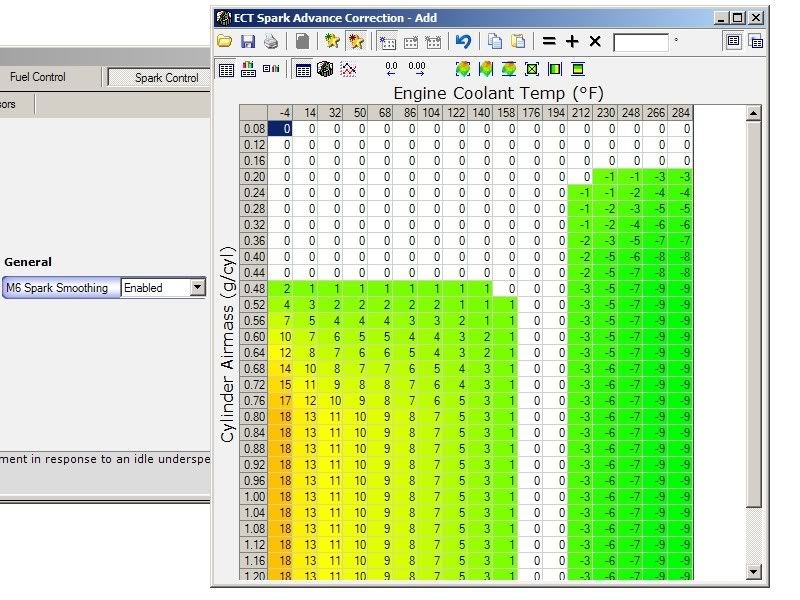
tune will allow you to reduce the amount of timing pull due to iat & ect, but if you insist on using the stock stat i wouldn't be messing with the timing pull, gm did that to keep engine knock away. you would be just asking for trouble. i am sure gm isn't going to warranty when something blows. so stock stat = don't mess with timing pulls. i have posted the charts below before, just incase you had never seen it. take a look at your 230* temp, ecm is pulling 6* of timing, at this ect i am sure your iat is easily over 100*, even at 100* iat that is still a couple more degrees of timing pull on top of the 6* been up from the ect.

Le Mans Master
Joined: Jul 2005
Posts: 5,328
Likes: 405
160 stat never runs at 160 ect (unless you have a catek one which i believe opens more like 150) it actually runs at 178-180* due to the stat location is at the inlet for cool coolant entering the engine. our ect sensor is locate at driver side head much closer where the hot coolant exist the engine block. you can think of it this way, under the old engine set up where the stat is the exist point for hot engine coolant back to radiator this would be equal to 180* stat. another way to put it, if you were to remove the stat house to the outlet point you would use 180* and you will see the exact coolant temp as the 160 stat in stock location. this is why everyone with the 160 (unless you have a cartek one) all report their high air flow / cool weather cruising temp is around 180*
The stat isn't "in" the inlet entering the water pump from a temperature sensing standpoint. If it were, the stat would never open since the inlet temp would remain at ambient with no water flow through the radiator. Technically, the stat is in the water pump since the temperature sensing element is in the water pump. When the stat is closed, coolant is circulated in the engine by the water pump and also through the heater core. So as the engine warms up, the stat "sees" the same temp as the ECT sensor. Since the stat is in the water pump it sees all the water flowing through the engine during warm up and gives a more accurate opening in relation to true engine temp than the "old style" that was literally at the outlet. The "old stlye had a "bleed hole" so some coolant could circulate past it to get a "sampling" of the engine temp. But since the flow was so small, the opening point of the stat caused the engine temp to "overshoot" the desired temp. Also, remember the "old style" had the inlet at the water pump and the outlet was at the top of the intake manifold. The LSx engines have the inlet and outlet at the water pump. This means as the engine warms up, the temp at the stat is exactly what the ECT sensor sees. As the stat begins to open, most of the coolant is still "recirculated" by the pump maintaining the flow across the stat and its' accuracy. This accuracy is maintained through the full range of the stat. Maybe you need to review that engineering class on coolant flow.

People don't continue to debate this thermostat temp issue because of the location of the stat, they debate it because there is good data/theory supporting both sides. Smokey Yunick built a 78 cubic inch two cylinder that put out 150 HP and got 60 MPG in the '70s in the days of carburators...it was called the Hot Vapor Cycle Engine (sometimes called the Adiabatic Engine) and had intake temps of ~440*F.

http://schou.dk/hvce/
http://www.smokeyyunick.com/PressRel...mithsonian.pdf
http://www.eng-tips.com/viewthread.cfm?qid=78116&page=1
http://www.eng-tips.com/viewthread.c...=176663&page=1
From a thermodynamic standpoint, higher operating temps translates to more HP and better efficiencies/MPG. From an operational standpoint, lower than stock operating temps translates to more HP and the jury is still out on MPG.
Le Mans Master
Joined: Jul 2005
Posts: 5,328
Likes: 405
Okay, it seems like we have two different opinions here. Some say it's high but Glass Slipper says it's good. Like I said before, I have done no mods and I want the car to run at whatever it was originally designed to run at. I could care less about more horsepower. The darn thing is more than quick enough for me. I just want to make sure I'm not tearing it up. I guess I'll do the flush and just to be on the safe side, change the thermostat one more time. That's a whole lot cheaper than a new engine!
Thanks for your brain cells guys, I really appreciate the feedback.
Thanks for your brain cells guys, I really appreciate the feedback.
Be careful who you listen to on the internet...you never know who's stating opinion and who's stating fact. Oh yeah, I wouldn't bother with the extra flush and thermostat replacement, it'll just be a waste of time/money. Stop worrying and just go enjoy driving the car, it's running perfectly.

Drifting
Joined: Jul 2005
Posts: 1,533
Likes: 0
From: az
The 160*F stat never runs at 160 because that is the temp it begins to open at as wbear said. It is fully open at ~178*F. The factory stat begins to open at 188*F and is fully open at ~206*F. Thermostats aren't like on-off switches. There is a wax pellet element that expands when heated and actuates a piston to move the stat valve to the open position. For the wax to expand enough to move the piston/thermostat valve from fully closed to fully open requires ~18*F difference.
The stat isn't "in" the inlet entering the water pump from a temperature sensing standpoint. If it were, the stat would never open since the inlet temp would remain at ambient with no water flow through the radiator. Technically, the stat is in the water pump since the temperature sensing element is in the water pump. When the stat is closed, coolant is circulated in the engine by the water pump and also through the heater core. So as the engine warms up, the stat "sees" the same temp as the ECT sensor. Since the stat is in the water pump it sees all the water flowing through the engine during warm up and gives a more accurate opening in relation to true engine temp than the "old style" that was literally at the outlet. The "old stlye had a "bleed hole" so some coolant could circulate past it to get a "sampling" of the engine temp. But since the flow was so small, the opening point of the stat caused the engine temp to "overshoot" the desired temp. Also, remember the "old style" had the inlet at the water pump and the outlet was at the top of the intake manifold. The LSx engines have the inlet and outlet at the water pump. This means as the engine warms up, the temp at the stat is exactly what the ECT sensor sees. As the stat begins to open, most of the coolant is still "recirculated" by the pump maintaining the flow across the stat and its' accuracy. This accuracy is maintained through the full range of the stat. Maybe you need to review that engineering class on coolant flow.
People don't continue to debate this thermostat temp issue because of the location of the stat, they debate it because there is good data/theory supporting both sides. Smokey Yunick built a 78 cubic inch two cylinder that put out 150 HP and got 60 MPG in the '70s in the days of carburators...it was called the Hot Vapor Cycle Engine (sometimes called the Adiabatic Engine) and had intake temps of ~440*F.
http://schou.dk/hvce/
http://www.smokeyyunick.com/PressRel...mithsonian.pdf
http://www.eng-tips.com/viewthread.cfm?qid=78116&page=1
http://www.eng-tips.com/viewthread.c...=176663&page=1
From a thermodynamic standpoint, higher operating temps translates to more HP and better efficiencies/MPG. From an operational standpoint, lower than stock operating temps translates to more HP and the jury is still out on MPG.
The stat isn't "in" the inlet entering the water pump from a temperature sensing standpoint. If it were, the stat would never open since the inlet temp would remain at ambient with no water flow through the radiator. Technically, the stat is in the water pump since the temperature sensing element is in the water pump. When the stat is closed, coolant is circulated in the engine by the water pump and also through the heater core. So as the engine warms up, the stat "sees" the same temp as the ECT sensor. Since the stat is in the water pump it sees all the water flowing through the engine during warm up and gives a more accurate opening in relation to true engine temp than the "old style" that was literally at the outlet. The "old stlye had a "bleed hole" so some coolant could circulate past it to get a "sampling" of the engine temp. But since the flow was so small, the opening point of the stat caused the engine temp to "overshoot" the desired temp. Also, remember the "old style" had the inlet at the water pump and the outlet was at the top of the intake manifold. The LSx engines have the inlet and outlet at the water pump. This means as the engine warms up, the temp at the stat is exactly what the ECT sensor sees. As the stat begins to open, most of the coolant is still "recirculated" by the pump maintaining the flow across the stat and its' accuracy. This accuracy is maintained through the full range of the stat. Maybe you need to review that engineering class on coolant flow.
People don't continue to debate this thermostat temp issue because of the location of the stat, they debate it because there is good data/theory supporting both sides. Smokey Yunick built a 78 cubic inch two cylinder that put out 150 HP and got 60 MPG in the '70s in the days of carburators...it was called the Hot Vapor Cycle Engine (sometimes called the Adiabatic Engine) and had intake temps of ~440*F.
http://schou.dk/hvce/
http://www.smokeyyunick.com/PressRel...mithsonian.pdf
http://www.eng-tips.com/viewthread.cfm?qid=78116&page=1
http://www.eng-tips.com/viewthread.c...=176663&page=1
From a thermodynamic standpoint, higher operating temps translates to more HP and better efficiencies/MPG. From an operational standpoint, lower than stock operating temps translates to more HP and the jury is still out on MPG.
http://forums.corvetteforum.com/show...1743335&page=3
review? funny on page 6-623 under radiator hose replacement - outlet picture shows the hose is attach to radiator outlet and the stat housing, so wouldn't this make the stat the engine coolant inlet?
page 6-622 under radiator hose replacement - inlet, it shows one end of the hose attach to the radiator and the other end of the hose attach to the water pump. hmmm, wouldn't this make the water pump the outlet for engine coolant?
it is you that need a reread and relearn. i highly doubt it.who in the hell is asking about MPG? frankly anyone cares that much about perhap .5mph lost is driving the wrong car.
Last edited by cbrf4i1; Jul 31, 2007 at 04:55 AM.
Drifting
Joined: Jul 2005
Posts: 1,533
Likes: 0
From: az
please tell us were you stating the facts then? or wishful thinking?
Safety Car
Joined: Jul 2007
Posts: 4,333
Likes: 6
From: Louisville Kentucky
When I was growing up, I could only afford big, old gas guzzlers that broke down every so often. It got to the point where I could walk up to a car and tell you where the leaks were and what was leaking just by the smell alone. I've got a nose like a bloodhound so I knew something was fishy when I got a slight whiff of antifreeze. Sure enough, there was a tiny leak coming from the hose where it attaches to the fill tank. I took it off and it wasn't brittle or cracked so I put it back on and it hasn't leaked since.
I'm just wanting to be safe. I saw a Vette engine blow up one time. Good Lord, it wasn't pretty!
Le Mans Master
Joined: Jul 2005
Posts: 5,328
Likes: 405
Okay! If that's what the manual says, then that's good enough for me. However, my antifreeze stinks to high hell. You sure it doesn't need a flush?
When I was growing up, I could only afford big, old gas guzzlers that broke down every so often. It got to the point where I could walk up to a car and tell you where the leaks were and what was leaking just by the smell alone. I've got a nose like a bloodhound so I knew something was fishy when I got a slight whiff of antifreeze. Sure enough, there was a tiny leak coming from the hose where it attaches to the fill tank. I took it off and it wasn't brittle or cracked so I put it back on and it hasn't leaked since.
I'm just wanting to be safe. I saw a Vette engine blow up one time. Good Lord, it wasn't pretty!
When I was growing up, I could only afford big, old gas guzzlers that broke down every so often. It got to the point where I could walk up to a car and tell you where the leaks were and what was leaking just by the smell alone. I've got a nose like a bloodhound so I knew something was fishy when I got a slight whiff of antifreeze. Sure enough, there was a tiny leak coming from the hose where it attaches to the fill tank. I took it off and it wasn't brittle or cracked so I put it back on and it hasn't leaked since.
I'm just wanting to be safe. I saw a Vette engine blow up one time. Good Lord, it wasn't pretty!
Safety Car
Joined: Jul 2007
Posts: 4,333
Likes: 6
From: Louisville Kentucky
Thanks for the info! With as many engines that I have blown up, you'd think I'd learn something about them other than how to blow them up.
By the way, I just realized that I'm in the wrong forum for these questions. May the admin's forgive me! My bad.
By the way, I just realized that I'm in the wrong forum for these questions. May the admin's forgive me! My bad.
Last edited by Junkman2008; Jul 31, 2007 at 08:00 AM.

Safety Car
Joined: Dec 2004
Posts: 3,565
Likes: 5
From: stafford country, va. Avatar: Me on turn 3 @ Bristol (The World's Fastest Half-Mile)
... Smokey Yunick built a 78 cubic inch two cylinder that put out 150 HP and got 60 MPG in the '70s in the days of carburators...it was called the Hot Vapor Cycle Engine (sometimes called the Adiabatic Engine) and had intake temps of ~440*F.
http://schou.dk/hvce/
http://www.smokeyyunick.com/PressRel...mithsonian.pdf
http://www.eng-tips.com/viewthread.cfm?qid=78116&page=1
http://www.eng-tips.com/viewthread.c...=176663&page=1
From a thermodynamic standpoint, higher operating temps translates to more HP and better efficiencies/MPG. From an operational standpoint, lower than stock operating temps translates to more HP and the jury is still out on MPG.
http://schou.dk/hvce/
http://www.smokeyyunick.com/PressRel...mithsonian.pdf
http://www.eng-tips.com/viewthread.cfm?qid=78116&page=1
http://www.eng-tips.com/viewthread.c...=176663&page=1
From a thermodynamic standpoint, higher operating temps translates to more HP and better efficiencies/MPG. From an operational standpoint, lower than stock operating temps translates to more HP and the jury is still out on MPG.