



Rotating mass

Thread Starter
Race Director


Joined: Mar 2005
Posts: 11,549
Likes: 27
From: Southampton NJ
 Rotating mass
here's the question guys whats the rule of thumb for rotating weight at the wheels via from rotors or wheels . 100 lbs of weight reduces et 1/10 in the 1/4 what would 100 lbs rotating reduce et in the 1/4. also what would account for more reduced weight on the back drive wheels or the front or would it be the same
Thread Starter
Race Director
Joined: Mar 2005
Posts: 11,549
Likes: 27
From: Southampton NJ

Team Owner

Joined: Sep 2003
Posts: 43,084
Likes: 33
From: Raleigh / Rolesville NC
1 lb of rotating is ~ 6.5 lbs of non rototaing or unsporting wt.
Do a search. We did a long thread about this over a year ago,
all the mathematics are listed.
also over on LS1 tech, we looked wt wheel wts, rim diameters to acceleration and braking.
in short, the lighter the wheels, the better, 18"s wheels were much better then 19" wheels do to the wt was closer to the center of rotation
and 15 or 16" drag rims with much taller tires was far better for acceleration.
Wt is not only in the wheels, but the car and the driver.
Best way to reduce wt is to cut out the Micky D's or Krispy Kreams
Do a search. We did a long thread about this over a year ago,
all the mathematics are listed.
also over on LS1 tech, we looked wt wheel wts, rim diameters to acceleration and braking.
in short, the lighter the wheels, the better, 18"s wheels were much better then 19" wheels do to the wt was closer to the center of rotation
and 15 or 16" drag rims with much taller tires was far better for acceleration.
Wt is not only in the wheels, but the car and the driver.
Best way to reduce wt is to cut out the Micky D's or Krispy Kreams
Last edited by AU N EGL; Aug 28, 2008 at 07:43 AM.

Race Director
Joined: Mar 2007
Posts: 11,331
Likes: 18
From: Missouri City Texas
...The best way to reduce weight is with weight reduction 
You aren't giong to drop hundreds of pounds by going on a diet.
For a daily driven car I would start with skinnies up front, odyssey battery, and no front swaybar when you go to the track.
You aren't giong to drop hundreds of pounds by going on a diet.
For a daily driven car I would start with skinnies up front, odyssey battery, and no front swaybar when you go to the track.
Thread Starter
Race Director
Joined: Mar 2005
Posts: 11,549
Likes: 27
From: Southampton NJ
1 lb of rotating is ~ 6.5 lbs of non rototaing or unsporting wt.
Do a search. We did a long thread about this over a year ago,
all the mathematics are listed.
also over on LS1 tech, we looked wt wheel wts, rim diameters to acceleration and braking.
in short, the lighter the wheels, the better, 18"s wheels were much better then 19" wheels do to the wt was closer to the center of rotation
and 15 or 16" drag rims with much taller tires was far better for acceleration.
Wt is not only in the wheels, but the car and the driver.
Best way to reduce wt is to cut out the Micky D's or Krispy Kreams
Do a search. We did a long thread about this over a year ago,
all the mathematics are listed.
also over on LS1 tech, we looked wt wheel wts, rim diameters to acceleration and braking.
in short, the lighter the wheels, the better, 18"s wheels were much better then 19" wheels do to the wt was closer to the center of rotation
and 15 or 16" drag rims with much taller tires was far better for acceleration.
Wt is not only in the wheels, but the car and the driver.
Best way to reduce wt is to cut out the Micky D's or Krispy Kreams
Corvette Stories
The Best of Corvette for Corvette Enthusiasts

5 Best & 5 Worst Corvette Daily Drivers
Joe Kucinski
The Headlights of Every Corvette Generation Explained
Joe Kucinski
5 Best & 5 Most Overrated Corvette Track Packages of All Time!
Joe Kucinski
Every 2027 Corvette Engine Explained
Joe Kucinski
Designer Imagines A Corvette That Looks More Like a Corvette Than the Corvette
Verdad Gallardo
10 Ugly Corvettes That We Still Kinda Love
Joe Kucinski
Top 10 Most Expensive Corvettes Ever Sold on Bring A Trailer
Brett Foote
10 Things Every Corvette Owner Needs (2026 Edition)
Michael S. Palmer
8 Most "Only Corvette Owners Understand" Quirks and Problems
Pouria Savadkouei
Team Owner
Joined: Sep 2003
Posts: 43,084
Likes: 33
From: Raleigh / Rolesville NC
Lowering ETs has more to do with driving skill, then loosing wt.
However, the more wt you take out of your car, Speakers, stereo, carpet passenger seat, and bling bling shinny chrome crap, and YES reducing wheel and tire wt will help.
a drag set up with Skinnies up front and DRs in back would have a very big advantage

Instructor

Joined: Dec 2007
Posts: 195
Likes: 0
From: Cranston RI
I am no expert on this but there is a difference between unsprung and rotational weight. There seems to be no definitive consensus over the effects of reducing weight but IIRC unsprung weight is about 1:4 and rotational is about 1:8.
I understood it was better to remove rotational weight than unsprung weight because the rotational weight removed is also usually unsprung weight (wheels, tires) and has to overcome the dual inertia's of moving forward in a straight line (standard unsprung weight) as well as the accelerating from a stop in a circle (rotational weight).
Obviously, with rotational weight you have to keep in mind that there is a difference in the effect of weight removal depending upon how far the weight was from the axis of rotation.
Dennis: keep in mind that just switching to smaller wheels, etc. does not automatically give you a rotational benefit. A lot of the wheels weight is towards the center on lightweight wheels, so switching from one lightweight wheel to a slightly more lightweight wheel does not automatically guarantee a rotational loss (does guarantee an unsprung weight loss though).
Maybe someone with more knowledge can clarify or chime in.
I understood it was better to remove rotational weight than unsprung weight because the rotational weight removed is also usually unsprung weight (wheels, tires) and has to overcome the dual inertia's of moving forward in a straight line (standard unsprung weight) as well as the accelerating from a stop in a circle (rotational weight).
Obviously, with rotational weight you have to keep in mind that there is a difference in the effect of weight removal depending upon how far the weight was from the axis of rotation.
Dennis: keep in mind that just switching to smaller wheels, etc. does not automatically give you a rotational benefit. A lot of the wheels weight is towards the center on lightweight wheels, so switching from one lightweight wheel to a slightly more lightweight wheel does not automatically guarantee a rotational loss (does guarantee an unsprung weight loss though).
Maybe someone with more knowledge can clarify or chime in.
Last edited by beanfree; Aug 28, 2008 at 12:22 PM.

Melting Slicks

Joined: Oct 2006
Posts: 2,905
Likes: 1
From what I've read, if you remove 1 lb of rotational weight it's like removing 7 lbs of unsprung weight from the car, and most drag racers agree that 100lbs weight reduction equal .1 reduction in ET, all other things equal (track prep, launch, traction, weather...etc...) FWIW, there's carbon fiber and magnesum wheels out there that will fit the vette, costly, I've looked into them, but at only 11-14lbs each compared to stock wheel weight, you could see a massive reduction in ETs if the formulas are true.


Team Owner
Joined: Sep 2003
Posts: 43,084
Likes: 33
From: Raleigh / Rolesville NC
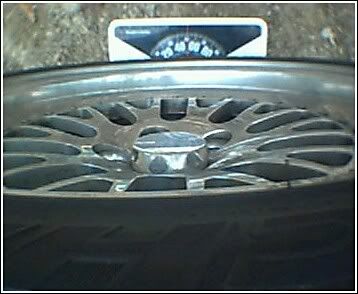
Here are two photographs
My rear street wheel 18x12 with 18x335/30 at 51 lbs
and my rear road race wheel 18x13 with 18x25.5x11.5 at 39 lbs
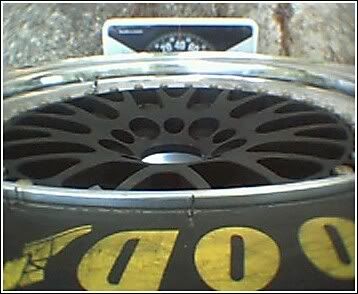
12 lbs difference per rear wheel
fronts are 10 lbs differnce
total 44 lbs diffence
44 x 6.5 ~ 280 lbs rotating mass diffence
or there about
My rear street wheel 18x12 with 18x335/30 at 51 lbs
and my rear road race wheel 18x13 with 18x25.5x11.5 at 39 lbs
12 lbs difference per rear wheel
fronts are 10 lbs differnce
total 44 lbs diffence
44 x 6.5 ~ 280 lbs rotating mass diffence
or there about

Team Owner


Joined: Aug 2004
Posts: 21,543
Likes: 3,216
From: Park City Utah
None of the posts so far have been accurate. You can't "define" a ratio of rotating mass vs. mass w/out knowing a few things; first, the distance from the center line that the rotating inertia is, and second, the delta in speed of the part in question.
Lightening a drive shaft for example is wasted money b/c the thing is such a small diameter, it doesn't take much energy to accerate it (radially) no matter how much it weighs! A flywheel, by comparison, is a much, MUCH more effective place to cut weight.
Also, let's look at the DELTA in RPM for the two components, in say the 1/4 mile. From zero to ~110 mph, w/a 3.42 gear, your drive shaft will accelerate from zero to about 5000 RPM (Rought trap rpm in 4th gear at 110). So you have ~12 second to accelerate a 2" diameter tube from 0-5000 RPM. How much energy does that consume? Not 6.5 TIMES it's weight, that's for sure!
Now look that the flywheel. It goes from roughly 2500 RPM, to 6500 RPM, then from 4500 to 6500, then from 4500 to 6500, then from 4500 to about 5000 for a total DELTA of 8500 RPM in teh same 12 seconds! Not to mention the diameter is much larger, and so the (rotating) mass has a much larger "lever arm" working against the torque the engine is producing.
Making blanket statements about xx# of rotating = xx#'s of mass....that doesn't work. Money well spent on reducing rotating inertia is in parts w/large diameters, and large RPM ranges.
Lightening a drive shaft for example is wasted money b/c the thing is such a small diameter, it doesn't take much energy to accerate it (radially) no matter how much it weighs! A flywheel, by comparison, is a much, MUCH more effective place to cut weight.
Also, let's look at the DELTA in RPM for the two components, in say the 1/4 mile. From zero to ~110 mph, w/a 3.42 gear, your drive shaft will accelerate from zero to about 5000 RPM (Rought trap rpm in 4th gear at 110). So you have ~12 second to accelerate a 2" diameter tube from 0-5000 RPM. How much energy does that consume? Not 6.5 TIMES it's weight, that's for sure!
Now look that the flywheel. It goes from roughly 2500 RPM, to 6500 RPM, then from 4500 to 6500, then from 4500 to 6500, then from 4500 to about 5000 for a total DELTA of 8500 RPM in teh same 12 seconds! Not to mention the diameter is much larger, and so the (rotating) mass has a much larger "lever arm" working against the torque the engine is producing.
Making blanket statements about xx# of rotating = xx#'s of mass....that doesn't work. Money well spent on reducing rotating inertia is in parts w/large diameters, and large RPM ranges.
Last edited by Tom400CFI; Aug 28, 2008 at 02:48 PM.
Team Owner
Joined: Sep 2003
Posts: 43,084
Likes: 33
From: Raleigh / Rolesville NC
Correct and why we said APPROXIMATELY, and that there is no exact relationship to times.
-------------
Wheel differences:
First you need to know the weight and dimensions of the rim. Next, weight the rim with the tire on it and however much air you usually keep in the tire.
Now for the equations:
I = 1/2 MR^2 (the "^2" denotes "to the second power" aka "squared")
This is the equation for a solid sphere which you would use on the rim. Obviously, the rim isn't perfectly uniform,
but this will give you a close enough estimation to be able to compare two different wheel/tire combos. M stands for the weight (do it in pounds) of just the rim and
R (half the diameter of the rim) is the radius (do it in feet).
I = 1/2 M (R1^2 + R2^2)
This would be for the tire. You know the mass because it is the weight of the wheel and tire combo minus the weight of the wheel.
R1 is the inner radius (which equals half the diameter of the rim) and R2 is half the diameter of the entire tire.
Add the two I's together and you get the moment of inertia (resistance to rotation) in pound feet. This is for one rim and tire which needs to be compared
to the other type of rim and tire combination. Obviously, multiplying by 4 for each combo gives their total values.
http://ls1tech.com/forums/showthread...3&page=3&pp=20
http://en.wikipedia.org/wiki/Moment_of_inertia
Here is a good start for a few of you.
-------------
Wheel differences:
First you need to know the weight and dimensions of the rim. Next, weight the rim with the tire on it and however much air you usually keep in the tire.
Now for the equations:
I = 1/2 MR^2 (the "^2" denotes "to the second power" aka "squared")
This is the equation for a solid sphere which you would use on the rim. Obviously, the rim isn't perfectly uniform,
but this will give you a close enough estimation to be able to compare two different wheel/tire combos. M stands for the weight (do it in pounds) of just the rim and
R (half the diameter of the rim) is the radius (do it in feet).
I = 1/2 M (R1^2 + R2^2)
This would be for the tire. You know the mass because it is the weight of the wheel and tire combo minus the weight of the wheel.
R1 is the inner radius (which equals half the diameter of the rim) and R2 is half the diameter of the entire tire.
Add the two I's together and you get the moment of inertia (resistance to rotation) in pound feet. This is for one rim and tire which needs to be compared
to the other type of rim and tire combination. Obviously, multiplying by 4 for each combo gives their total values.
http://ls1tech.com/forums/showthread...3&page=3&pp=20
http://en.wikipedia.org/wiki/Moment_of_inertia
Here is a good start for a few of you.
Thread Starter
Race Director
Joined: Mar 2005
Posts: 11,549
Likes: 27
From: Southampton NJ
ok, i see there is no rule of thumb, all the math equations gives me a head ache. so if i put a lighter rotors front and back and use c5 rotors a smaller diameter. closer to the center of inertia 50lbs lighter and put a 10 lb lighter ccw rim on the back for a total of 60lbs rotating, what is your best guess of the et gain in 1/10s
Le Mans Master

Joined: Oct 2007
Posts: 6,149
Likes: 11
From: Greater Detroit Metro MI, when I'm not travelling.
None of the posts so far have been accurate. You can't "define" a ratio of rotating mass vs. mass w/out knowing a few things; first, the distance from the center line that the rotating inertia is, and second, the delta in speed of the part in question.
Lightening a drive shaft for example is wasted money b/c the thing is such a small diameter, it doesn't take much energy to accerate it (radially) no matter how much it weighs! A flywheel, by comparison, is a much, MUCH more effective place to cut weight.
Also, let's look at the DELTA in RPM for the two components, in say the 1/4 mile. From zero to ~110 mph, w/a 3.42 gear, your drive shaft will accelerate from zero to about 5000 RPM (Rought trap rpm in 4th gear at 110). So you have ~12 second to accelerate a 2" diameter tube from 0-5000 RPM. How much energy does that consume? Not 6.5 TIMES it's weight, that's for sure!
Now look that the flywheel. It goes from roughly 2500 RPM, to 6500 RPM, then from 4500 to 6500, then from 4500 to 6500, then from 4500 to about 5000 for a total DELTA of 8500 RPM in teh same 12 seconds! Not to mention the diameter is much larger, and so the (rotating) mass has a much larger "lever arm" working against the torque the engine is producing.
Making blanket statements about xx# of rotating = xx#'s of mass....that doesn't work. Money well spent on reducing rotating inertia is in parts w/large diameters, and large RPM ranges.
Lightening a drive shaft for example is wasted money b/c the thing is such a small diameter, it doesn't take much energy to accerate it (radially) no matter how much it weighs! A flywheel, by comparison, is a much, MUCH more effective place to cut weight.
Also, let's look at the DELTA in RPM for the two components, in say the 1/4 mile. From zero to ~110 mph, w/a 3.42 gear, your drive shaft will accelerate from zero to about 5000 RPM (Rought trap rpm in 4th gear at 110). So you have ~12 second to accelerate a 2" diameter tube from 0-5000 RPM. How much energy does that consume? Not 6.5 TIMES it's weight, that's for sure!
Now look that the flywheel. It goes from roughly 2500 RPM, to 6500 RPM, then from 4500 to 6500, then from 4500 to 6500, then from 4500 to about 5000 for a total DELTA of 8500 RPM in teh same 12 seconds! Not to mention the diameter is much larger, and so the (rotating) mass has a much larger "lever arm" working against the torque the engine is producing.
Making blanket statements about xx# of rotating = xx#'s of mass....that doesn't work. Money well spent on reducing rotating inertia is in parts w/large diameters, and large RPM ranges.
 Very good post. No such thing as a rule of thumb, ZERO difference in high gears where the acceleration ratio is very small, and the diameter of what you are lightening is the biggest determining factor. The only other thing I will add is that it doesn't matter if you lighten the front or the rear wheel/tire/brake; they all spin at the same speed so they all have the same effect.
I too am planning on lightweight brake rotors btw. Already shaved 24lbs off by going to non run flat tires.



Thread Starter
Race Director
Joined: Mar 2005
Posts: 11,549
Likes: 27
From: Southampton NJ
Very good post. No such thing as a rule of thumb, ZERO difference in high gears where the acceleration ratio is very small, and the diameter of what you are lightening is the biggest determining factor. The only other thing I will add is that it doesn't matter if you lighten the front or the rear wheel/tire/brake; they all spin at the same speed so they all have the same effect.I too am planning on lightweight brake rotors btw. Already shaved 24lbs off by going to non run flat tires.