




Elevation Boost Drop Formula?
Thread Starter
Tech Contributor


Joined: Mar 2003
Posts: 12,094
Likes: 197
From: Colorado Springs, CO
St. Jude Donor '08-'09-'10-'11
 Elevation Boost Drop Formula?
Does anyone know of a formula for drop in boost pressure by elevation?
I am at 6850 feet and see 12 PSI. What would I be at boost-wise at sea level? 14? 15?
Is it simply the same formula as the HP loss drop of 18-20% for this elevation?
I am at 6850 feet and see 12 PSI. What would I be at boost-wise at sea level? 14? 15?
Is it simply the same formula as the HP loss drop of 18-20% for this elevation?
Last edited by SpinMonster; Jun 4, 2009 at 08:09 AM.

Safety Car


Joined: Dec 2005
Posts: 4,157
Likes: 37
From: North Carolina
St. Jude Donor '07-'08-'09-'11-'12
Here is some info from another forum and thread (an STI guy in Colo near Pike's Peak... ) maybe it will help, but at the very least I thought since it was from your back yard you'd find it interesting none the less:
Just for fun I will put some numbers to the Pikes Peak example:
Lets take a stock STi with the stock VF39 turbo.
1ST - calculate the absolute pressure/air that you are pushing through the engine:
-At sea level:
run 14.5 stock psi + 14.7psi (atmospheric pressure) = 29.2psi total.
-At 6000ft ~ the beginning of Pikes Peak hill climb:
run 14.5 stock psi + 11.4psi (atmospheric pressure) = 25.9psi total.
-At 14,380ft ~ the end of Pikes Peak hill climb:
going off the above example I have noticed about 1.1psi atmospheric drop for every 2000ft you go up (6000ft ~ 3.3psi pressure drop). So 14.5psi + 8psi (atmospheric pressure) = 22.5psi total
2ND - calculate the % of air loss you experience compared to sea level (aka roughly the amount of hp loss you will experience with a stock STi):
-at 6000ft 25.9 / 29.2 = 88% so you have 12% less pressure going into the engine
-at 14,380ft 22.5 / 29.2 = 77% so you have 23% less pressure going into the engine
NOW same comparison for a NA car in terms of how much % less air:
-at 6000ft 11.4 / 14.7 = 77% so you have 23% less pressure going into the engine.
-at 14,380ft 8 / 14.7 = 54% so you have 46% less pressure going into the engine.
3RD - NOW for the good part - calculate the PR you would have to run on the STi to get the same 14.5psi of RELATIVE boost at each elevation:
-at sea level - (14.5 + 14.7) / 14.7 = 1.98 PR
-at 6000ft - (14.5 + 11.4) / 11.4 = 2.27 PR
-at 14,380ft - (14.5 + 8) / 8 = 2.8 PR
Some interesting notes on the above example:
-Just to run the same relative boost pressures WHILE still experiencing a 23% loss in air/power you have to spin the turbo at a PR of 2.8 instead of 2.0 at sea level.
-The above example doesn't take into account less efficient affects of intercooling with less dense air.
-The above example doesn't take into account lower VEs from higher turbine speeds from higher PRs.
-The fact that you have vacuum in the intake tube between your air filter and the compressor wheel/inlet. The short of this is you have to add an extra 0.2-0.3 to your PR since your turbo doesn't even get to work with the above atmospheric pressures I just told you. (This is starting to get into the real world side of things [heh]).
Now you might say well just turn up the boost to compensate right? Well lets just see what that would do to the PR at 6000ft.
So we want to run the same pressure through the engine at 6000ft as we did at sea level right?
-Sea level total pressure = 29.2psi
-So at 6000ft 11.4psi (atmospheric) + x = 29.2 where x is the amount of boost your turbo has to run which would be 17.8 psi.
SO the PR for running 17.8 psi would be (17.8 + 11.4) / 11.4 = 2.56 PR compared to 1.98 PR at sea level.
) maybe it will help, but at the very least I thought since it was from your back yard you'd find it interesting none the less:Just for fun I will put some numbers to the Pikes Peak example:
Lets take a stock STi with the stock VF39 turbo.
1ST - calculate the absolute pressure/air that you are pushing through the engine:
-At sea level:
run 14.5 stock psi + 14.7psi (atmospheric pressure) = 29.2psi total.
-At 6000ft ~ the beginning of Pikes Peak hill climb:
run 14.5 stock psi + 11.4psi (atmospheric pressure) = 25.9psi total.
-At 14,380ft ~ the end of Pikes Peak hill climb:
going off the above example I have noticed about 1.1psi atmospheric drop for every 2000ft you go up (6000ft ~ 3.3psi pressure drop). So 14.5psi + 8psi (atmospheric pressure) = 22.5psi total
2ND - calculate the % of air loss you experience compared to sea level (aka roughly the amount of hp loss you will experience with a stock STi):
-at 6000ft 25.9 / 29.2 = 88% so you have 12% less pressure going into the engine
-at 14,380ft 22.5 / 29.2 = 77% so you have 23% less pressure going into the engine
NOW same comparison for a NA car in terms of how much % less air:
-at 6000ft 11.4 / 14.7 = 77% so you have 23% less pressure going into the engine.
-at 14,380ft 8 / 14.7 = 54% so you have 46% less pressure going into the engine.
3RD - NOW for the good part - calculate the PR you would have to run on the STi to get the same 14.5psi of RELATIVE boost at each elevation:
-at sea level - (14.5 + 14.7) / 14.7 = 1.98 PR
-at 6000ft - (14.5 + 11.4) / 11.4 = 2.27 PR
-at 14,380ft - (14.5 + 8) / 8 = 2.8 PR
Some interesting notes on the above example:
-Just to run the same relative boost pressures WHILE still experiencing a 23% loss in air/power you have to spin the turbo at a PR of 2.8 instead of 2.0 at sea level.
-The above example doesn't take into account less efficient affects of intercooling with less dense air.
-The above example doesn't take into account lower VEs from higher turbine speeds from higher PRs.
-The fact that you have vacuum in the intake tube between your air filter and the compressor wheel/inlet. The short of this is you have to add an extra 0.2-0.3 to your PR since your turbo doesn't even get to work with the above atmospheric pressures I just told you. (This is starting to get into the real world side of things [heh]).
Now you might say well just turn up the boost to compensate right? Well lets just see what that would do to the PR at 6000ft.
So we want to run the same pressure through the engine at 6000ft as we did at sea level right?
-Sea level total pressure = 29.2psi
-So at 6000ft 11.4psi (atmospheric) + x = 29.2 where x is the amount of boost your turbo has to run which would be 17.8 psi.
SO the PR for running 17.8 psi would be (17.8 + 11.4) / 11.4 = 2.56 PR compared to 1.98 PR at sea level.
Le Mans Master


Joined: Oct 2007
Posts: 6,149
Likes: 11
From: Greater Detroit Metro MI, when I'm not travelling.
Its not a percentage: Look at the ABSOLUTE pressure your blower is seeing; At sea level it is 14.7PSI and at 6850feet it is 11.4PSI*. The simplistic way of looking at this is that you will see approximately 3.3PSI less than you would at sea level.
In reality because it is taking in more rarefied air your supercharger is also working at a different point in its compressor map and so the actual supercharger efficiency will end up being lower. The intercooler is also fed lower density air, making intercooling efficiency lower too: you can end up seeing even more than a 3.3psi boost drop because of the combined effect of lower operating ambient pressure and lower system efficiency.
Oh yeah, on the plus side, your car also experiences less aerodynamic drag in this less dense air... So your theoretical top speed at any given power leven should be slightly higher

* Air pressure above sea level can be calculated as
p = 101325 (1 - 2.25577 10-5 h)5.25588 (1)
where
p = air pressure (Pa)
h = altitude above sea level (m)

Le Mans Master


Joined: Jul 2005
Posts: 5,328
Likes: 405
It took me a minute to recognize the above formula because the exponents aren't clearly defined, so I'm going to rewrite the formula in an easier to understand format:
p = 101325*(1 - 2.25577*(10^-5)*h)^5.25588
where "^" means "raised to the power of".


Melting Slicks

Joined: Apr 2005
Posts: 3,418
Likes: 1
From: Chicagoland Area IL

Mike
Le Mans Master
Joined: Jul 2005
Posts: 5,328
Likes: 405
Thread Starter
Tech Contributor
Joined: Mar 2003
Posts: 12,094
Likes: 197
From: Colorado Springs, CO
St. Jude Donor '08-'09-'10-'11
Thanks for the input. Lots of good info.
I finally got a solution to belt slip and boost loss from the BOV.
I replaced the bosch with a vortek unit and the pulley was a simple fix. I tried to get a reichard but no one had them and the only one I found was a different size (bigger) and was 200 bucks.....so
I took out the dremel and made a jig up to cut the slots at equal spaces to each other and put it back on my car....I gained 1.25psi. Nearly 100 miles and nothing looks bad with the belt either.
There is a great deal of improvement in the part throttle transitions. This car is so much more fun to drive now. The BOV closes sooner. The belt isnt slipping. The MAF sensor allows better part throttle.
So sharp. You gotta love FI. I cant beleive I resisted. ECS should hire me as the new poster boy.
I finally got a solution to belt slip and boost loss from the BOV.
I replaced the bosch with a vortek unit and the pulley was a simple fix. I tried to get a reichard but no one had them and the only one I found was a different size (bigger) and was 200 bucks.....so
I took out the dremel and made a jig up to cut the slots at equal spaces to each other and put it back on my car....I gained 1.25psi. Nearly 100 miles and nothing looks bad with the belt either.
There is a great deal of improvement in the part throttle transitions. This car is so much more fun to drive now. The BOV closes sooner. The belt isnt slipping. The MAF sensor allows better part throttle.
So sharp. You gotta love FI. I cant beleive I resisted. ECS should hire me as the new poster boy.
Le Mans Master
Joined: Oct 2007
Posts: 6,149
Likes: 11
From: Greater Detroit Metro MI, when I'm not travelling.
There is a great deal of improvement in the part throttle transitions. This car is so much more fun to drive now. The BOV closes sooner. The belt isnt slipping. The MAF sensor allows better part throttle.
So sharp. You gotta love FI. I cant beleive I resisted. ECS should hire me as the new poster boy.
So sharp. You gotta love FI. I cant beleive I resisted. ECS should hire me as the new poster boy.

BTW, on the subject of belt slip... That's one of the biggest downsides of pullying down... You increase the load on the belt, but at the same time you reduce the belt surface area in contact with the pulley... The slotting sounds like a clever fix; Gatorback belts are pre-slotted and are supposed to be less likely to slip too. Personally I think if I wanted to run anything smaller than a 3.6 inch drive pulley I would go 8 rib.
Corvette Stories
The Best of Corvette for Corvette Enthusiasts

Top 10 Most Expensive Corvettes Ever Sold on Bring A Trailer
Brett Foote
10 Things Every Corvette Owner Needs (2026 Edition)
Michael S. Palmer
8 Most "Only Corvette Owners Understand" Quirks and Problems
Pouria Savadkouei
10 Reasons the C6 Z06 is Still A Performance Benchmark After 20 Years
Joe Kucinski
How Much Horsepower Every Corvette Engine "LOST" in 1972
Joe Kucinski
Top 10 DOs and DON'Ts for Protecting Your Convertible Top!
Michael S. Palmer
Top 10 Most Explosive Corvettes Ever Made: Power-to-Weight Ratio Ranked!
Joe Kucinski
150 hp to 1,250 hp: Every Corvette Generation Compared by the Specs That Matter
Joe Kucinski
8 Coolest Corvette Pace Cars (and Replicas) of All Time
Verdad Gallardo
Le Mans Master
Joined: Jul 2005
Posts: 5,328
Likes: 405

Le Mans Master
Joined: Oct 2007
Posts: 6,149
Likes: 11
From: Greater Detroit Metro MI, when I'm not travelling.

Thread Starter
Tech Contributor
Joined: Mar 2003
Posts: 12,094
Likes: 197
From: Colorado Springs, CO
St. Jude Donor '08-'09-'10-'11
Quoted for posteriority... I only told you 100 times that you needed to ditch that plastic BOSCH valve for a proper adjustable one and that would improve your trottle response
BTW, on the subject of belt slip... That's one of the biggest downsides of pullying down... You increase the load on the belt, but at the same time you reduce the belt surface area in contact with the pulley... The slotting sounds like a clever fix; Gatorback belts are pre-slotted and are supposed to be less likely to slip too. Personally I think if I wanted to run anything smaller than a 3.6 inch drive pulley I would go 8 rib.
BTW, on the subject of belt slip... That's one of the biggest downsides of pullying down... You increase the load on the belt, but at the same time you reduce the belt surface area in contact with the pulley... The slotting sounds like a clever fix; Gatorback belts are pre-slotted and are supposed to be less likely to slip too. Personally I think if I wanted to run anything smaller than a 3.6 inch drive pulley I would go 8 rib.
For the record the BOV was replaced first weeks ago with little change in throttle response so you can unQuote for posteriority. What it did do was hold the higher boost level making more power. When I saw it wasnt holding boost with the new pulley and hearing they had issues over 10psi, I got a new one. My real complaint about the bosch was that it sounded like a chirping cricket and cheesy from day one.
The belt slip was the biggest culprit.
The cutting of the slots produced over a pound more boost but did its biggest improvement on sudden hits of the throttle--hence the throttle response. The belt slip issue is one of initial rpm change (transients). A belt wont slip if the rpm remains steady. Its when you ask for a sudden increase in RPM that it slips initially and thats the case at part throttle too just as with a clutch or tire. Once it gains traction, it holds it. I have many many hours on the slotted pulley and the belt looks fine. I was initally concerned that the sharp edges would kill the belt but its fine.
Anyone who thinks they dont have pulley slip is wrong. All sharp increases in RPM will have some slip just as a clutch slips initially going into gear or a tire gets a 1/4 rotation (chirps) on hard shifts. This slight slip manifests itself in a minor loss in belt traction and feels like a mushy throttle. People who swap to a reichard report the difference I speak of here locally here in CO where FI is the rule of the day.
As I have said already, the MAF's driveability improvement was also very apparent.
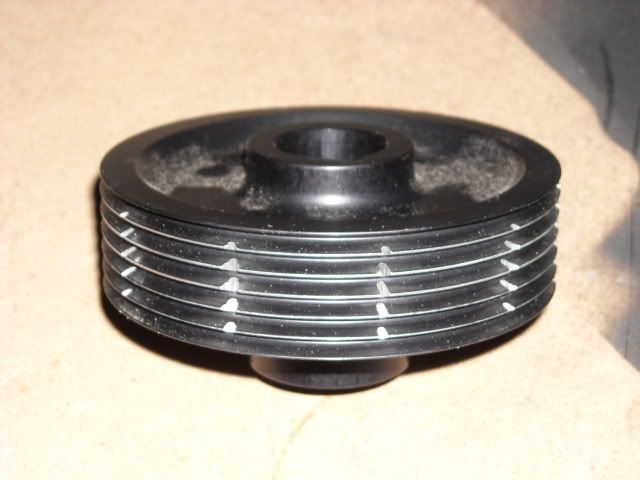
I agree with 8 rib set-ups but I seem to have fixed the belt slip issue with a 2 minute (ok its was 10 minutes) proceedure which was free as opposed to a 1200 dollar pulley set. If it helps anyone, here is a pic of the slotted pulley:
I tried getting a reichard but no one had them in stock in my size, or anything close, and 200 bucks made it worth trying this first.
A quickie DIY on how to do this is to take electical tape and put it on the pulley unstretched around the entire circumference and cut it exactly to size. Remove it from the pulley and put it on a ruler and stretch it up top the nearest inch. Make marks every inch and when you remove it from the ruler the marks will shrink to equal but less than one inch marks. Put the tape back on the pulley and the marks will be eqi-distant and act as a template for the disc cutter of your dremel tool. You can do it while its still on the blower with the belt removed if you mask off everything from the aluminum dust and then blow it all clean with an air hose.
Last edited by SpinMonster; Jun 7, 2009 at 07:06 AM.
