




failed h/c project...

Safety Car


Joined: Sep 2007
Posts: 3,502
Likes: 82

Your issue is the o-ring.
Do not try starting the car like that.
The o-ring goes on the pick-up tube which then gets inserted into the oil pump. You do not put the o-ring in the pump then on the tube. It pinches it every time and causes exactly what is happening.
Hopefully when you get a new o-ring in it, there wont be any damage to bearings. Obviously revving isnt helping things.
Do not try starting the car like that.
The o-ring goes on the pick-up tube which then gets inserted into the oil pump. You do not put the o-ring in the pump then on the tube. It pinches it every time and causes exactly what is happening.
Hopefully when you get a new o-ring in it, there wont be any damage to bearings. Obviously revving isnt helping things.

It's a $2.00 part...you should have replaced it. As mentioned above, the o-ring goes on the pick up tube...lube the crap out of it. Put oil in the bore of the pump. Leave the pump bolts loose and wiggle it slightly as you insert the pick-up tube. If in doubt, pull it apart and try again.

Former Vendor
Joined: May 2005
Posts: 3,749
Likes: 4
From: Valencia Ca
1 - As you know, the double roller chain uses two 1/8" shims (going between the the oil pump and block) which space the oil pump forward from the stock location.
2 - The oil pump pickup tube is somewhat "fixed" in place (it is attached to a main bolt stud)
Though the pickup tube is fastened, there is enough pliability in its mounting such that you can pull it straightforward. Make sure you have this aligned well and of course, use a new o-ring.
Thread Starter
Burning Brakes

Joined: Jan 2010
Posts: 796
Likes: 0
From: Orient Oh
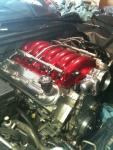
Yea I followed slp instructions to the tee. I did everything how they instructed. I used there double roller and it cam with everything. I pulled my valve covers off and there seems to be oil circulating so that's really good. Here is a really quick video were you can see oil around the springs and me turning it over a few times without coil connected. I know after a H/c swap your suppose to turn it over a few time so it'll help circulate oil. I did so just to see if there would be oil circulating and nothing. Should I start it up with the valve cover off and make a video of it? Here's the video with out a start up.

Thread Starter
Burning Brakes
Joined: Jan 2010
Posts: 796
Likes: 0
From: Orient Oh
Your issue is the o-ring.
Do not try starting the car like that.
The o-ring goes on the pick-up tube which then gets inserted into the oil pump. You do not put the o-ring in the pump then on the tube. It pinches it every time and causes exactly what is happening.
Hopefully when you get a new o-ring in it, there wont be any damage to bearings. Obviously revving isnt helping things.
Do not try starting the car like that.
The o-ring goes on the pick-up tube which then gets inserted into the oil pump. You do not put the o-ring in the pump then on the tube. It pinches it every time and causes exactly what is happening.
Hopefully when you get a new o-ring in it, there wont be any damage to bearings. Obviously revving isnt helping things.
Tech Contributor


Joined: Mar 2003
Posts: 12,094
Likes: 197
From: Colorado Springs, CO
St. Jude Donor '08-'09-'10-'11
You will get passed this and smile after the work is done. Suck it up and start wrenching. You're not the first guy to have to pull the steering rack out twice on a head/cam swap.
Le Mans Master


Joined: May 2011
Posts: 5,022
Likes: 18
From: Tampa FL (formerly Justinjor)
Tech Contributor
St. Jude Donor '11-'12-'13-'14
Agree. I don't know if you saw in your other thread, but I bought an extra O ring just in case the one I pulled out was bad. If you need it, I'll be happy to priority mail it to you, just let me know.
Corvette Stories
The Best of Corvette for Corvette Enthusiasts

Top 10 Most Explosive Corvettes Ever Made: Power-to-Weight Ratio Ranked!
Joe Kucinski
150 hp to 1,250 hp: Every Corvette Generation Compared by the Specs That Matter
Joe Kucinski
8 Coolest Corvette Pace Cars (and Replicas) of All Time
Verdad Gallardo
Top 10 Corvette Engines RANKED by Peak Torque (70+ Years of Muscle!)
Joe Kucinski
Corvette ZR1X Will Be Pacing the Indy 500, And Could Probably Race, Too!
Verdad Gallardo
Top 10 Corvettes Coming to Mecum Indy 2026!
Brett Foote
Top 10 C9 Corvette MUST-HAVES to Fix These C8 Generation Flaws!
Michael S. Palmer
10 Revolutionary 'Corvette Firsts' Most People Don't Know
Joe Kucinski
5 Reasons to Upgrade to an LS6-Powered Corvette; 5 Reasons to Stay LT2
Michael S. Palmer
Le Mans Master

Joined: Jul 2005
Posts: 5,328
Likes: 405
I was going to say that since you had the oil pump off the car, what you now have is a "cavitated" oil pump which will result in zero oil pressure.
However, if you are in fact getting some oil pressure, your oil pump is not cavitated ... and the problem is that O ring others here have mentioned.
However, if you are in fact getting some oil pressure, your oil pump is not cavitated ... and the problem is that O ring others here have mentioned.
Cavitation occurs on the suction side of the pump when demand for fluid exceeds the amount that can be supplied by the suction piping without the absolute pressure dropping (or vacuum increasing as some people prefer) to the point where "boiling" occurs causing air bubbles to form from the naturally occurring entrained air. The air bubbles go through the pump until the pressure increases to the point the air bubbles "explode" and they go back into solution. The "explosion" of the air bubbles is very destructive and will ruin the pump in time.
Aeration is when you have a leak on the suction side of the pump allowing air to enter the suction piping. In extreme cases (a very large leak), zero oil pressure can occur because air flows easier than oil into the suction piping but oil pumps make terrible air compressors. Most of the time the leak is not that large although oil pressure may decrease at lower pump RPM. The oil/air mixture will go through the pump but you'll now have millions of tiny air bubbles dispersed throughout the oil giving it a "frothy" appearance because the oil can't hold any more air in its solution. This oil/air mixture has a reduced load carrying capability which can affect lubrication, particularly hydrodynamic lubrication (journal bearings like the mains, rods, and cam).
The difference between the two can best be summed up by saying cavitation is air coming out of the oil solution and aeration is air going into the oil solution. Cavitation is always damaging to the pump while aeration can sometimes be damaging to the engine.

For more reading:
http://www.machinerylubrication.com/...ic-root-causes

Racer

Joined: Dec 2010
Posts: 418
Likes: 0
From: South Central Kansas
Cavitation does not cause zero oil pressure and cavitation can exist when there is oil pressure. In the OP's case, he has aeration...many people don't know the difference between cavitation and aeration.
Cavitation occurs on the suction side of the pump when demand for fluid exceeds the amount that can be supplied by the suction piping without the absolute pressure dropping (or vacuum increasing as some people prefer) to the point where "boiling" occurs causing air bubbles to form from the naturally occurring entrained air. The air bubbles go through the pump until the pressure increases to the point the air bubbles "explode" and they go back into solution. The "explosion" of the air bubbles is very destructive and will ruin the pump in time.
Aeration is when you have a leak on the suction side of the pump allowing air to enter the suction piping. In extreme cases (a very large leak), zero oil pressure can occur because air flows easier than oil into the suction piping but oil pumps make terrible air compressors. Most of the time the leak is not that large although oil pressure may decrease at lower pump RPM. The oil/air mixture will go through the pump but you'll now have millions of tiny air bubbles dispersed throughout the oil giving it a "frothy" appearance because the oil can't hold any more air in its solution. This oil/air mixture has a reduced load carrying capability which can affect lubrication, particularly hydrodynamic lubrication (journal bearings like the mains, rods, and cam).
The difference between the two can best be summed up by saying cavitation is air coming out of the oil solution and aeration is air going into the oil solution. Cavitation is always damaging to the pump while aeration can sometimes be damaging to the engine.
For more reading:
http://www.machinerylubrication.com/...ic-root-causes
Cavitation occurs on the suction side of the pump when demand for fluid exceeds the amount that can be supplied by the suction piping without the absolute pressure dropping (or vacuum increasing as some people prefer) to the point where "boiling" occurs causing air bubbles to form from the naturally occurring entrained air. The air bubbles go through the pump until the pressure increases to the point the air bubbles "explode" and they go back into solution. The "explosion" of the air bubbles is very destructive and will ruin the pump in time.
Aeration is when you have a leak on the suction side of the pump allowing air to enter the suction piping. In extreme cases (a very large leak), zero oil pressure can occur because air flows easier than oil into the suction piping but oil pumps make terrible air compressors. Most of the time the leak is not that large although oil pressure may decrease at lower pump RPM. The oil/air mixture will go through the pump but you'll now have millions of tiny air bubbles dispersed throughout the oil giving it a "frothy" appearance because the oil can't hold any more air in its solution. This oil/air mixture has a reduced load carrying capability which can affect lubrication, particularly hydrodynamic lubrication (journal bearings like the mains, rods, and cam).
The difference between the two can best be summed up by saying cavitation is air coming out of the oil solution and aeration is air going into the oil solution. Cavitation is always damaging to the pump while aeration can sometimes be damaging to the engine.
For more reading:
http://www.machinerylubrication.com/...ic-root-causes
Bob
Thread Starter
Burning Brakes
Joined: Jan 2010
Posts: 796
Likes: 0
From: Orient Oh
well I'm 90% done with re-tear down. Just a pulley remover away from finishing the "hard" stuff. Crazy I did all this work within 3 hours with out looking at the cam swap guide once. I'm going to wait until I get the new O ring in before I take off the timing cover off. This stuff is like riding a bike. Once you figure it out you'll never forget. I am full confident that I could do a cam swap within 10 hours easy. I could do tear down with eye's closed but install I'm still going to have to look at the torques

 saves me a lot of time trying to find it online.
Le Mans Master
Joined: May 2011
Posts: 5,022
Likes: 18
From: Tampa FL (formerly Justinjor)
Tech Contributor
St. Jude Donor '11-'12-'13-'14
Not a problem Matthew--like I said, I'm happy to help out a fellow vette owner, and more importantly, a fellow service member.
I'll have to dig it up tonight(it's in the garage somewhere) and drop it in the mail tomorrow morning. Now where did I put that box of 'leftovers'. . .
I'll have to dig it up tonight(it's in the garage somewhere) and drop it in the mail tomorrow morning. Now where did I put that box of 'leftovers'. . .

Le Mans Master

Joined: Feb 2006
Posts: 5,762
Likes: 4
From: Chandler Arizona
That pick-up tube o-ring is a BIATCH! I pinched mine twice before I finally got it installed properly. First time, I thought I had it, but when I used a mirror, I could see it protruding out the backside. The problem is that the oil pick-up tube no longer lines up when you go to the double roller chain since you have to shim the oil pump out some.
Good luck!
Glenn
Good luck!
Glenn
Le Mans Master
Joined: May 2011
Posts: 5,022
Likes: 18
From: Tampa FL (formerly Justinjor)
Tech Contributor
St. Jude Donor '11-'12-'13-'14
Found the O ring and put it in the mail tonight. I wrapped it up with a bunch of padding and stuff so it should make the journey without issue. It's inside a few plastic bags and then wrapped up with tape.
Keep us posted
Keep us posted

Thread Starter
Burning Brakes
Joined: Jan 2010
Posts: 796
Likes: 0
From: Orient Oh
True but the hardest thing is those darn power steering lines getting them fished. Well my first time I installed them I bolted the power steering unit first and man that was a pain! Now I learned a bit I'm going to fish the lines and bolt them to the steering rack then bolt up the power steering unit. Wazslow reason people don't want to do this is because it seems over whelming until you get into it. Seeing it on paper I was giving second thoughts but then I drank a few beers and started at it anyway. I done this physically all by myself besides a help from my buddy pulling the radiator out for obvious reasons. I could have a buddy help but this car being one of my most favorable items, I wouldn't want to blame anyone else if something got up.

