




Thoughts on this LS7 crankcase venting solution

Thread Starter
Racer


Joined: Mar 2022
Posts: 398
Likes: 33

Crankcase pressure always reduce ring function and forces oil into piston rings and combustion chamber bypassing the intake route completely. Improper piston drainage leads to hard carbon deposits and ruins cylinder wall.
Crankcase pressure directly controls oil droplet density and radius. More pressure results with larger droplets and more oil suspension.
The more vacuum pulled on crankcase the better rings will function, better pistons drain oil, cleaner oil circulating reduce carbon deposits around orifices, and reduce oil suspension in crankcase gas allowing more crankcase scavenging with less oil contamination to the intake.
Never vent to atmosphere.
-Greg Banish
-Calibrated Success, Inc.
https://www.corvetteforum.com/forums...post1606137830
Crankcase pressure directly controls oil droplet density and radius. More pressure results with larger droplets and more oil suspension.
The more vacuum pulled on crankcase the better rings will function, better pistons drain oil, cleaner oil circulating reduce carbon deposits around orifices, and reduce oil suspension in crankcase gas allowing more crankcase scavenging with less oil contamination to the intake.
Never vent to atmosphere.
-Greg Banish
-Calibrated Success, Inc.
https://www.corvetteforum.com/forums...post1606137830

Safety Car


Joined: Oct 2007
Posts: 4,222
Likes: 1,080
From: South Florida
You can run any kind of vacuum you wish, exhaust, electric, pump driven, air filter pressure drop (suction inlet like OEM),
As long as you MEASURE the pressure inside the crankcase to ensure it is target 1.5"Hg to 2.5"Hg range in wet sump applications.
In dry sump pressure can be even lower, but your goal is a MINIMUM pressure drop of about 1"Hg at least. Keep it away from the 0psi threshold.
The pressure below rings is working against the piston ring seal which we consider as oil sealing behavior condition. At the end of power stroke the force on piston rings from crankcase pressure is unsealing the ring, causing blow-by to increase and forcing oil into the ring pack. Early ring switching & ring flutter are general culprits for gas and oil transfer into ring pack at end of power stroke. The gas ported rings may help seal the ring to the cylinder wall during power stroke but that pressure is leaving quickly at the end of power stroke, it is then the inertial force of the ring balanced by gas pressure and friction from the cylinder wall which has far greater influence once combustion pressure decreased. What you want for longevity is a vacuum which can clear the ring pack of oil and gas components and allow the oil control rings to drain out properly. An OEM ring will work well around 1" to 3"Hg for most engines in the world, however they do make low tension rings designed to work with increased vacuum for vacuum pump applications which emphasizes the importance of ring tension and crankcase pressure interplay.
As long as you MEASURE the pressure inside the crankcase to ensure it is target 1.5"Hg to 2.5"Hg range in wet sump applications.
In dry sump pressure can be even lower, but your goal is a MINIMUM pressure drop of about 1"Hg at least. Keep it away from the 0psi threshold.
The pressure below rings is working against the piston ring seal which we consider as oil sealing behavior condition. At the end of power stroke the force on piston rings from crankcase pressure is unsealing the ring, causing blow-by to increase and forcing oil into the ring pack. Early ring switching & ring flutter are general culprits for gas and oil transfer into ring pack at end of power stroke. The gas ported rings may help seal the ring to the cylinder wall during power stroke but that pressure is leaving quickly at the end of power stroke, it is then the inertial force of the ring balanced by gas pressure and friction from the cylinder wall which has far greater influence once combustion pressure decreased. What you want for longevity is a vacuum which can clear the ring pack of oil and gas components and allow the oil control rings to drain out properly. An OEM ring will work well around 1" to 3"Hg for most engines in the world, however they do make low tension rings designed to work with increased vacuum for vacuum pump applications which emphasizes the importance of ring tension and crankcase pressure interplay.
Safety Car
Joined: Oct 2007
Posts: 4,222
Likes: 1,080
From: South Florida
This is a crankcase pressure video measurement I have taken with 5.3L Turbo application showing how to prevent oil from blowing out of the engine.
it is fairly impossible for me to have oil induction to the intake manifold because,
A. I have pressure tested my PCV system properly (
)
B. I have incorporated 98' Toyota Supra PCV valve which seals up against 30+psi of boost properly (chevrolet PCV valve does/did not)
C. During boost the PCV valve is completely shut so no matter how much oil frothing/hurricane in the crankcase no flow exists to the intake manifold via PCV valve
D. The only exit from crankcase is to the turbocharger inlet at wide open throttle which means any oil leaving the crankcase must enter the turbocharger/intercooler/plumbing/etc... it cannot reach the engine unless it also ruins the intercooler (complete engine catastrophic failure mode fills the intercooler with oil)
E. By monitoring the turbo inlet I can assure there is no presence of liquid oil, only a dry oil spray caused by gaseous hydrocarbon components (as with OEM PCV systems for all turbo vehicles in the world)
F. A light oil coating is beneficial to the turbo compressor inlet as it will help seal the housing, protect the metal materials from oxidation, and help trap fine particulate debris which passed the air filter over time that can be wiped out during routine (12-25k miles) maintenance. This is done by OEM design I simply copied the Toyota/Nissan design strategy
it is fairly impossible for me to have oil induction to the intake manifold because,
A. I have pressure tested my PCV system properly (
B. I have incorporated 98' Toyota Supra PCV valve which seals up against 30+psi of boost properly (chevrolet PCV valve does/did not)
C. During boost the PCV valve is completely shut so no matter how much oil frothing/hurricane in the crankcase no flow exists to the intake manifold via PCV valve
D. The only exit from crankcase is to the turbocharger inlet at wide open throttle which means any oil leaving the crankcase must enter the turbocharger/intercooler/plumbing/etc... it cannot reach the engine unless it also ruins the intercooler (complete engine catastrophic failure mode fills the intercooler with oil)
E. By monitoring the turbo inlet I can assure there is no presence of liquid oil, only a dry oil spray caused by gaseous hydrocarbon components (as with OEM PCV systems for all turbo vehicles in the world)
F. A light oil coating is beneficial to the turbo compressor inlet as it will help seal the housing, protect the metal materials from oxidation, and help trap fine particulate debris which passed the air filter over time that can be wiped out during routine (12-25k miles) maintenance. This is done by OEM design I simply copied the Toyota/Nissan design strategy
Thread Starter
Racer
Joined: Mar 2022
Posts: 398
Likes: 33
Interesting, where do the vacuum numbers you are quoting come from? Just curious cause basically any atmosphere vented setups wouldn't even begin to vent until hitting 0psi and then more as the pressure builds. And people have been venting like that for a long time. I'd prefer to do what's best for the car so trying to take in all I can here. Oh, I'm guessing your vacuum numbers are net of atmospheric pressure, correct? I'll watch videos in a bit when I have some more time. Thanks.
Safety Car
Joined: Oct 2007
Posts: 4,222
Likes: 1,080
From: South Florida
It is a published worldwide specification for gasoline combustion and diesel engines in general.
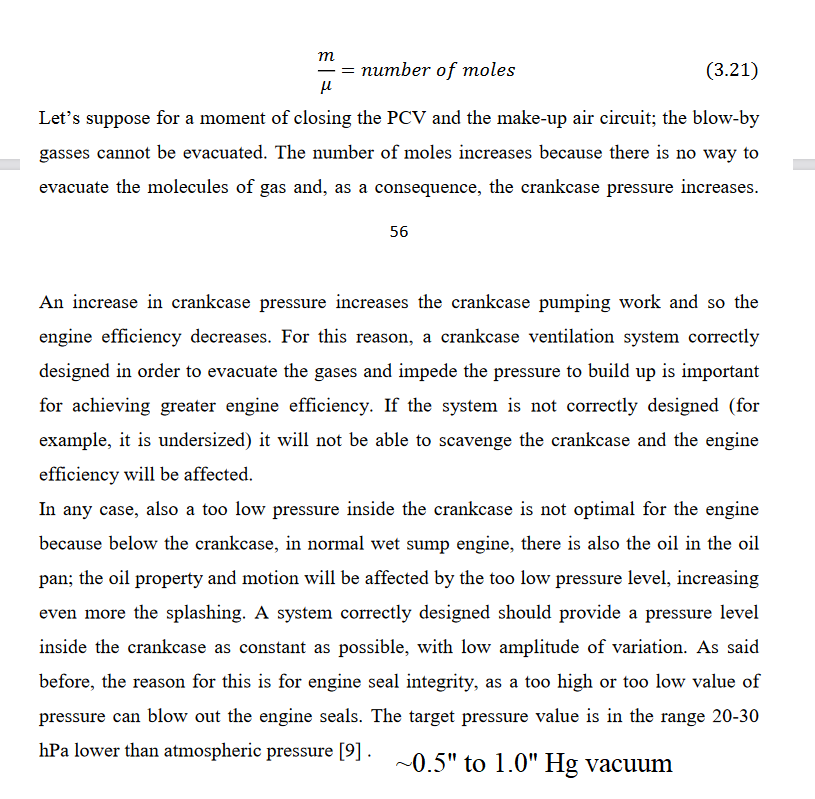
The pressure is a diagnostic significance for all engines from all manufacturers, more modern engines from BMW/Toyota for example use more vacuum and employ pressure crankcase sensors which throw CEL
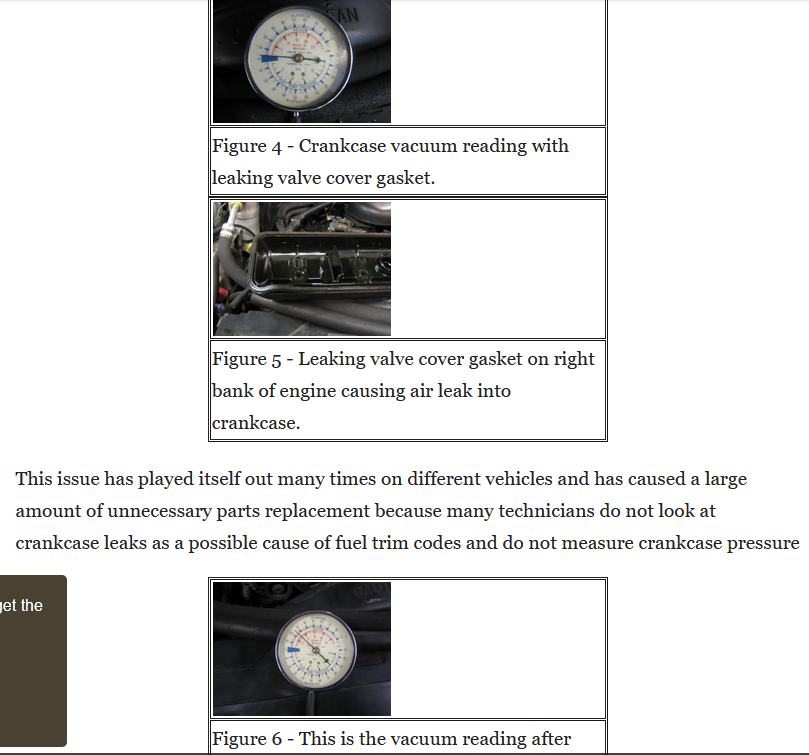
The pressure is set with respect atmospheric pressure. The pressure of atmosphere is reduced depending on friction in tubes. This is absolute pressure.
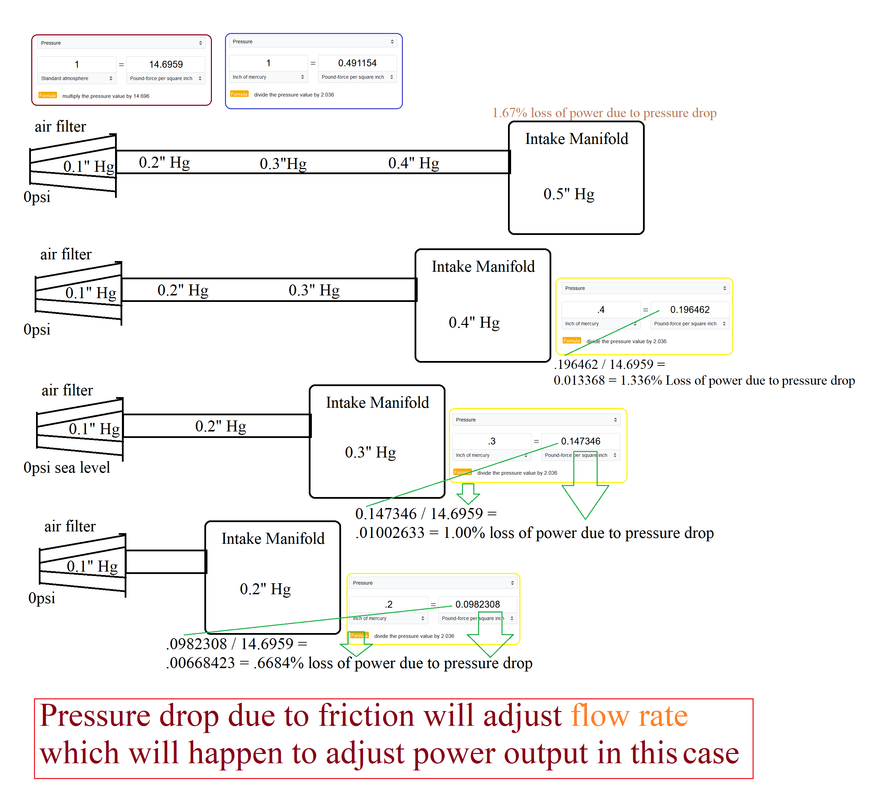
Therefore when we say 3" Hg this equals 1.47346PSI of pressure. So for example at sea level the atmosphere is 14.5PSI~ so 3"Hg would be 14.5 - 1.47346 = 13.02654PSI Inside the crankcase absolute.
If you google "inches of mercury to PSI" you can see any calculable relationship. PSI and Inches of Mercury are interchangeable.
The pressure is a diagnostic significance for all engines from all manufacturers, more modern engines from BMW/Toyota for example use more vacuum and employ pressure crankcase sensors which throw CEL
The pressure is set with respect atmospheric pressure. The pressure of atmosphere is reduced depending on friction in tubes. This is absolute pressure.
Therefore when we say 3" Hg this equals 1.47346PSI of pressure. So for example at sea level the atmosphere is 14.5PSI~ so 3"Hg would be 14.5 - 1.47346 = 13.02654PSI Inside the crankcase absolute.
If you google "inches of mercury to PSI" you can see any calculable relationship. PSI and Inches of Mercury are interchangeable.
Thread Starter
Racer
Joined: Mar 2022
Posts: 398
Likes: 33
Yes, I understand the relationship between the different air pressure units lol. I also can read a compressor map fairly well so I understand pressure ratios and abs pressure.
Thanks for the sources on crankcase vacuum. I just have to wonder how my subaru does it on 30psi boost pressure and vented to atmosphere. Maybe it has something to do with my oil pan baffles. This is all very interesting to me because I talked to some very well known and respected engine shops that say to vent to atmosphere.
Thanks for the sources on crankcase vacuum. I just have to wonder how my subaru does it on 30psi boost pressure and vented to atmosphere. Maybe it has something to do with my oil pan baffles. This is all very interesting to me because I talked to some very well known and respected engine shops that say to vent to atmosphere.
Safety Car
Joined: Oct 2007
Posts: 4,222
Likes: 1,080
From: South Florida
Because they have no idea what they are doing. They are not engineering the engine, just buy an engine designed by somebody else then modify it however they want without understanding repercussions.
They all copy each other because 'it works'. You can vent the crankcase and it 'works'. But there are consequences similar to smoking. When you start smoking nothing seems to happen, you are fine. But years (miles) down the road if compare smoking vs not-smoking you will see the difference in reliability and longevity it makes. But nobody is making that comparison with engines, because nobody is building two identical engines then venting one of them and going 100k miles to see the difference. Actually many people are but nobody is paying attention- how many 5.3L engines blowing oil smoking with aftermarket air filters and misdiagnosed PCV issues out there? So it is a esoteric and fairly unknown result where only the higher tuners associated with OEM engineering such as Greg Banish will understand and relay that information.
They all copy each other because 'it works'. You can vent the crankcase and it 'works'. But there are consequences similar to smoking. When you start smoking nothing seems to happen, you are fine. But years (miles) down the road if compare smoking vs not-smoking you will see the difference in reliability and longevity it makes. But nobody is making that comparison with engines, because nobody is building two identical engines then venting one of them and going 100k miles to see the difference. Actually many people are but nobody is paying attention- how many 5.3L engines blowing oil smoking with aftermarket air filters and misdiagnosed PCV issues out there? So it is a esoteric and fairly unknown result where only the higher tuners associated with OEM engineering such as Greg Banish will understand and relay that information.
Thread Starter
Racer
Joined: Mar 2022
Posts: 398
Likes: 33
Because they have no idea what they are doing. They are not engineering the engine, just buy an engine designed by somebody else then modify it however they want without understanding repercussions.
They all copy each other because 'it works'. You can vent the crankcase and it 'works'. But there are consequences similar to smoking. When you start smoking nothing seems to happen, you are fine. But years (miles) down the road if compare smoking vs not-smoking you will see the difference in reliability and longevity it makes. But nobody is making that comparison with engines, because nobody is building two identical engines then venting one of them and going 100k miles to see the difference. Actually many people are but nobody is paying attention- how many 5.3L engines blowing oil smoking with aftermarket air filters and misdiagnosed PCV issues out there? So it is a esoteric and fairly unknown result where only the higher tuners associated with OEM engineering such as Greg Banish will understand and relay that information.
They all copy each other because 'it works'. You can vent the crankcase and it 'works'. But there are consequences similar to smoking. When you start smoking nothing seems to happen, you are fine. But years (miles) down the road if compare smoking vs not-smoking you will see the difference in reliability and longevity it makes. But nobody is making that comparison with engines, because nobody is building two identical engines then venting one of them and going 100k miles to see the difference. Actually many people are but nobody is paying attention- how many 5.3L engines blowing oil smoking with aftermarket air filters and misdiagnosed PCV issues out there? So it is a esoteric and fairly unknown result where only the higher tuners associated with OEM engineering such as Greg Banish will understand and relay that information.
Corvette Stories
The Best of Corvette for Corvette Enthusiasts

Top 10 Most Expensive Corvettes Ever Sold on Bring A Trailer
Brett Foote
10 Things Every Corvette Owner Needs (2026 Edition)
Michael S. Palmer
8 Most "Only Corvette Owners Understand" Quirks and Problems
Pouria Savadkouei
10 Reasons the C6 Z06 is Still A Performance Benchmark After 20 Years
Joe Kucinski
How Much Horsepower Every Corvette Engine "LOST" in 1972
Joe Kucinski
Top 10 DOs and DON'Ts for Protecting Your Convertible Top!
Michael S. Palmer
Top 10 Most Explosive Corvettes Ever Made: Power-to-Weight Ratio Ranked!
Joe Kucinski
150 hp to 1,250 hp: Every Corvette Generation Compared by the Specs That Matter
Joe Kucinski
8 Coolest Corvette Pace Cars (and Replicas) of All Time
Verdad Gallardo
Safety Car
Joined: Oct 2007
Posts: 4,222
Likes: 1,080
From: South Florida
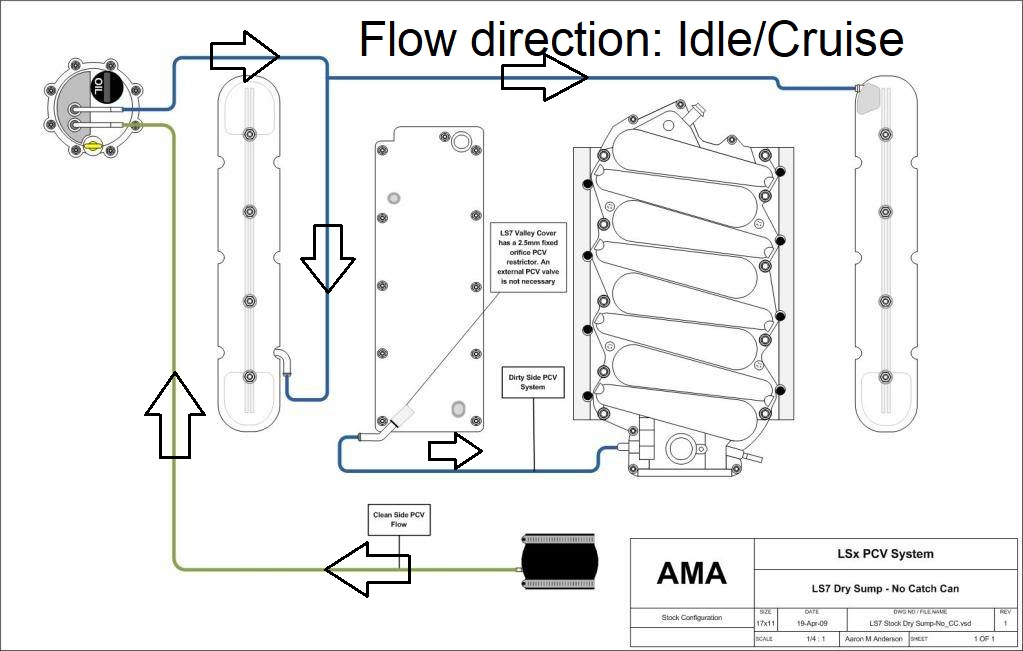
Its so much wrong. I am not picking on you but its got these issues
1. No flow direction for idle/cruise vs wot will confuse and mix the crankcase gas and adds friction and elastic collision frequency raises pressure
2. Additional lines add friction which causes pressure drop which kills flow creating more pressure in the crankcase
3. Additional volume will reduce the response time of the PCV to switch from idle/cruise to WOT completely different flow and pressure direction vector components
4. Kinetic energy is all over the place - flow is confused
5. No label for restrictions e.g. valve cover orifice .200" or valley cover orifice etc... will impact flow and purpose
I could write in all the details to your diagram but I'd rather just either explain it plainly or draw a proper diagram. Do you want to discuss this via discord or something I can explain more easily than a text wall. Or you can look at some diagrams from the OEM system which works perfectly fine when the engine is healthy.
i did not invent PCV nor does any of my measurements or settings anything new- it is simply OEM design from forced induction engines such as Toyota Supra and Nissan Skyline I have reverse engineered, and tested in various applications over 25 years.
There is an enormous knowledge gap on this subject for what is a relatively simple philosophy that spans several of engineering and chemistry dichotomy.
It took 25 years of tuning turbo apps, thousands of OEM engines inspected and 16 years of college chemistry/engineering education to understand the way I do.
Examine these for a minute then revise your considerations and I will help you understand if you wish
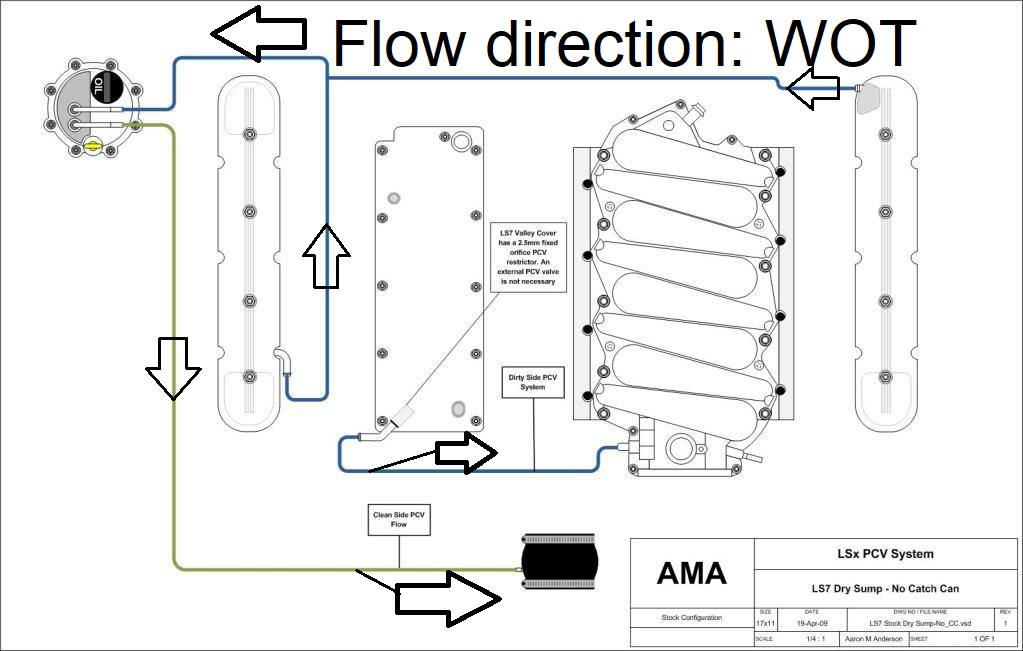
Again OEM is ideal for all but most vigorous applications with severe cornering forces that pools oil in the heads and floods the baffle systems in which case the fix is a baffle re-design and improved oil drainback feature internally to the engine- not a catching system. Never catch oil that will be in presence of water/combustion products/CO2 and heat cycled, myriad forming products and carbonic acids will be introduced to the intake system. Much worse than a little oil you find there. Oil will get into the intake system no matter what you do. Oil (dry oil gas, not necessarily liquid) is a natural part of cylinder operation present on cylinder walls and always partially mixing into operation.
1. No flow direction for idle/cruise vs wot will confuse and mix the crankcase gas and adds friction and elastic collision frequency raises pressure
2. Additional lines add friction which causes pressure drop which kills flow creating more pressure in the crankcase
3. Additional volume will reduce the response time of the PCV to switch from idle/cruise to WOT completely different flow and pressure direction vector components
4. Kinetic energy is all over the place - flow is confused
5. No label for restrictions e.g. valve cover orifice .200" or valley cover orifice etc... will impact flow and purpose
I could write in all the details to your diagram but I'd rather just either explain it plainly or draw a proper diagram. Do you want to discuss this via discord or something I can explain more easily than a text wall. Or you can look at some diagrams from the OEM system which works perfectly fine when the engine is healthy.
i did not invent PCV nor does any of my measurements or settings anything new- it is simply OEM design from forced induction engines such as Toyota Supra and Nissan Skyline I have reverse engineered, and tested in various applications over 25 years.
There is an enormous knowledge gap on this subject for what is a relatively simple philosophy that spans several of engineering and chemistry dichotomy.
It took 25 years of tuning turbo apps, thousands of OEM engines inspected and 16 years of college chemistry/engineering education to understand the way I do.
Examine these for a minute then revise your considerations and I will help you understand if you wish
Again OEM is ideal for all but most vigorous applications with severe cornering forces that pools oil in the heads and floods the baffle systems in which case the fix is a baffle re-design and improved oil drainback feature internally to the engine- not a catching system. Never catch oil that will be in presence of water/combustion products/CO2 and heat cycled, myriad forming products and carbonic acids will be introduced to the intake system. Much worse than a little oil you find there. Oil will get into the intake system no matter what you do. Oil (dry oil gas, not necessarily liquid) is a natural part of cylinder operation present on cylinder walls and always partially mixing into operation.
Thread Starter
Racer
Joined: Mar 2022
Posts: 398
Likes: 33
I posted the OEM design in the first post of this thread. So I know for a fact that my last proposed setup is not too much different than OEM. Just a couple cans added as well as an added vent line on one valve cover. I cannot use the OEM setup as I am adding a blower and will be making north of 1000whp plus going from NA to boosted. However, I would like to see what you have in mind for a diagram for a blown LS7. In fact, I would love to see it.
I'm not sure what discord is.
I understand you are very passionate about this, but at the same time, I cannot completely ignore my own experience on the topic which is a boosted car with a turbo making 30psi on a small 2.5L and crankcase vented to atmosphere and zero issues.
I'm not sure what discord is.
I understand you are very passionate about this, but at the same time, I cannot completely ignore my own experience on the topic which is a boosted car with a turbo making 30psi on a small 2.5L and crankcase vented to atmosphere and zero issues.

Safety Car
Joined: Oct 2007
Posts: 4,222
Likes: 1,080
From: South Florida
I posted the OEM design in the first post of this thread. So I know for a fact that my last proposed setup is not too much different than OEM. Just a couple cans added as well as an added vent line on one valve cover. I cannot use the OEM setup as I am adding a blower and will be making north of 1000whp plus going from NA to boosted. However, I would like to see what you have in mind for a diagram for a blown LS7. In fact, I would love to see it.
I'm not sure what discord is.
I understand you are very passionate about this, but at the same time, I cannot completely ignore my own experience on the topic which is a boosted car with a turbo making 30psi on a small 2.5L and crankcase vented to atmosphere and zero issues.
I'm not sure what discord is.
I understand you are very passionate about this, but at the same time, I cannot completely ignore my own experience on the topic which is a boosted car with a turbo making 30psi on a small 2.5L and crankcase vented to atmosphere and zero issues.
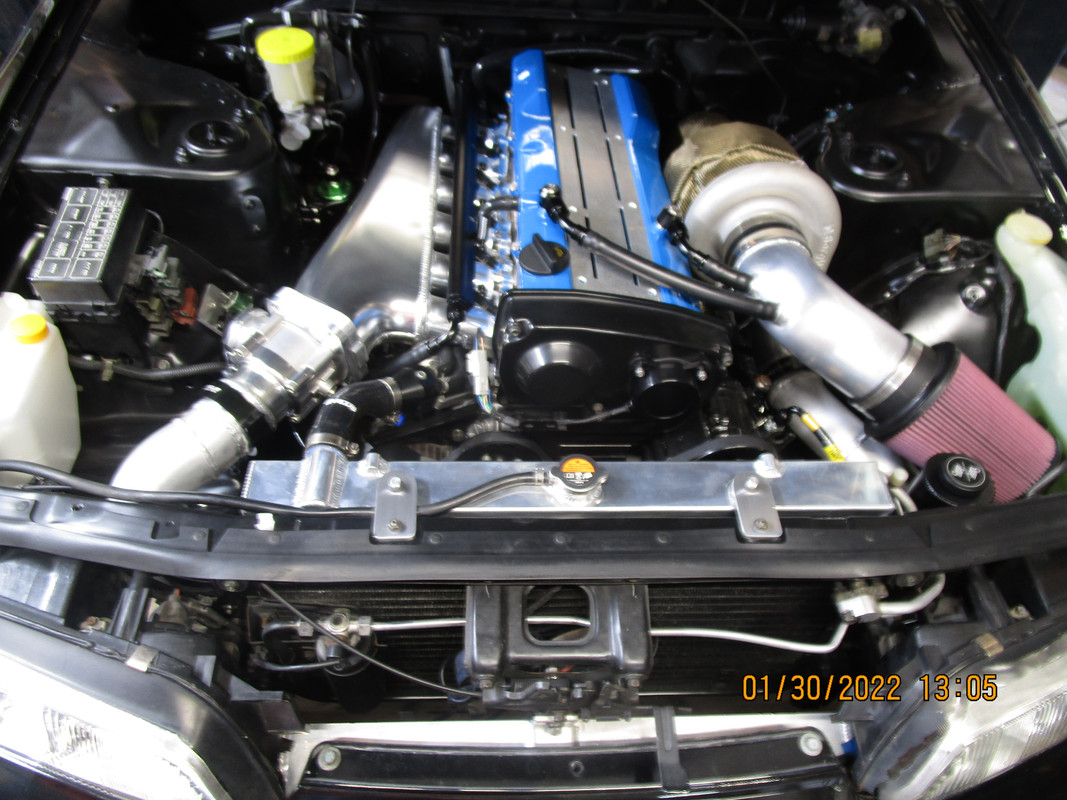
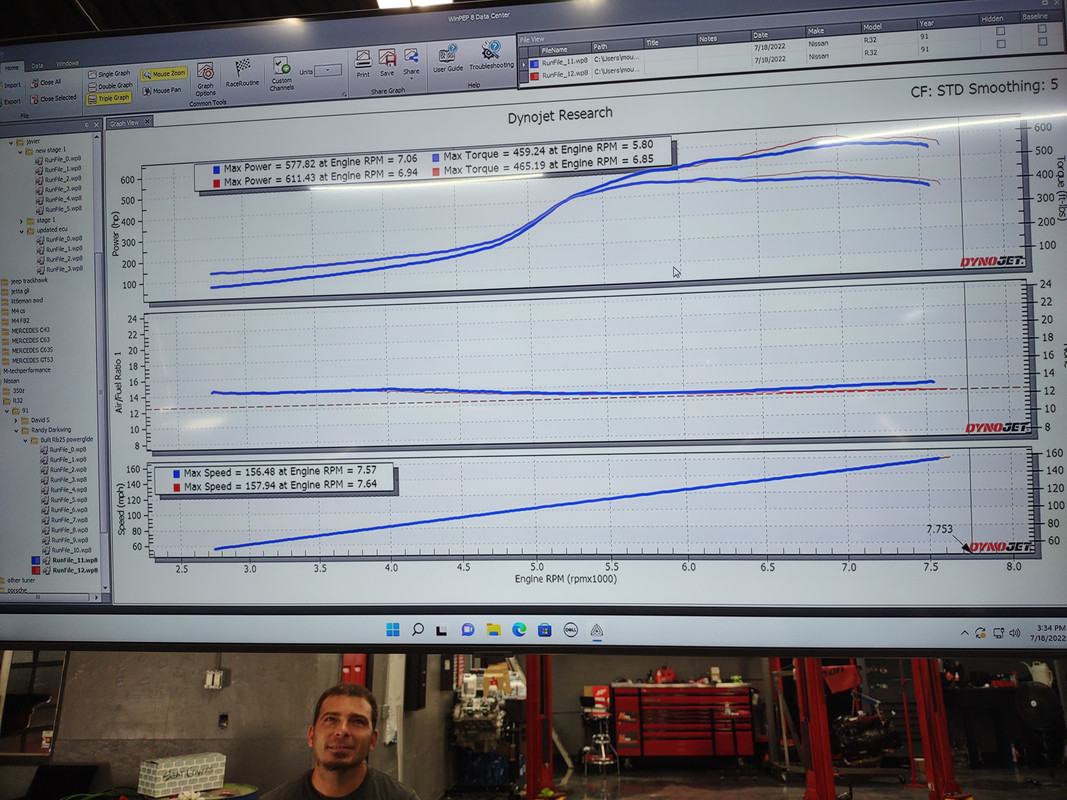
No catching. OEM PCV only. It can be done if you measure and set the crankcase pressure properly.
I have used the same OEM PCV on 1000rwhp 3L 2jz-gte as well for 20 years
https://www.supraforums.com/threads/.../post-14037909
It is simple to use OEM PCV from Skyline/Supra on your engine. Simply add a Supra PCV valve to the valley cover to stop intake manifold pressure from entering the crankcase.
Then move the fresh air source to the compressor inlet.
Then, Pressure test the system to find leaking like my video. Then, Measure the crankcase pressure and adjust as needed. I can explain how to do that once you get to that
Thread Starter
Racer
Joined: Mar 2022
Posts: 398
Likes: 33
Here is my 2.5L 30psi 600rwhp turbo application
No catching. OEM PCV only. It can be done if you measure and set the crankcase pressure properly.
I have used the same OEM PCV on 1000rwhp 3L 2jz-gte as well for 20 years
https://www.supraforums.com/threads/.../post-14037909
It is simple to use OEM PCV from Skyline/Supra on your engine. Simply add a Supra PCV valve to the valley cover to stop intake manifold pressure from entering the crankcase.
Then move the fresh air source to the compressor inlet.
Then, Pressure test the system to find leaking like my video. Then, Measure the crankcase pressure and adjust as needed. I can explain how to do that once you get to that
No catching. OEM PCV only. It can be done if you measure and set the crankcase pressure properly.
I have used the same OEM PCV on 1000rwhp 3L 2jz-gte as well for 20 years
https://www.supraforums.com/threads/.../post-14037909
It is simple to use OEM PCV from Skyline/Supra on your engine. Simply add a Supra PCV valve to the valley cover to stop intake manifold pressure from entering the crankcase.
Then move the fresh air source to the compressor inlet.
Then, Pressure test the system to find leaking like my video. Then, Measure the crankcase pressure and adjust as needed. I can explain how to do that once you get to that

Safety Car
Joined: Oct 2007
Posts: 4,222
Likes: 1,080
From: South Florida
There is an air/oil separator in the factory baffle system. It operates on kinetic energy requirement, separation requires energy supply from a vacuum pump. The engine is a vacuum pump. Part of the engine's vacuum pumping may be used to drive air/oil separation that is how factory separators intended to work.
If we add a bunch of friction in the form of lines it may ruin the factory separator function and that is why a line/can starts to fill with oil.
Another way to ruin the separation is to decrease the energy input by adjusting the pressure of the air filter at wide open throttle. For example if we remove the air filter, now there is no energy supplied to drive separation you have essentially vented the engine to atmosphere. Let that sink in- a PCV system which APPEARS to be factory can still be ruined by the engine's air filter and leads to venting. Let me repeat that, the FACTORY PCV SYSTEM will act like a VENTING system if the air filter is not properly adjusted to provide the necessary pressure drop at wide open throttle.
You can diagnose this and avoid this fate by simply measuring the crankcase pressure and setting it properly. When crankcase pressure rises over atmospheric it becomes pressure scalar driven which allows blow-by gas to mix with engine oil and dissolve into oil based on partial pressure of dissolved gas (more gas dissolves under pressure) and circulates through the engine leaving deposits, accelerating wear.
Combustion blow-by is a gas it cannot be captured in any catch can or volume, no way to catch gas in a jug. Remember that blow-by gas contains carbon which forms deposits; gasoline is a hydrocarbon miscible with oil and may form carbon deposits like oil. They both will form hard diamond like deposits on valves whether there is oil or not in the gas flow doesn't matter.
The oil accumulates partly by traveling along with the combustion gas because of failure to separate the oil from the gas.
However, part of the oil component is a gas as well. In other words oil forms droplets based on pressure, but some oil molecules are a gas state and will not be captured in any can.
I can assure you despite oil occlusion around intake ports which is unavoidable for most engines no matter what you do- there are many ways to satisfactory deal with your concerns in a way that you will feel more comfortable if that is what it takes.
Here are two suggestions for your concern (not recommendations; merely to satisfy your concern)
1. Vacuum pump drive the PCV (provides the energy instead of the engine) this way you can directly control crankcase pressure without interfering with intake system concerns .
2. Electric vacuum pump the PCV - this can avoid the complexity and maintenance associated with belt driven pumps however you must use a full-time crankcase pressure monitoring system so when the pump fails you will catch it before the engine starts to leak and blow oil due to pressure.
From my own experience I can tell you it is easily to use OEM PCV On a factory engine with 100,000 to 200,000 miles such as 05' L33 Engine, produce 900rwhp easily in a turbo application on factory bottom end without ever taking it apart, use OEM PCV for 200,000 miles without issue. Yes the intake ports are covered with a bit of liquid oil on those engines no matter what you do. No it does not interfere with the engine operation or fuel quality. The combustion chambers stay clean and clear the plugs nice and clean, I can do these all day. The important part is control of crankcase pressure. When crankcase pressure rises over atmosphere it is like a rock rolling downhill gaining momentum over time starts sending oil into oil seals and ruining the seals, and contaminating the oil.
There are plenty of people who will build an engine, race it with a venting system and catch cans, those engines won't see 50k miles those people never know the road they are on.
If I own a machine shop it is advantageous to me to tell people to use a vent system and catch can because this will increase the frequency of them coming back for a fresh engine and they will never know or understand the knowledge behind why this keeps happening.
If we add a bunch of friction in the form of lines it may ruin the factory separator function and that is why a line/can starts to fill with oil.
Another way to ruin the separation is to decrease the energy input by adjusting the pressure of the air filter at wide open throttle. For example if we remove the air filter, now there is no energy supplied to drive separation you have essentially vented the engine to atmosphere. Let that sink in- a PCV system which APPEARS to be factory can still be ruined by the engine's air filter and leads to venting. Let me repeat that, the FACTORY PCV SYSTEM will act like a VENTING system if the air filter is not properly adjusted to provide the necessary pressure drop at wide open throttle.
You can diagnose this and avoid this fate by simply measuring the crankcase pressure and setting it properly. When crankcase pressure rises over atmospheric it becomes pressure scalar driven which allows blow-by gas to mix with engine oil and dissolve into oil based on partial pressure of dissolved gas (more gas dissolves under pressure) and circulates through the engine leaving deposits, accelerating wear.
Combustion blow-by is a gas it cannot be captured in any catch can or volume, no way to catch gas in a jug. Remember that blow-by gas contains carbon which forms deposits; gasoline is a hydrocarbon miscible with oil and may form carbon deposits like oil. They both will form hard diamond like deposits on valves whether there is oil or not in the gas flow doesn't matter.
The oil accumulates partly by traveling along with the combustion gas because of failure to separate the oil from the gas.
However, part of the oil component is a gas as well. In other words oil forms droplets based on pressure, but some oil molecules are a gas state and will not be captured in any can.
I can assure you despite oil occlusion around intake ports which is unavoidable for most engines no matter what you do- there are many ways to satisfactory deal with your concerns in a way that you will feel more comfortable if that is what it takes.
Here are two suggestions for your concern (not recommendations; merely to satisfy your concern)
1. Vacuum pump drive the PCV (provides the energy instead of the engine) this way you can directly control crankcase pressure without interfering with intake system concerns .
2. Electric vacuum pump the PCV - this can avoid the complexity and maintenance associated with belt driven pumps however you must use a full-time crankcase pressure monitoring system so when the pump fails you will catch it before the engine starts to leak and blow oil due to pressure.
From my own experience I can tell you it is easily to use OEM PCV On a factory engine with 100,000 to 200,000 miles such as 05' L33 Engine, produce 900rwhp easily in a turbo application on factory bottom end without ever taking it apart, use OEM PCV for 200,000 miles without issue. Yes the intake ports are covered with a bit of liquid oil on those engines no matter what you do. No it does not interfere with the engine operation or fuel quality. The combustion chambers stay clean and clear the plugs nice and clean, I can do these all day. The important part is control of crankcase pressure. When crankcase pressure rises over atmosphere it is like a rock rolling downhill gaining momentum over time starts sending oil into oil seals and ruining the seals, and contaminating the oil.
There are plenty of people who will build an engine, race it with a venting system and catch cans, those engines won't see 50k miles those people never know the road they are on.
If I own a machine shop it is advantageous to me to tell people to use a vent system and catch can because this will increase the frequency of them coming back for a fresh engine and they will never know or understand the knowledge behind why this keeps happening.
Safety Car
Joined: Oct 2007
Posts: 4,222
Likes: 1,080
From: South Florida
This is kind of the graph of what you are going for. You can use inches of water but that isn't much vacuum it is just to get the idea.
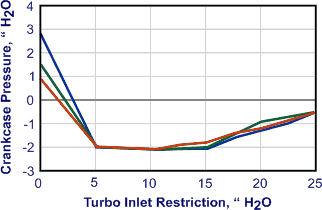
Filter pressure drop drives crankcase pressure negative. This causes oil to fall back to the oil pan easily which keeps oil out of the blow-by gas flowing into the PCV system. This also reduces the elastic collisions between molecules which prevents large oil droplets from forming. This is how you can use the engine as a vacuum pump to scavenge blow-by gas out of the engine through a factory separator without bringing oil along with it. This is how factory Turbocharged engines do PCV, all of them. I have received 2jz-gte engines from Japan with over 200,000 miles that look brand new inside because of this feature. It is how I know from inspecting a thousand engines imported the importance of PCV- engines with disturbed PCV systems and aftermarket filters can get pretty nasty inside and full of debris etc... i.e. if you are selecting an engine for any project the ideal engine is the one with the least modifications despite high mileage.
Filter pressure drop drives crankcase pressure negative. This causes oil to fall back to the oil pan easily which keeps oil out of the blow-by gas flowing into the PCV system. This also reduces the elastic collisions between molecules which prevents large oil droplets from forming. This is how you can use the engine as a vacuum pump to scavenge blow-by gas out of the engine through a factory separator without bringing oil along with it. This is how factory Turbocharged engines do PCV, all of them. I have received 2jz-gte engines from Japan with over 200,000 miles that look brand new inside because of this feature. It is how I know from inspecting a thousand engines imported the importance of PCV- engines with disturbed PCV systems and aftermarket filters can get pretty nasty inside and full of debris etc... i.e. if you are selecting an engine for any project the ideal engine is the one with the least modifications despite high mileage.
Thread Starter
Racer
Joined: Mar 2022
Posts: 398
Likes: 33
I've looked into mechanical vacuum pumps, they are belt driven, that is not an option with my 8rib blower belt in the way.
I've looked into electric vacuum pumps, my concern with those is that at wide open throttle and under boost, they will not be able to keep up and then actually become worse than a vented to atmosphere setup.
Im not suggesting a can is perfect, but I am trying to minimize the oil in the intake.
So you are saying that soaking the intake, head ports, and god knows what else, does not affect fuel quality or octane? Of course the combustion chamber is clean, that oil is burning. Albeit, possibly knocking because the octane is lower.
I've looked into electric vacuum pumps, my concern with those is that at wide open throttle and under boost, they will not be able to keep up and then actually become worse than a vented to atmosphere setup.
Im not suggesting a can is perfect, but I am trying to minimize the oil in the intake.
So you are saying that soaking the intake, head ports, and god knows what else, does not affect fuel quality or octane? Of course the combustion chamber is clean, that oil is burning. Albeit, possibly knocking because the octane is lower.
Safety Car
Joined: Oct 2007
Posts: 4,222
Likes: 1,080
From: South Florida
I've looked into mechanical vacuum pumps, they are belt driven, that is not an option with my 8rib blower belt in the way.
I've looked into electric vacuum pumps, my concern with those is that at wide open throttle and under boost, they will not be able to keep up and then actually become worse than a vented to atmosphere setup.
Im not suggesting a can is perfect, but I am trying to minimize the oil in the intake.
So you are saying that soaking the intake, head ports, and god knows what else, does not affect fuel quality or octane? Of course the combustion chamber is clean, that oil is burning. Albeit, possibly knocking because the octane is lower.
I've looked into electric vacuum pumps, my concern with those is that at wide open throttle and under boost, they will not be able to keep up and then actually become worse than a vented to atmosphere setup.
Im not suggesting a can is perfect, but I am trying to minimize the oil in the intake.
So you are saying that soaking the intake, head ports, and god knows what else, does not affect fuel quality or octane? Of course the combustion chamber is clean, that oil is burning. Albeit, possibly knocking because the octane is lower.
I'm saying that I've successfully tuned turbo engines over 25 years perhaps around a thousand of them using the same OEM PCV system (its not my invention) and by setting/measuring properly I've done to 1/2zz, 3sgte, VR6, sbc, LSx, 2jz, sr20det, rb25/6det(t), etc... myriad engines at 2x 3x 4x factory output, mostly factory bottom ends with high mileage in fact, and have had absolutely no issues with any of them, ever, when they are setup properly. I've come to customer cars that had cans smoking and seals leaking and ripped the cans off restored the PCV system to factory style and cured the smoking and leaking.
I'm saying I built two demonstration vehicles one with 2.5L forged piston large gap on alcohol and one with a factory 240,000 miles piece of junk LM7 600rwhp and use these vehicles to demonstrate the correct way to do PCV and tune an engine for reliability. I'm saying I specialize in reliability and longevity and I assure you the factory knows exactly what it is doing and if you can copy the factory methods exactly in terms of setting up and pressure it will be more than adequate on gasoline or alcohol fuels for the majority of daily driver applications and street/strip in terms of longevity and reliability.
I am *not* saying these methods will always work in every racing events, extreme situations, which require more than a simple Factory PCV system setting up. Those applications must be taken one-off positions for example on the RB use a drain on the back of the head to prevent oil pooling, Honda S2k apps for road racing drill holes in the baffle system under the covers for drainage. Some engines are positioned oddly in swap vehicles which causes weird oil related problems and so forth. There are always one-off examples. But if you have a factory engine position in original vehicle and not intent to extreme racing events the OEM PCV is generally well tested (the dry sump system from Chevrolet is indeed put through rigorous testing I would imagine) for what you are doing.
I *am* also saying that your eyes cannot tell you anything about the fuel quality and presence of oil with respect to combustion. There is oil coming from the rings and cylinder walls that has nothing to do with the intake system for example. You do not know how much is going up and what you are doing to the boundary layer of gas on the cylinder walls. For example people love to spray alcohol around 280 degrees before top dead center compression for kinetic energy performance bonus- a strong spray into open intake valve of alcohol rapidly washing the oil down the back of the cylinder wall mixing with oil and those engines run absolutely fine and experience excessive cylinder wall and ring-wear. Those people attribute the wear to the fuel they use and do not understand that the tune is the problem. This issue of PCV, OIL, OCTANE, FUELING the engine is far more complex than simply catching the oil between crankcase and intake system.