When you click on links to various merchants on this site and make a purchase, this can result in this site earning a commission. Affiliate programs and affiliations include, but are not limited to, the eBay Partner Network.
As a scientist I would say convince yourself by comparing catch system vs no catching. Empirical testing...
A catching system is a problem because of its energy requirement. At first glance we can compensate by measuring and setting the crankcase pressure back to factory spec.
In other words, by adjusting the air filter pressure drop and using a restrictor on the fresh air vent to generate a vacuum signal in the crankcase at idle/cruise it can make up for the friction of the catch system at the cost of %hp (3 to 8%HP depending on friction)
However can volume will kill PCV response time because crankcase volume is directly related to response of a pressure signal, not good on the wot side. On the intake suction side it won't matter much though I would think.
That is a roadblock to empirical investigation because even if we set the pressure equal,the rate of pressure cannot be adjusted to be equal due to volume difference of crankcase.
Another problem I noticed in LSx application is the intake manifold tends to act as an oil sponge/reservoir. At least the factory manifolds seem to. I have tried soaking the intake in degreaser and excessive washing to visually clean inspection- only to find oil leaking down into cylinder #1 from the factory PCV hose of the previous owner ( a hose which is no longer present during my testing so it is impossible for oil to come from my test engine ).
In other words, you perform test one way, and the manifold collects oil that you cannot effectively remove. On the second test, some of that oil will become part of your second test even though it came from the first test.
The way around this is to install a fresh new intake manifold for each test before the mileage and visual inspection of intake ports.
In my case I simply inspect the pcv hoses. The hose is a 'catch can' which may collect oil, residue carbon, deposits, etc... Any sign of deposits, oil, or burning smell, is something wrong with the PCV system. My PCV hoses are always clean, smell clean, no oil residue, no carbon deposits. I would say if you connect the pcv system properly like factory, set the pressure properly, you can do the same, simply check the hose for oil, smell, deposits, etc... they will be clean and clear when pcv is done proper.
What's the thought on using a McMaster check valve instead of a supra pcv valve? I think they are good to 300psi.
I still think it would be a good idea to keep a catch can between the valley and intake manifold though. Do you think that would hinder vacuum too much?
What's the thought on using a McMaster check valve instead of a supra pcv valve? I think they are good to 300psi.
I still think it would be a good idea to keep a catch can between the valley and intake manifold though. Do you think that would hinder vacuum too much?
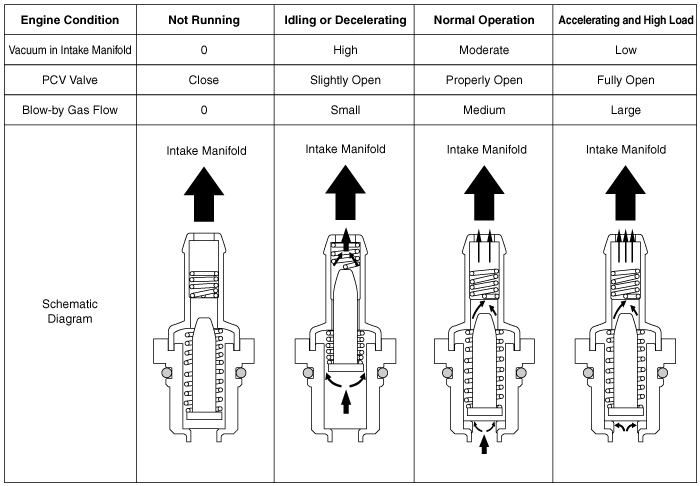
A PCV valve is not just a check valve. It is a flow orifice which also changes flow with pressure differential.
The flow rate must exceed the rate of blow-by at all intake vacuum signal condition. Engines with more blow-by need larger orifices to control crankcase pressure. That is why they make PCV valves like this https://mewagner.com/?p=444
You can use whatever PCV valve you want as long as
1. It provides necessary flow rate to maintain crankcase pressure target (1" to 3"Hg) under normal driving conditions
2. It adequately seals up during pressure testing *must be tested*
3. It's flow rate has been properly balanced by the fresh air intake source orifice
Here is an example of a factory fresh air orifice
By controlling the orifice size leading from the fresh air into the crankcase, AND by controlling the orifice size leading from the intake manifold to PCV valve (restrictor in the valley cover or valve cover for example) and by controlling the orifice of the PCV valve (by adjusting the pcv valve or changing the number of pcv valves) One can control the crankcase pressure directly balancing blow-by gas with crankcase evacuation clearing rate.
I still think it would be a good idea to keep a catch can between the valley and intake manifold though.
The intake manifold only flows from the crankcase during idle/cruise.
At idle/cruise there is minimum blow-by. In other words there is very little if any oil splashing, whipping, hurricane in the crankcase. Minimum combustion gas products. There is very little blow-by at idle. At idle speeds and low engine speeds oil will not blow out of the engine or be forced into the passages and baffles systems.
Imagine the engine is at idle and oil is gushing out of it. That is a massive problem, the engine has some broken pistons.
Imagine any other way to cause oil to blow out of an engine at resting, idle or while cruising. It is impossible unless the engine is damaged.
My question would be, why is oil leaving your engine at idle speed? That is, while the engine is sitting basically off in the driveway, and oil is gushing out of the valley cover. How is that happening? why does that happen to people? Is the engine really blowing oil out while sitting there at rest in the driveway?
How it really happens on valley cover engines with or without pcv valves is:
-At wide open throttle the crankcase pressure is controlled by the air filter pressure drop. If this is not properly configured crankcase pressure rises over atmospheric and blows oil into the pcv valve (or restrictor) orifice which leads to the intake manifold.
Once you realize the engine is blowing oil around at WOT you can center your mind to this discussion proper.
At wide open throttle people do not measure their crankcase pressure this leads to oil blowing out of the engine.
It will not happen by idle speeds and cruising around. There is very little blow-by (pressure and flow from blow-by) and very little whipping/hurricane at low rpm that oil will not be blown out of the engine from just sitting at rest somewhere.
In a boost application the PCV Valve will shut this avenue so even at wide open throttle even if the crankcase pressure rises because you failed to measure it and set it properly, unlike N/A apps the pcv valve will not flow oil into the intake manifold (assuming you pressure tested it properly).
--> Next lets discuss why you wouldn't want a can there for other reasons .
We place some volume between the intake manifold and crankcase. They are separated by a orifice restrictor and a PCV valve orifice (either or both).
At idle/cruise there is plenty of kinetic energy to drive PCV using intake suction (plenty of intake vacuum to spare unlike WOT).
1. The first problem we notice is the recovery time transition from WOT to CRUISE. Because of the added can volume the rate of crankcase vacuum change is going to be reduced, it will pull vacuum more slowly. Its like having a larger tire and taking longer to fill or drain that tire of air, now you have these added time constants where the crankcase is spending more time at higher pressure because of the added can volume (added tire volume when trying to change the tire pressure).
2. The second problem is during shut-down the can volume will be full of water and CO2 and carbon combustion products. For every gallon of gasoline burnt will produce around 1 gallon of water, blow-by gas is full of water gas state. Hot, high velocity water molecules, which now slowing down and condense inside the catch can volume as they cool. The can volume is causing a pressure change and temperature change to the blow-by gas which is allowing water to form liquid state droplets which collect and dissolve blow-by gas. In other words, you start collecting water and the water starts to collect blow-by gas dissolved in the presence of carbonic acids and carbon products which are then heat cycled in the presence of water and carbon (crude soup products) forming myriad products. My question at this point would be- why did you do that? Why did you attach an external cooling reservoir that will catch acidic water mixing with oil and carbon products in the presence of heat cycling and pressure changes- then suck that back into the engine later over time? Who thinks that is a good idea? Its absolutely crazy when I type it to think people do this to their engines.
Here is what you really want (OEM high mileage setup)
Blow-by gas with fresh water and fresh carbon blow-by products (hot, recent, high velocity gas state, was just ripped out of the crankcase by strong low pressure signal),
rapidly returned at high velocity (short, direct, small volume OEM size tube) to the intake manifold where it can be pulled into a cylinder before it can condense or form deposits and dissolve blow-by gas. By rapidly moving the high velocity, hot gas, it will help clean the intake manifold and valves of carbon instead of forming deposits. High velocity hot-water with hot-gasoline vapors is a cleaning agent and came directly from the combustion chamber where it is quickly returned before it can cool and collect as liquid and deposits.
Do you paint the picture now in your mind, ? The idle engine, at rest, gushing oil, how ridiculous? Hot fast moving water in the presence of dissolved gas? Hot, high velocity carbon rich water vapors, you can rapidly direct them for cleaning action.
A PCV valve is not just a check valve. It is a flow orifice which also changes flow with pressure differential.
The flow rate must exceed the rate of blow-by at all intake vacuum signal condition. Engines with more blow-by need larger orifices to control crankcase pressure. That is why they make PCV valves like this https://mewagner.com/?p=444
So does the Supra valve change flow rates based on pressure differential? If not, it would be the same as a check valve, but likely does not seal up to 300psi like the McMaster does. Correct?
In the oem system, there is no pcv valve between the valley cover and intake manifold, so the sole purpose of me adding a valve there is to prevent the boost pressure from the added supercharger. So since there was not one there from the factory, and all I need it to do is prevent boost from entering crankcase, then a check valve should be sufficient, correct?
The McMaster check valve is easier to integrate too, since you can get them in different sizes with barbs on each end, versus trying to integrate the supra valve which looks like I would need some grommet to make it work.
With a motor setup for boost, meaning larger gap on the piston rings, there is some crankcase pressure at idle, especially when cold or not fully warmed up before the rings expand to eliminate the gap. I can literally feel this on a motor I have now that is vented to atmosphere through an air oil separator. I can feel the air being pushed out at idle. And I know its a healthy motor with only about 30k miles and good compression.
I'm just trying to have the best setup I can on my fairly expensive Dart 427.
You have to do that no matter what check valve or pcv valve you use. You can't stick a random flowing check valve without measuring with a vacuum gauge and adjusting. You might need 3 check valves in parallel to make the kind of flow necessary to drive complete evacuation. If you do not follow the instructions to use vacuum gauge for setting crankcase pressure, it may not perform properly and will do the thing you hate start drinking oil. Do you start to see why people are drinking oil and adding catch cans? You can't get around the vacuum measurement and just select random check valves & orifices and then complain it doesn't work. You didn't do the work.
That looks easy enough to set. I think I will keep the catch can between the valley cover and intake manifold and then get that dual flow valve and set it properly with the catch can in place. Is there a way to do any testing on the other side of things for wide open throttle? That would seem to be more difficult with no easy port to hook a gauge up to.
You have to do that no matter what check valve or pcv valve you use. You can't stick a random flowing check valve without measuring with a vacuum gauge and adjusting. You might need 3 check valves in parallel to make the kind of flow necessary to drive complete evacuation. If you do not follow the instructions to use vacuum gauge for setting crankcase pressure, it may not perform properly and will do the thing you hate start drinking oil. Do you start to see why people are drinking oil and adding catch cans? You can't get around the vacuum measurement and just select random check valves & orifices and then complain it doesn't work. You didn't do the work.
If I'm understanding your post correctly, are you saying the GM engineers that did the OEM LS7 PVC system are idiots? Because I tried the newest valley cover GM made when I built my LS7. Used the GM LS7 valley cover, and PCV valve setup. Hooked the molded hose to the TB, and there was still enough oil in my intake within 3,000 miles to cause a temporary shortage at the refineries!!!
If I'm understanding your post correctly, are you saying the GM engineers that did the OEM LS7 PVC system are idiots? Because I tried the newest valley cover GM made when I built my LS7. Used the GM LS7 valley cover, and PCV valve setup. Hooked the molded hose to the TB, and there was still enough oil in my intake within 3,000 miles to cause a temporary shortage at the refineries!!!
I just spent over 30 min on the phone with MEWagner. They say the oem LS setup is very inefficient. I also know my 5.3L LS in my 2009 silverado with 100% oem pcv setup has black oil after 1500 miles. My ls7 (before breaking a piston) had black oil after 1500 miles with oem routing of pcv. Yet my boxer engine on ethanol with 30psi of boost and vented to atmosphere has golden clean oil after 2500 miles. I may not be a scientist or engineer, but i do have a degree in finance and math. Oh and I also have a sample size of 3 here that's tough to argue with. I'm more lost now than when I started this thread. Lol
If you're looking for a check valve that has almost
zero pressure drop, check out the ones from Elite Engineering. They don't have an internal spring that requires significant pressure to overcome, instead they have a Teflon ball inside that effectively seals when flow tries to reverse. They aren't cheap but worth it in my opinion. I have 2 on my set up. If you're wondering what is mounted to the intake, it is an Elite Venturi that creates suction at WOT to evacuate the crack case. The catch can has 1 intake (valley cover) and 2 outlets, 1 outlet goes to intake ( thru check valve 1) to the throttle body which has vacuum at idle and Cruise, and the other outlet goes to the Venturi (thru check valve 2) which creates vacuum at WOT.
Last edited by robert.m.kalis; Feb 22, 2024 at 07:53 AM.
If I'm understanding your post correctly, are you saying the GM engineers that did the OEM LS7 PVC system are idiots? Because I tried the newest valley cover GM made when I built my LS7. Used the GM LS7 valley cover, and PCV valve setup. Hooked the molded hose to the TB, and there was still enough oil in my intake within 3,000 miles to cause a temporary shortage at the refineries!!!
No I am saying you need to measure. This entire thread is about measuring something that nobody ever measures. The key to collecting data and making improvements is measurement. Randomly adding parts or buying parts that make the issue worse and mask it by collecting the fallout that you can see isn't fixing anything. It is just making the issue worse internally to the engine.
I can't believe how hard it is to get people to realize they have to check their tire pressure. You would think its obvious but
It doesn't matter what car or parts you buy; if you do not measure the tire pressure, something bad will happen. If you do not measure the fuel pressure, something bad will happen. You "built" an engine, or changed a part, like a tire or fuel injectors or an intake manifold or head work or whatever. The parts do not set the crankcase pressure for you, that is YOUR job. You never did your job so the engine consumes oil. The part does nothing to help your situation; only your actually measurement and setting the pressure yourself is what can save the engine.
They say the oem LS setup is very inefficient.
Everyone says that. But there is never any data or proof. 24 years of LS engines and I've never seen a chart or diagram comparing oil ingestion or crankcase cleanliness with PCV configurations. It is something people say with no idea or data to back up, a copy and paste that can be used to sell you things.
I would ask you this instead, how many completely OEM 5.3L Fleet engines make it to 350,000 miles with just maintenance? The number is statistically significant if you are looking for a sample group with 999999 examples. Around 99.6% of fleet trucks will reach 350,000 miles assuming no accidents and that includes mistakes made during maintenance and filthy maintenance issues (dirty hands on engine parts = catastrophic failure). The engine is designed for high mileage, like a Corolla engine or Supra engine. The design and PCV are entirely similar across all manufacturers because this is the only right way to do these things using engine as a pump.
All engines have a catch can. The wet sump design is a catch can. The dry sump has an external reservoir which is a catch can. Look at how the wet sump and dry sump hold and handle the oil. That is the ideal catch can.
Wet sump has oil in the oil pan and inlet/outlet near the top in wet sump. And dry sump uses an external reservoir- a catch can itself. All engines could use a catch can- a dry sump- because that is a great way to control oil and help control crankcase pressure. Notice the successful qualities of a catch can (Dry sump external reservoir), oil is never stagnant, oil is part of the main supply, it cannot be overfilled with oil during operation due to 'catching oil' (doing its job doesn't overfill it), filling it doesn't empty the engine oil supply, and A powerful pumping system maintains oil pressure and evacuation.
What you are really doing is adding external catch cans onto an existing catch can. This will take a portion of energy from the fluids which needs to come from somewhere. You must correctly measure and set the crankcase pressure; however the consequences of freeing up that extra energy could reveal the inherent flaw with adding external catch cans if you are measuring it properly. But nobody is measuring it.
IF you put some new tires or a new fuel system or a new turbo or whatever on a vehicle and you do not measure the boost, fuel, tire pressure, etc... what do you expect will happen?
I've been using OEM PCV on my 5.3L since 2018 over 65,000 miles 600rwhp gasoline and its been clean and perfection for me. I also measured and set my crankcase pressure properly. Even completely OEM vehicles may have some pressure leaking or cracked old hose or something if you do not measure and pressure test the system you would think the PCV system is not working properly. But whose fault is that
Last edited by Kingtal0n; Feb 22, 2024 at 08:15 AM.
I just spent over 30 min on the phone with MEWagner. They say the oem LS setup is very inefficient. I also know my 5.3L LS in my 2009 silverado with 100% oem pcv setup has black oil after 1500 miles. My ls7 (before breaking a piston) had black oil after 1500 miles with oem routing of pcv. Yet my boxer engine on ethanol with 30psi of boost and vented to atmosphere has golden clean oil after 2500 miles. I may not be a scientist or engineer, but i do have a degree in finance and math. Oh and I also have a sample size of 3 here that's tough to argue with. I'm more lost now than when I started this thread. Lol
If you're venting to atmosphere, which I also do after my OEM PCV turned my intake into an oil storage tank, you shouldn't have any oil in the intake. I just wanted Talon to comment on what he thought of the GM engineers who designed the PCV system......
No I am saying you need to measure. This entire thread is about measuring something that nobody ever measures. The key to collecting data and making improvements is measurement. Randomly adding parts or buying parts that make the issue worse and mask it by collecting the fallout that you can see isn't fixing anything. It is just making the issue worse internally to the engine.
I can't believe how hard it is to get people to realize they have to check their tire pressure. You would think its obvious but
It doesn't matter what car or parts you buy; if you do not measure the tire pressure, something bad will happen. If you do not measure the fuel pressure, something bad will happen. You "built" an engine, or changed a part, like a tire or fuel injectors or an intake manifold or head work or whatever. The parts do not set the crankcase pressure for you, that is YOUR job. You never did your job so the engine consumes oil. The part does nothing to help your situation; only your actually measurement and setting the pressure yourself is what can save the engine.
Everyone says that. But there is never any data or proof. 24 years of LS engines and I've never seen a chart or diagram comparing oil ingestion or crankcase cleanliness with PCV configurations. It is something people say with no idea or data to back up, a copy and paste that can be used to sell you things.
I would ask you this instead, how many completely OEM 5.3L Fleet engines make it to 350,000 miles with just maintenance? The number is statistically significant if you are looking for a sample group with 999999 examples. Around 99.6% of fleet trucks will reach 350,000 miles assuming no accidents and that includes mistakes made during maintenance and filthy maintenance issues (dirty hands on engine parts = catastrophic failure). The engine is designed for high mileage, like a Corolla engine or Supra engine. The design and PCV are entirely similar across all manufacturers because this is the only right way to do these things using engine as a pump.
All engines have a catch can. The wet sump design is a catch can. The dry sump has an external reservoir which is a catch can. Look at how the wet sump and dry sump hold and handle the oil. That is the ideal catch can.
Wet sump has oil in the oil pan and inlet/outlet near the top in wet sump. And dry sump uses an external reservoir- a catch can itself. All engines could use a catch can- a dry sump- because that is a great way to control oil and help control crankcase pressure. Notice the successful qualities of a catch can (Dry sump external reservoir), oil is never stagnant, oil is part of the main supply, it cannot be overfilled with oil during operation due to 'catching oil' (doing its job doesn't overfill it), filling it doesn't empty the engine oil supply, and A powerful pumping system maintains oil pressure and evacuation.
What you are really doing is adding external catch cans onto an existing catch can. This will take a portion of energy from the fluids which needs to come from somewhere. If you correctly measure and set the crankcase pressure it doesn't matter how many catch cans you add; however the consequences of freeing up that extra energy could reveal the inherent flaw with adding external catch cans if you are measuring it properly. But nobody is measuring it.
IF you put some new tires or a new fuel system or a new turbo or whatever on a vehicle and you do not measure the boost, fuel, tire pressure, etc... what do you expect will happen?
I've been using OEM PCV on my 5.3L since 2018 over 65,000 miles 600rwhp gasoline and its been clean and perfection for me. I also measured and set my crankcase pressure properly. Even completely OEM vehicles may have some pressure leaking or cracked old hose or something if you do not measure and pressure test the system you would think the PCV system is not working properly. But whose fault is that
If the GM engineers who designed the PCV system did even an average job of engineering the PCV system, nobody should have to measure anything. I really like my LS7. But I'll also say that some people who originally deaigned this engine, as well as some of the bean counters who partially handcuffed some of the engineers, and vendors who machined parts (Linamar) would lose their jobs/contracts if I would've been in charge of this program. This engine has issues of a magnitude that no previous GM engine has ever had. Its pretty sad that they couldn't even get the PCV system done correctly. The PCV system on all the Gen III and Gen IV LS engines suck, literally....
No I am saying you need to measure. This entire thread is about measuring something that nobody ever measures. The key to collecting data and making improvements is measurement. Randomly adding parts or buying parts that make the issue worse and mask it by collecting the fallout that you can see isn't fixing anything. It is just making the issue worse internally to the engine.
I can't believe how hard it is to get people to realize they have to check their tire pressure. You would think its obvious but
It doesn't matter what car or parts you buy; if you do not measure the tire pressure, something bad will happen. If you do not measure the fuel pressure, something bad will happen. You "built" an engine, or changed a part, like a tire or fuel injectors or an intake manifold or head work or whatever. The parts do not set the crankcase pressure for you, that is YOUR job. You never did your job so the engine consumes oil. The part does nothing to help your situation; only your actually measurement and setting the pressure yourself is what can save the engine.
Everyone says that. But there is never any data or proof. 24 years of LS engines and I've never seen a chart or diagram comparing oil ingestion or crankcase cleanliness with PCV configurations. It is something people say with no idea or data to back up, a copy and paste that can be used to sell you things.
I would ask you this instead, how many completely OEM 5.3L Fleet engines make it to 350,000 miles with just maintenance? The number is statistically significant if you are looking for a sample group with 999999 examples. Around 99.6% of fleet trucks will reach 350,000 miles assuming no accidents and that includes mistakes made during maintenance and filthy maintenance issues (dirty hands on engine parts = catastrophic failure). The engine is designed for high mileage, like a Corolla engine or Supra engine. The design and PCV are entirely similar across all manufacturers because this is the only right way to do these things using engine as a pump.
All engines have a catch can. The wet sump design is a catch can. The dry sump has an external reservoir which is a catch can. Look at how the wet sump and dry sump hold and handle the oil. That is the ideal catch can.
Wet sump has oil in the oil pan and inlet/outlet near the top in wet sump. And dry sump uses an external reservoir- a catch can itself. All engines could use a catch can- a dry sump- because that is a great way to control oil and help control crankcase pressure. Notice the successful qualities of a catch can (Dry sump external reservoir), oil is never stagnant, oil is part of the main supply, it cannot be overfilled with oil during operation due to 'catching oil' (doing its job doesn't overfill it), filling it doesn't empty the engine oil supply, and A powerful pumping system maintains oil pressure and evacuation.
What you are really doing is adding external catch cans onto an existing catch can. This will take a portion of energy from the fluids which needs to come from somewhere. You must correctly measure and set the crankcase pressure; however the consequences of freeing up that extra energy could reveal the inherent flaw with adding external catch cans if you are measuring it properly. But nobody is measuring it.
IF you put some new tires or a new fuel system or a new turbo or whatever on a vehicle and you do not measure the boost, fuel, tire pressure, etc... what do you expect will happen?
I've been using OEM PCV on my 5.3L since 2018 over 65,000 miles 600rwhp gasoline and its been clean and perfection for me. I also measured and set my crankcase pressure properly. Even completely OEM vehicles may have some pressure leaking or cracked old hose or something if you do not measure and pressure test the system you would think the PCV system is not working properly. But whose fault is that
I certainly appreciate all your input here and am learning along the way, just know I'm reading and considering it all. But, the more people I talk to, the more variety comes into what a proper solution is and at the end of the day, I have to decide what is best for me. MEWagner does agree that vacuum is important but contradicts in other areas. Like they say a fresh air source is important, which in my case at WOT using the OEM setup, the check valve would prevent the fresh air due to not wanting to boost the crankcase (see image below). They also say larger lines are a good idea and also initially recommended some type of air oil separator. Our discussions are not done, so maybe that will change, but I'm working with them as well as taking in all I can online to find the best solution for me. But, one thing I can tell you is that my 5.3L in my truck has had about the easiest life possible. It's maintained often, always garaged, never sits in the sun, and I keep records of everything I do to it. It even got the recall done which was a new valve cover with updated PCV baffling. Hell, my windshield wipers last over 10 years, that is how little use it gets and I am always up on maintenance. So given that, the oil is still black after 1500 miles is certainly odd. Then couple that with the same from my LS7 before it let go. Further, I have a 30psi boosted car vented to atmosphere through an air oil separator and the oil stays very clean, ON ETHANOL of all fuels too. Tough for me to all of a sudden go against that experience.
Oh and MEWagner has done a lot of testing so insinuating they have not isn't true, especially since you referenced them in your post earlier. And comparing a 1000whp engine to some fleet vehicles is kind of odd, dont you think? I bet I could block off the pcv system on fleet vehicles and they would last 300k miles with regular oil changes, come on man.
If you're looking for a check valve that has almost
zero pressure drop, check out the ones from Elite Engineering. They don't have an internal spring that requires significant pressure to overcome, instead they have a Teflon ball inside that effectively seals when flow tries to reverse. They aren't cheap but worth it in my opinion. I have 2 on my set up. If you're wondering what is mounted to the intake, it is an Elite Venturi that creates suction at WOT to evacuate the crack case. The catch can has 1 intake (valley cover) and 2 outlets, 1 outlet goes to intake ( thru check valve 1) to the throttle body which has vacuum at idle and Cruise, and the other outlet goes to the Venturi (thru check valve 2) which creates vacuum at WOT.
No, the only modification to the system (dry sump LS3) is the removal of the small hose from the valley cover to the throttle body. The additions are Elite E2 dual port catch can, Elite Venturi, 2 Elite check valves and 3/8 tubing
I was coached on this set up by an engineer from Elite.
This is what I have settled on to start with, a pair of Motion Race works valve covers with 10AN ports into their 2 port catch can then run to the exhaust through the Moroso weld in bungs for some venturi effect. I will try and measure the vacuum at idle and wide open to see what this does. I just don't think the OEM valve covers have large enough orifices to handle the boost. I can switch it up later if I need to. Hopefully no mess in the intake, no chance of a check valve failing and boost pressure going straight to crankcase, and hopefully some decent vacuum at all times.