










DCT Filter Access Door

Race Director

Joined: Aug 2019
Posts: 12,351
Likes: 14,184
From: Central Illinois


Racer


Joined: Apr 2024
Posts: 353
Likes: 180
From: Michigan
I hate that the lock is "backwards" IMO. Lock shouldn't be parallel to the side and open perpendicular. I removed the nut on the back and rotated the brass piece 90* so mine now operates as one would expect.

Intermediate
Joined: Jan 2025
Posts: 34
Likes: 32
these are my thoughts, I’m not automotive an engineer.
Corvette Stories
The Best of Corvette for Corvette Enthusiasts

Top 10 Most Expensive Corvettes Ever Sold on Bring A Trailer
Brett Foote
10 Things Every Corvette Owner Needs (2026 Edition)
Michael S. Palmer
8 Most "Only Corvette Owners Understand" Quirks and Problems
Pouria Savadkouei
10 Reasons the C6 Z06 is Still A Performance Benchmark After 20 Years
Joe Kucinski
How Much Horsepower Every Corvette Engine "LOST" in 1972
Joe Kucinski
Top 10 DOs and DON'Ts for Protecting Your Convertible Top!
Michael S. Palmer
Top 10 Most Explosive Corvettes Ever Made: Power-to-Weight Ratio Ranked!
Joe Kucinski
150 hp to 1,250 hp: Every Corvette Generation Compared by the Specs That Matter
Joe Kucinski
8 Coolest Corvette Pace Cars (and Replicas) of All Time
Verdad Gallardo
Instructor
Joined: Feb 2021
Posts: 230
Likes: 206
From: Port St. Lucie, FL
2026 Corvette of the Year Finalist - Unmodified
2025 C8 Stingray of the Year Winner - Unmodified
Then why didn't general motors make an access door or at least the hole to access the filter?
Intermediate
Joined: Jan 2025
Posts: 34
Likes: 32
Thought 1. I don’t think they want the average Bubba Handy Dandy servicing the filter at home. Between the soft aluminum threads, single use screws that new to be guided, very particular and light torque spec, and the difficulty removing the cap where it is very tempting to use a pry tool. Irreversible damage is pretty easy during the service. Engine oil filter was left exposed due to the frequency and ease of removal(bare hand)
Thought 2. It could also be that when the plate was designed, the DCT service intervals had not yet been fully discovered in testing. Later to find out that the service was a big revenue generator for the dealer network, that most owners don’t mind paying for. Therefore not justifying to expense to modify the design.


Race Director

Joined: Aug 2016
Posts: 12,790
Likes: 10,218
From: Garden Valley CA
The loss in stiffness could be calculated but it would likely require computational analysis because of the complex shape and you would need to know where/how the loads are applied/transmitted. I suspect the structural analysts would have prefered not had the oil filter hole there but lost to practicality. Putting a larger rectangular hole adjacent to the existing oil filter hole was probably a bit too much.

Intermediate
Joined: Jan 2025
Posts: 34
Likes: 32
It is structural, GM calls it a shear plate. Whether or not you could actually tell the difference on the track is debatable but every little bit helps. The other concern would be if cracks start developing at the corners of the hole.
The loss in stiffness could be calculated but it would likely require computational analysis because of the complex shape and you would need to know where/how the loads are applied/transmitted. I suspect the structural analysts would have prefered not had the oil filter hole there but lost to practicality. Putting a larger rectangular hole adjacent to the existing oil filter hole was probably a bit too much.
The loss in stiffness could be calculated but it would likely require computational analysis because of the complex shape and you would need to know where/how the loads are applied/transmitted. I suspect the structural analysts would have prefered not had the oil filter hole there but lost to practicality. Putting a larger rectangular hole adjacent to the existing oil filter hole was probably a bit too much.
I wonder if something like the X-brace would repair, and improve upon the loss in lateral rigidity… even though it’s in another location?
Race Director
Joined: Aug 2016
Posts: 12,790
Likes: 10,218
From: Garden Valley CA
not that I would reverse this modification, AI says 10-20% of rigidity COULD be lost from the hole, with 50-70% of that restored by the door. I’ll assume 10% total loss, of this panel. For spirited back road driving at perhaps 50% of the cars limits (that’s probably exaggerated for most drivers, including my own skill levels) I’m comfortable with that loss. Top class track days or racers may be weary of that loss in strength.
I wonder if something like the X-brace would repair, and improve upon the loss in lateral rigidity… even though it’s in another location?
I wonder if something like the X-brace would repair, and improve upon the loss in lateral rigidity… even though it’s in another location?

Racer


Joined: Mar 2014
Posts: 262
Likes: 223
From: Huntsville, Alabama
The door frame is made of stainless steel and is very ridged and has 8 rivets. I’m not concerned with any possible loss of structural stability and I’ll watch for cracked. The bottom plate is mainly to protect the underside of the motor and transmission.
if you needed a solid plat the braces above the motor would be a solid plate.
if you needed a solid plat the braces above the motor would be a solid plate.

Race Director


Joined: Mar 2007
Posts: 11,395
Likes: 8,558
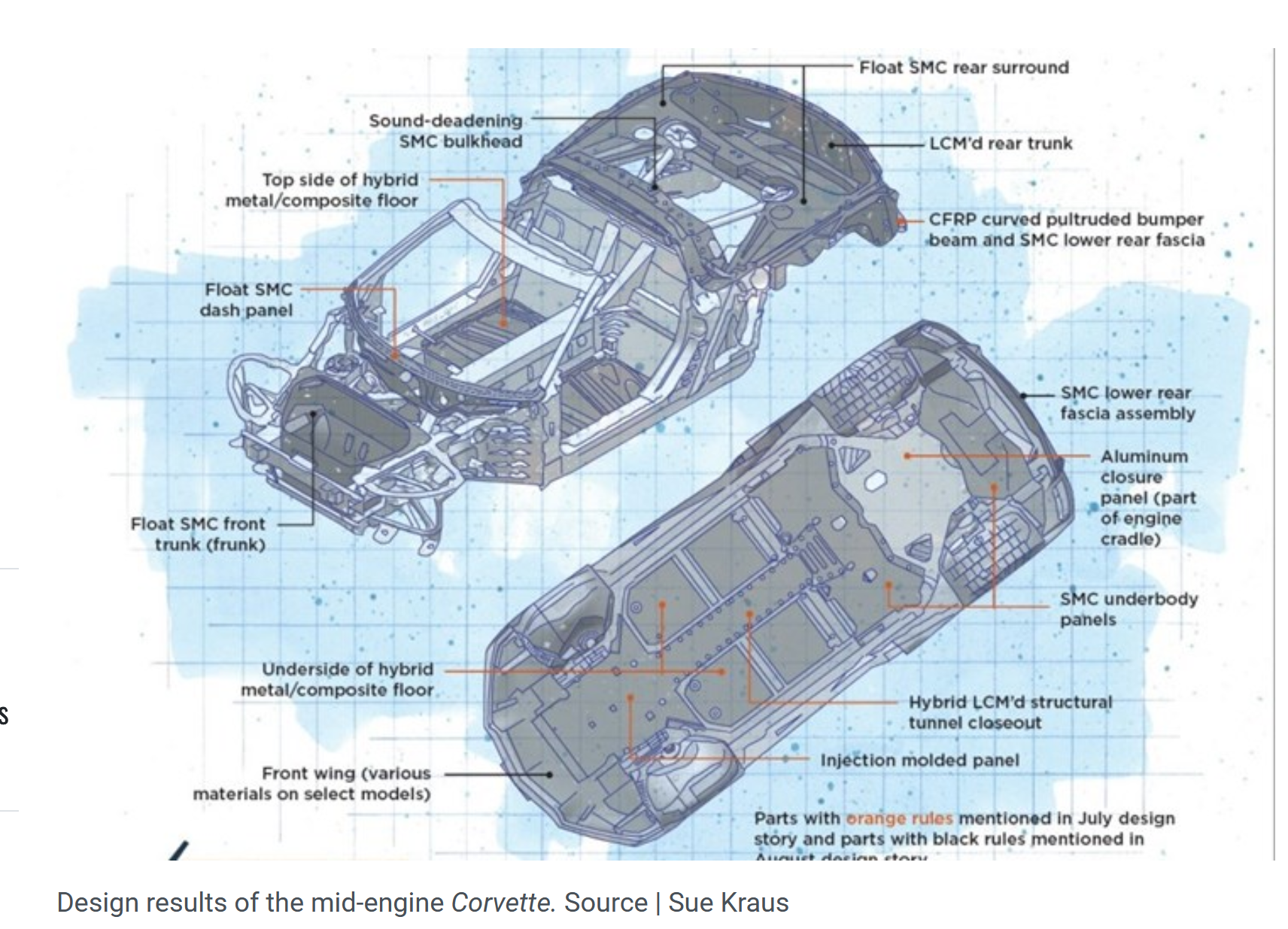
Is there any evidence from GM that the plate being discussed is structural. It could be. I see articles about the center tunnel cover, which is s composite material, being structural. Is there similar information about the other undercarriage plates?
In any case, those plates are fastened to the frame. And the frame will flex. So, those plates, if tightened down properly will be subject to the frame flex and will have an impact on that flexing, perhaps reducing. Is there any info about that from GM or an automotive magazine?
The info about the tunnel cover appeared in an article about composite materials used in the C8. The attached illustration is from "Composite-intensive materwork: 2020 Corvette, Part 1" by CVS Composites World, dated 6/23/2020.
https://www.compositesworld.com/arti...orvette-part-1
It identifies the tunnel cover, which is composite, as structural and discusses it. The aluminum panels could be structural too, but they are not composite, so they are not discussed in detail.
In any case, those plates are fastened to the frame. And the frame will flex. So, those plates, if tightened down properly will be subject to the frame flex and will have an impact on that flexing, perhaps reducing. Is there any info about that from GM or an automotive magazine?
The info about the tunnel cover appeared in an article about composite materials used in the C8. The attached illustration is from "Composite-intensive materwork: 2020 Corvette, Part 1" by CVS Composites World, dated 6/23/2020.
https://www.compositesworld.com/arti...orvette-part-1
It identifies the tunnel cover, which is composite, as structural and discusses it. The aluminum panels could be structural too, but they are not composite, so they are not discussed in detail.



Burning Brakes


Joined: Nov 2022
Posts: 1,059
Likes: 1,118
From: Western Mass
All good questions. I believe it's structural if for no other reason that if GM could have gotten away with a plastic panel they would have. Both for cost and weight. I'm going to install this panel in the next month or so as I do DCT fluid and filter changes more often than most. I also have a structural cross brace which, I believe, counter any loss in structural capability of the plate. Drilling holes in the corner is good practice to reduce the likelihood of cracks developing.

Drifting

Joined: Feb 2008
Posts: 1,643
Likes: 1,080
From: Chattanooga tn
All good questions. I believe it's structural if for no other reason that if GM could have gotten away with a plastic panel they would have. Both for cost and weight. I'm going to install this panel in the next month or so as I do DCT fluid and filter changes more often than most. I also have a structural cross brace which, I believe, counter any loss in structural capability of the plate. Drilling holes in the corner is good practice to reduce the likelihood of cracks developing.
I just had my panel off for CPC (clutch pressure controller). Still no issues with cracks. I am at 2500 miles with it and I mainly drag race but beat on my car pretty hard. I do not foresee any cracking with these stainless steel plates being riveted in.
Race Director
Joined: Mar 2007
Posts: 11,395
Likes: 8,558
All good questions. I believe it's structural if for no other reason that if GM could have gotten away with a plastic panel they would have. Both for cost and weight. I'm going to install this panel in the next month or so as I do DCT fluid and filter changes more often than most. I also have a structural cross brace which, I believe, counter any loss in structural capability of the plate. Drilling holes in the corner is good practice to reduce the likelihood of cracks developing.
Yes, regardless of whether or not the aluminum panels reduce frame flex, since they are fastened to the frame, the will be subject to some stress, and so cracks could develop at corners. The triangular opening are "flared" or whatever that's called. And the oil filter access has all rounded edges. If I were adding the DCT filter access, I would avoid sharp corners or drill holes.

Pro


Joined: Nov 2001
Posts: 725
Likes: 21
From: Dallas TX
I’m just hypothesizing here.
Thought 1. I don’t think they want the average Bubba Handy Dandy servicing the filter at home. Between the soft aluminum threads, single use screws that new to be guided, very particular and light torque spec, and the difficulty removing the cap where it is very tempting to use a pry tool. Irreversible damage is pretty easy during the service. Engine oil filter was left exposed due to the frequency and ease of removal(bare hand)
Thought 2. It could also be that when the plate was designed, the DCT service intervals had not yet been fully discovered in testing. Later to find out that the service was a big revenue generator for the dealer network, that most owners don’t mind paying for. Therefore not justifying to expense to modify the design.
Thought 1. I don’t think they want the average Bubba Handy Dandy servicing the filter at home. Between the soft aluminum threads, single use screws that new to be guided, very particular and light torque spec, and the difficulty removing the cap where it is very tempting to use a pry tool. Irreversible damage is pretty easy during the service. Engine oil filter was left exposed due to the frequency and ease of removal(bare hand)
Thought 2. It could also be that when the plate was designed, the DCT service intervals had not yet been fully discovered in testing. Later to find out that the service was a big revenue generator for the dealer network, that most owners don’t mind paying for. Therefore not justifying to expense to modify the design.

Instructor
Joined: Oct 2019
Posts: 123
Likes: 29
I do.... will be doing this mod before the season starts in New England. I track my car so will be doing a lot more fluid and filter changes. There seems to be ample room to access the filter without issue. I go through the wheel well to add the extra 2 liters. It's a good mod for those that DIY maintenance.
me too, is there a part number for the access panel he installed? I’m going to do this, makes a lot of sense.