When you click on links to various merchants on this site and make a purchase, this can result in this site earning a commission. Affiliate programs and affiliations include, but are not limited to, the eBay Partner Network.
I just got back from shopping for the 16 grit discs. The first two places I went to didn't have any and said they couldn't order any. The third place said they sell them but don't have them in stock think it would take about a month to order them in. The fourth place tells me they have 17 in stock at $1.38 each. I told them "I'll take all of them". Then they tell me I can't have them because the minimum purchase is for 25 of the four and 1/2 diameter discs and they'd have to order another 8 from a different store which doesn't have them in stock either so it will be 2 weeks or more to get them. I ask them if they have 25 of the 5 inch diameter 16 grit discs and they do and they're only 53 cents each! So I'm feeling pretty pleased with myself.
For what this is worth..and hopefully it taken as I intend it to be helpful information.
I am 'saying' this in order to help those who may be wondering why so much effort was put into to obtaining 16 grit discs. Obviously they felt that it was worth it to them to speed up prep/grinding and give them a really rough surface to their liking.....instead of spending the time and using a 24 grit and getting the job done effectively also. Like I wrote before...there is not rule saying that the grinder has to be run at full throttle all the time. Which can aid in achieving a good scratch if that is what someone is looking for when prepping panel.
There is no need for anyone to have to go out and buy 16 grit grinding discs in order to prep fiberglass for repairs, laminating or bonding. Unless they want to. I have 16 grit discs at my shop but they are for metal...and I basically never use them due to I can use 24 grit and get the prep I need. SO...on fiberglass using 24 and 36 grit are quite effective. I can get large particles of fiberglass to come off when grinding and it has everything to do with how hard I am apply the disc to the surface and how fast the grinder is turning. I can do some serious damage in fiberglass/SMC with 24 grit. The hotter the disc gets when being used...causes it to wear out faster.
And actually...this is a fact and not my opinion....but in some scenarios of bonding panels....the panels are prepped by scuffing them and NOT grinding them. Which actually contradicts the normal way of thinking. It has all to do with surface area of the scratches...not so much the depth of scratch.
Simply by knowing how to use the air tool as I mentioned before, I know I could prep a fiberglass panel and get it rough with good effective hatch using either 24 or 36 grit....compared to a panel that was prepped with 16 grit. Keep in mind I have done enough repairs and laminations over my career and I have tested different methods. When no ill-effects have ever taken place in using the 24 or 36 grit discs and putting these repairs under some severe tests...it is hard to dispute an end result that does not lead to a repair failure. This is where if a person where to do a few tests and see for themselves how the repairs hold up....like I have....would understand what I wrote.
I am just trying to express a bit of my knowledge/experience so those who may read this and are not knowing this stuff...do not get confused and think that just because the surface is really rough...that it has to be that way... and because it is that way... makes it the better surface to repair on. This can be proven to be an incorrect thought process. A lot more than that goes into a proper repair....because I have separated someone else's repair to literally have come off and I am looking at a really rough prepped surface with NO adhesion...and I have also separated repairs where the surface was not even scuffed.
If someone wants to use 16 grit to prep surfaces (as in this scenario)...that is entirely there choice. I am just commenting on that it is not required.
I would think that 24 grit would be course enough but after going over the 70-73 ACI rear clip with the 24 grit it was still quite smooth. I was looking for the same sort of roughness I got on the 79's bonding seams with 40 grit on the inline sander. It took 16 grit on the 70-73 ACI rear clip to give me the same sort of roughness I had with the 40 grit on the West Systems epoxy fiberglass. Also, when sanding down the bonding strips on the inside of the 79's quarter panels it took a very long time to make any progress with the 24 grit, the 16 grit worked much better.
I don't doubt that in most cases 24 grit is course enough for most people, it just didn't do the job for me.
As I posted earlier I was very disappointed in the fit the first time I tried to place the 70-73 ACI rear clip in place. While the upper quarter panels were close to the same width the lower quarter panel on the 79 was a few inches narrower than the lower quarter on the 70-73 ACI rear clip
I took another inch out of the ACI rear clip between the ducktail and line shown at point "A" above. I felt the previous fit was a disaster but this time it fit much better than I was expecting. The mid quarter panel horizontal character lines are where I want them, the width of the lower quarter panels is close to the same and the width of the upper quarter panels isn't all that far out. So, this looks right and its not going to be the huge mismatch on the quarter panels I had been expecting for the past few weeks.
I'm going to remove another 1/2 inch or so from the quarter panels on the 79 and then I need to think for a while on how I'm going to get the upper quarter panels closer together to join them. So, I'm feeling a lot better about where I'm at than I was just this morning.
I will not get technical again due to it appears that some people can not grasp it and it bores them. If a person who reads this wants a bit more technical stuff to get a better understanding. Simply PM me.
What amazes me is that all I try to do is offer my expertise. If it is acknowledged...great...if it is not...that is fine also. I know I can not please everybody...that is for sure. It is funny how what I am writing is not being disputed....because it is valid.
But when I am writing something it is to HELP people. So when a person is needing help or is over budget.....then I feel it is only the right thing to do it to AGAIN help those people save money and their time by giving information that CAN help them keep the cost down....or do a repair that can save them sometime by having the proper equipment...or whatever it is.
I will not offer my thoughts on what the next step I would take would be due to that question has not been asked.
I can say that the final photos show a MAJOR improvement. You should feel really good about that.
I will not offer my thoughts on what the next step I would take would be due to that question has not been asked.
What would you recommend next?
Originally Posted by DUB
I can say that the final photos show a MAJOR improvement. You should feel really good about that.
DUB
Thanks. I was feeling really discouraged after that first fitting and deeply regretting that I hadn't just put pace car spoilers on it and painted it. I'm feeling much better now.
Tex Smith said it's only metal. Well it's only fiberglass and that's easier to fix than sheet metal.
Looks to me you're going to have to put quite a few slit cuts in both the original body and rear clip to get things to flow. Kind of like this but in fiberglass of course.
Yes, I've got some rough initial ideas but I need to develop them further into a more concrete plan before I proceed. I'm going to trim a little more off the 79 quarter panels to allow the 70-73 ACI rear clip to be mocked up without the quarter panels overlapping so I can see where things want to go now. My husband and I are going to look it over after that and see what we think. At least I don't have to join quarter panels that differ in width by 3 or 4 inches as I had thought I was going to have to do.
On second thought, it looks like cutting your rear clip down the middle between the tail lights to bring the outside top edges of the quarter panels in line might be a better idea. Obviously the license plate opening would have to be removed in its entirety so as not to widen that.
16 grit is insane! you can grind through sheet metal with 36 so why on earth would anyone use 16 on anything other than battleships.
Last edited by momo608; Apr 13, 2017 at 09:48 AM.
Reason: stroke of genius
You really have to be here to see what I'm seeing and spend five minutes to sand down 3 or 4 inches of the bonding strip with 24 grit to understand why I'm using 16 grit.
I took a look at the 3m disc grinder paper I'm using and sure enough it's 24grit. Been buying it in packs by part number for so long I lost track. Can't imagine using anything courser but what ever works for you. For whatever it's worth I only use the heavy grit stuff for going down, not for bringing things back up. If I'm forced to do things over well that's a different story. I'm in the process right now of sanding and repainting a car for the third time. Silver metallic can be a bitch to get right. I'm juggling three car restorations at the same time, if something has to be redone I cool off on another project and come back with a fresh head. Really helps get better results. You'll be cutting on that rascal for some time to come. It took me about a year to fit spats on an XK and about the same to fit euro style bumpers on a series 3 e type. I chopped a top some years ago and that went fast compared to these other jobs I thought would be easy. You never know what's coming until it gets here.
You get enough "advice", I'll shut up now. Not much sense arguing with people that I never will see their work. Not you, you're just trying to get through this and your probably done forever.
I have given this some thought. But honestly...I am going to do to you like I did to the guys who worked for me when they came to a 'fork in the road'. I allowed them to think about it and bring me their ideas. Reason being....I felt that it was better for them to think it out and express their ideas than me always giving them the solution BEFORE they went in and began cutting on panels. It made them much better ----faster.
Also their confidence grew also.
I can 'say' that the suggestion that 'momo608' wrote in POST# 610 is NOT too far fetched and has a lot of validity.
Thanks. I was feeling really discouraged after that first fitting and deeply regretting that I hadn't just put pace car spoilers on it and painted it. I'm feeling much better now.
You should fell good and not doubt your decision. Second guessing yourself...in my opinion... is the 'kiss of death'. I have made decisions that I stood by and many turned out as I had thought and were quite successful...while countless others were WRONG and I had to back track and rethink things through due to not considering some variables...that when they came into play...caused my decision to take a hard turn to another direction. THIS is where I have paid the price for what I know by failing and succeed countless times.
I can say that even though the side photos are great. I am needing a photo of what the clip looks like when put against the factory rear clip so I can see how the 'flow' of the top quarter panel lines are going....in comparison to the top lines on the ACI clip part.
And I understand that people may have a vision of what they want their car looking...and how they want to do it.... because they envision it looking a specific way from the backside of the slice/seam area. THIS is where opinions can differ greatly. And if they differ that much...then that completely changes how the job can be done. If that made any sense.
Some people do not want any bonding strips or thick areas where the panels are joined...and some do not care. So all you have to to is get it somewhat close and then get the outside shaping correct.
For me I would have no problem at all doing some complex laminating and would not think twice about it because I have done it and it is not that big of a deal to me. It is part of my job. This may not be what some people want to do due to the intensity of the process so they will chose their own path.
And for what it is worth again: I KNOW all about grinding hand laid fiberglass parts and SMC or press-molded fiberglass... so I know where you were grinding and what you were doing. And I can say that I have been in areas where a large grinder could NOT be used...and the only thing sometimes it a die-grinder or the 3" rol-loc discs..or even SANDBLASTING the area to obtain an acceptable surface. YES...sandblasting the surface can produce a surface texture quality that will allow stuff to adhere like crazy good.
So when a person HAS TO learn how to make the tools they have work...they get rather good at it...and find that even though I have discs that can do some serious damage...my technique makes it so I do not have to. Because if there is an area that a special grit disc will not fit and be able to be used...then what is a person supposed to do to achieve a grind texture that makes them happy....and that is what I was getting at.
And I know it often times falls on deaf ears...because I often times ask people to test it out first. Why people do not test products they have never used to see what is going to happen with them. Because if people preformed tests to see what they are going to do will actually work or not ...then they will not have to scratch their head when what they did on their car did not work.
If you can post good photos that can show the flow of the top quarter lines would be great.
RELAXXXXX! It will get there. It's better to make small cuts and "sneak upon" a good fit. (I'm afraid to add up the number of hours/days it took to get a good fit!)
I went out to work on it today and thought I'd make a couple of quick cuts and have it fit up but instead it was 2 & 1/2 hours of trimming putting the clip on, marking it, taking it off trimming and so on.
I went out to work on it today and thought I'd make a couple of quick cuts and have it fit up but instead it was 2 & 1/2 hours of trimming putting the clip on, marking it, taking it off trimming and so on.
2.5 hours? You're getting faster at sneaking up on it! (FYI: That's a good thing)











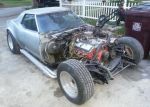


 we see the light at the tunnels end isn't a train afterall....