










Engine temp and Heater

Thread Starter
Advanced

Joined: Dec 2016
Posts: 56
Likes: 4
From: Denver CO
 Engine temp and Heater
Apologies if I ask something dumb as I'm new here and new to my C3. I did search but couldn't narrow the issue.
I have a '79 C3 in relatively stock condition ( Dad said he kept it stock or bloody close but finding a number of things aren't what he expected ). At any rate, I'm out here in Denver, the roads are clear but it is getting cold. I took her out yesterday and the temp gauge never got over 110 even though she ran perfectly well. The heater output never got above outside air temp either. The radiator is good and is full of anti-freeze as is the overflow.
Is this normal or is there something odd I should look into? I've never seen an engine run for 45 minutes refuse to warm up.

I have a '79 C3 in relatively stock condition ( Dad said he kept it stock or bloody close but finding a number of things aren't what he expected ). At any rate, I'm out here in Denver, the roads are clear but it is getting cold. I took her out yesterday and the temp gauge never got over 110 even though she ran perfectly well. The heater output never got above outside air temp either. The radiator is good and is full of anti-freeze as is the overflow.
Is this normal or is there something odd I should look into? I've never seen an engine run for 45 minutes refuse to warm up.
Thread Starter
Advanced
Joined: Dec 2016
Posts: 56
Likes: 4
From: Denver CO
That could be a possibility but I just had my mechanic replace the water pump Friday. He us usually 100% on the ball and I would think he would have checked that while he was in the area.
Know a good/easy way to check it other than pulling it and visually inspecting? It looks like it should be easy to get to but getting in to see him might be problematic just due to my schedule.
Know a good/easy way to check it other than pulling it and visually inspecting? It looks like it should be easy to get to but getting in to see him might be problematic just due to my schedule.

Team Owner


Joined: Sep 2006
Posts: 31,270
Likes: 4,362
From: Westminster Maryland
Hi RH,
Welcome!
First Posts!!
Chilly in Denver!!!
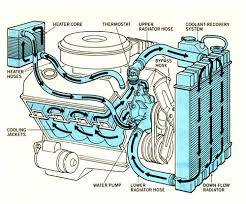
Here's the coolant flow direction for the cooling system.
Upon start up the upper hose stays 'relatively' cool until the thermostat opens; then it increases in temperature.
Lower hose warms more quickly.
The hoses to the heater core should become warm/hot to the touch as the engine coolant warms up. Note direction of coolant flow for those hoses too.
Regards,
Alan
Welcome!
First Posts!!
Chilly in Denver!!!
Here's the coolant flow direction for the cooling system.
Upon start up the upper hose stays 'relatively' cool until the thermostat opens; then it increases in temperature.
Lower hose warms more quickly.
The hoses to the heater core should become warm/hot to the touch as the engine coolant warms up. Note direction of coolant flow for those hoses too.
Regards,
Alan
Last edited by Alan 71; Dec 5, 2016 at 01:18 PM.
Drifting


Joined: Mar 2011
Posts: 1,347
Likes: 121
From: Kernersville NC
That could be a possibility but I just had my mechanic replace the water pump Friday. He us usually 100% on the ball and I would think he would have checked that while he was in the area.
Know a good/easy way to check it other than pulling it and visually inspecting? It looks like it should be easy to get to but getting in to see him might be problematic just due to my schedule.
Know a good/easy way to check it other than pulling it and visually inspecting? It looks like it should be easy to get to but getting in to see him might be problematic just due to my schedule.

Team Owner

Joined: Jan 2006
Posts: 37,637
Likes: 3,118
From: Crossville TN
Clean both surfaces [well] of all residual gasket material and/or sealant. Install stat with temp coil/sensor on the 'manifold' side; the stat flange should fit into the undercut on that manifold face. Install the gasket on that face AFTER the stat is installed. If you put sealant on the gasket, just put a thin wipe of it on both sides and let it nearly dry. DO NOT USE A SILICONE SEALANT FOR THIS JOB; use a gasket sealant like Permatex No. 2 sealant. Put some sealant on the last few threads of both bolts. (This will prevent any wicking up of coolant via any porosity in the manifold casting.) Install bolts to 28-30 ft-lbs torque.
Corvette Stories
The Best of Corvette for Corvette Enthusiasts

Top 10 Most Expensive Corvettes Ever Sold on Bring A Trailer
Brett Foote
10 Things Every Corvette Owner Needs (2026 Edition)
Michael S. Palmer
8 Most "Only Corvette Owners Understand" Quirks and Problems
Pouria Savadkouei
10 Reasons the C6 Z06 is Still A Performance Benchmark After 20 Years
Joe Kucinski
How Much Horsepower Every Corvette Engine "LOST" in 1972
Joe Kucinski
Top 10 DOs and DON'Ts for Protecting Your Convertible Top!
Michael S. Palmer
Top 10 Most Explosive Corvettes Ever Made: Power-to-Weight Ratio Ranked!
Joe Kucinski
150 hp to 1,250 hp: Every Corvette Generation Compared by the Specs That Matter
Joe Kucinski
8 Coolest Corvette Pace Cars (and Replicas) of All Time
Verdad Gallardo
Thread Starter
Advanced
Joined: Dec 2016
Posts: 56
Likes: 4
From: Denver CO
So last night, my son and I replaced the old thermostat with a new one rated for 160. The old one looked perfectly fine ( closed and straight ). However when we took her out for a test drive she did actually warm up 1/4 of the way ( with 220 at top middle ). The heater never did warm up on our feet though.
Drifting
Joined: Mar 2011
Posts: 1,347
Likes: 121
From: Kernersville NC
So last night, my son and I replaced the old thermostat with a new one rated for 160. The old one looked perfectly fine ( closed and straight ). However when we took her out for a test drive she did actually warm up 1/4 of the way ( with 220 at top middle ). The heater never did warm up on our feet though.
Zen Vet Master Level VII


Joined: Mar 2016
Posts: 5,218
Likes: 1,174
From: Southlake, TX
All systems are designed to run on a 195 stadt. You could accidentally send false reading to the system for Choke, ERG, emissions et. You coud possibly throw service engine light.
Plus, you heater does not like a cool stadt.
Thread Starter
Advanced
Joined: Dec 2016
Posts: 56
Likes: 4
From: Denver CO
Great info, thanks. I've never worked on anything other than a Jeep so there was only the one thermostat. It seemed to make sense when the parts guy ( who's normally good with my Jeep ) said the cooler one would be better for the larger engine and it's performance. Yes, I've got the manuals for the car but haven't gotten that far in yet.
I'll get a new thermostat today and install it though I'm not driving with the inch of snow on the ground.
I'll get a new thermostat today and install it though I'm not driving with the inch of snow on the ground.


Thread Starter
Advanced
Joined: Dec 2016
Posts: 56
Likes: 4
From: Denver CO
I was looking at the screen and it did list 2, 160 and 180, no 195. He may be used to the kids who race the little sportsters around town and think that that was my goal. I'll try a different parts store this morning.
Many thanks guys, very knowledgeable and friendly forum.
Many thanks guys, very knowledgeable and friendly forum.

Thread Starter
Advanced
Joined: Dec 2016
Posts: 56
Likes: 4
From: Denver CO
I replaced the thermostat with a 195 rating and it heats up correctly. I'm still not getting any heat though. My mechanic said he replaced the vacuum valve when it was in for Cat installation though I didn't verify. I can give him a call tomorrow, but any thoughts of anything else which might be worth looking at?

Drifting
Joined: Aug 2015
Posts: 1,939
Likes: 477
From: NSW, Australia
C3 of Year Finalist (track prepared) 2019
Are the heater hoses getting hot? If coolant is flowing through them then they should be a similar temp to the top radiator hose when the engine is up to temperature.
Thread Starter
Advanced
Joined: Dec 2016
Posts: 56
Likes: 4
From: Denver CO
OK, I took her out for a run tonight. With the 195 in it's holding that on the guage but it's still blowing cold air ( slowly ). I put my hand on the hose going to the vacuum switch and it's warm, seemed the other side of the switch was as well ( be VERY careful of the headers, ouch ).
Thoughts on where to look next?
Thoughts on where to look next?
Drifting
Joined: Mar 2011
Posts: 1,347
Likes: 121
From: Kernersville NC
OK, I took her out for a run tonight. With the 195 in it's holding that on the guage but it's still blowing cold air ( slowly ). I put my hand on the hose going to the vacuum switch and it's warm, seemed the other side of the switch was as well ( be VERY careful of the headers, ouch ).
Thoughts on where to look next?
Thoughts on where to look next?