When you click on links to various merchants on this site and make a purchase, this can result in this site earning a commission. Affiliate programs and affiliations include, but are not limited to, the eBay Partner Network.
I think you hit the TQ #, but are light on the HP #. I'll stick with 425HP.
Aluminum heads help a lot. You are way over what a L46 would make. I figure 20HP from the cubes, 20 HP from the HR cam, and 40HP from the heads. That's closer to 440. Even if I am 20 off, you are at 425. 12 sec car!!!
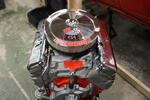
The rods could be eagle rods. I see Eagle on the bolt. Good for 7000+rpm. It is obviously a 4 bolt block, and the crank looks to have a wide grounded parting line, that would indicate a forged crank. I think you said it came from a race car, so these are very good, and very tough parts. 4 bolt 400 blocks are rare IIRC. We may never know if the pistons are forged or not. Unless you can find a # on them. If they are not limit the rpm to 6000 or so on a regular basis and you should be fine. You are not going to hurt anything if you miss a shift and it revs a little higher. A tough short block is a good thing to have! The only extra tough part my LT-1 had was forged pistons, and it saw 6700 rpm very regularly, and 7400 a few times, for 30 years. Zero issues. With no rpm limiter. But yours has TORQUE!
On the vibrations, I would say any bracket or frame part touching the fiberglass body, would transfer vibrations to the body and nullify the advantage of the rubber C2 mounts. I guess I will stick to my planned C2 rubber mounts, and just make sure nothing is touching, and go from there. Thanks!
I think you hit the TQ #, but are light on the HP #. I'll stick with 425HP.
Aluminum heads help a lot. You are way over what a L46 would make. I figure 20HP from the cubes, 20 HP from the HR cam, and 40HP from the heads. That's closer to 440. Even if I am 20 off, you are at 425. 12 sec car!!!
The rods could be eagle rods. I see Eagle on the bolt. Good for 7000+rpm. It is obviously a 4 bolt block, and the crank looks to have a wide grounded parting line, that would indicate a forged crank. I think you said it came from a race car, so these are very good, and very tough parts. 4 bolt 400 blocks are rare IIRC. We may never know if the pistons are forged or not. Unless you can find a # on them. If they are not limit the rpm to 6000 or so on a regular basis and you should be fine. You are not going to hurt anything if you miss a shift and it revs a little higher. A tough short block is a good thing to have! The only extra tough part my LT-1 had was forged pistons, and it saw 6700 rpm very regularly, and 7400 a few times, for 30 years. Zero issues. With no rpm limiter. But yours has TORQUE!
On the vibrations, I would say any bracket or frame part touching the fiberglass body, would transfer vibrations to the body and nullify the advantage of the rubber C2 mounts. I guess I will stick to my planned C2 rubber mounts, and just make sure nothing is touching, and go from there. Thanks!
Ditto for the steering coupler.
This is tremendously interesting. Thanks for sharing your insight.
I was doodling around on ChatGPT last night and dumped everything into the prompt. The answer it gave me very much aligns with yours.
Now I am thinking it might be a good time to replace my 14-year-old BF Goodrich Radial TAs
In other news, my rear strut rods were compressed as far as they could go the last time I went for an alignment. For this reason, the fellow did not align the rear and it was slightly off. Friday I go back for him to complete the job. But I need to modify the assembly to be able to go further.
So….
Hmmmm. I think I learned something here. Bolts go in the other way.
I have no clue where I set the rev limiter. Probably 5500.
I also haven’t the foggiest clue about power. The cam is 218/224 @ .050. And of course 1.6 rockers. I always though I was clocking in at 370HP and maybe 450TQ. The power seems to come on after 3000.
Cruises 70 & 2000.
As for the vibration. The jury is still out but leaning very seriously toward acquittal.
I went from the aluminum pucks to the C2 rubber. The idea was to preserve the body to frame clearance (and avoid problems with steering column geometry). Upon closer inspection I found that the brackets were touching, but also the entire crossmember was contacting the fiberglass bottom. The later C3 body mounts are much taller and made a dramatic difference. As I say, I had the car up to 90 (as high as I dared go on a backroad) and I was struggling to detect anomalous vibrations. I could feel no vibrations other than in the steering wheel and the shift lever. My drives were only a few minutes. More tests to come, but with three outings today… nothing that seemed off.
Seems someone has questions about this 400's (from a race car) pistons: questions if they are cast or forged. I see a faint clue.
In post #880, Second pic, there is an in-focus pic on Left side of frame of a piston. But, also, on the Right side of frame at about Two O'clock, there's a blurry image of another piston. The view is looking up and into that piston's underhead. Although out-of-focus, I can see what I believe is the tell-tale raised "crosshatching" pattern that's quite typical of cast pistons' underhead area. This also seen often at outer area around cast pistons' wristpin hole. I suggest those are likely a cast hypereutectic piston and seems to have a black polymer skirt coating as well. Perhaps they are Sealed Power/Speed Pro pieces ? The crosshatch pattern underhead is my flag. Perhaps you have other pics which may focus more clearly on underhead? I've seen many different pistons, both cast & forged; I've never seen a forged piece w/ crosshatch underhead while most cast do have underhead crosshatch.
Soooooo, a few days off for Xmas vacation, so I scurried off to my garage.
First order of business is return a welder to buddy and finally buy my own.
A Decapower 6-in-1 That includes plasma cutter
Synergetic.
Testing. I probably should have bought one of these years ago.
The reason for this purchase, was that I needed to weld together stainless steel V-clamps in my exhaust. I neglected to document but did a lot better than the first time around. I learned a lot about prepping and making everything is straight and square - taking lots of time there.
A few leak, that I will have to go back over, but pleased with result.
I never liked at all the flimsy brackets that came with shifter console to rest the shifter bezel on. Whatever supports for the bezel there were are now long gone and rickety solutions have been cobbled together. Further, the console is very fragile and I think could use reinforcing.
Let’s roll up them sleeves.
This is 14 gauge steel for the faceplate bracket. I used a threaded rivet for each corner. There is also a piece of galvanized steel (21 gauge?) to assist the console with keeping its shape.
As this bolt is hidden behind the seat, I figured… what the hell. The beef is worth the trade off. No one will ever see this. One on each side holds firmly the lower corner faceplate brackets.
The upper brackets (also 14 gauge) are held in place by bolts that go through where the fiber optics warning light bezel slots through. The bezel will not be needing these holes and the pins have been ground off. (No worries, repop.) The bezel rest on the console and will be interference fit.
Looks good.
This shifter console reinforcement arch will also be getting the threaded rivet treatment. This will be particularly useful when putting the side panels under the dash in.
Since the shifter console was out, might as well replace the dead ammeter (yes, I somehow killed
it again)… with a volt meter. I decided that first replacing the dead ammeter and then fiddling with it to get it to read accurately made little sense. With the high amp alternator and super beefy charging wire, it was sure to be a pain to fine tune. Maybe one day, who knows
A volt meter is expedient, it looks correct (or I hope it will) and it gives useful information.
Tomorrow I will install the voltmeter, but more important to me was the plastic oil pressure gauge sending tube. I have no idea how old mine is. It may be old and brittle… or not… but I can tell you that I never feel that I can relax with it know that it might randomly fail.
In August of 2024, I read @OldCarBum ’s thread on replacing the line with AN-3 steel braid and ordered all the parts he did, including the tough to find adapter from hosesandfitting .com
It worked well. Thanks OCB ! But I need to get another elbow fitting. I used the one I had to clear the ignition tin.
I never liked these. Always seem so fragile.
A good idea to take a pic of this, I like the way I sorted out the wires on the cap.
Dropping the gauge cluster. Best to take pics here too.
The elbow fitting on the block.
Straight, I’m very sure, will not work… but, I can test the concept. No leaks with the engine running. Elbow fitting on order.
[img alt="This was the adapter OCB came up with. It plugs into the back of the gauge and connects to AN-3
"]https://cimg7.ibsrv.net/gimg/www.corvetteforum.com-vbulletin/2000x1504/img_8168_3a85a8d123793112201111e4e4375a6 11a137fbd.jpeg[/img] This was the adapter OCB came up with. It plugs into the back of the gauge and connects to AN-3
I also,… while I am at it, need to figure out a way to elegantly wire my handheld and my laptop, so I can one day start laptop tuning the EFI.
Funny you should mention that. The BFG tires, I have concluded, are old tech and “lazy”.
It is a shame that I put so much work into to the steering and suspension only to be let down by them. The caster has been increased to 8, positive. Tubular upper an Arms with aluminum bushings, adjustable strut rods with heim joints. All bearings and clearances seen to. Borgeson conversion. Front end brace… and the list goes on.
It’s time to translate the work into real-world performance. When I drive, I want to feel this is a sports car.
Sooo, I picked up a set of the 19-inch BMW rims for a silly price. My plan is to slap 255/45R18s Michelin UHP tires on all four corners.
I think the back accented diamond cut, will look fine.
Hub centric adapters are required to make these work properly.
The improvement should be very significant.
I’ll keep BFG for events and shows, and the Michelin Pilot Sport 4S, if I can find them, for enjoying the drive.
It looks like you are getting a lot of necessary work done.
It all looks fantastic!
I can’t wait to see the new wheels mounted up and on the car!
I’m glad the oil pressure line worked out for you and thanks for the thumbs up.
Greg
It looks like you are getting a lot of necessary work done.
It all looks fantastic!
I can’t wait to see the new wheels mounted up and on the car!
I’m glad the oil pressure line worked out for you and thanks for the thumbs up.
Greg
Today, a little more work. Tomorrow, “back to work”.
This always annoyed me.
Was this a fast job ? Hell no ! It took quite a while to coax the wire back through.
Designer Imagines A Corvette That Looks More Like a Corvette Than the Corvette
Slideshow: A Jaguar designer's personal project imagines what a modern front-engined Corvette might look like if Chevrolet revisited the golden age of the Stingray.













 That includes plasma cutter


 But I need to get another elbow fitting. I used the one I had to clear the ignition tin.