When you click on links to various merchants on this site and make a purchase, this can result in this site earning a commission. Affiliate programs and affiliations include, but are not limited to, the eBay Partner Network.
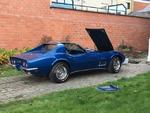
So, made some progress. With the PS pump replaced, it’s time to swap in a new steering wheel from Mid America. The diameter appears to be the same and the rim is thicker. Both are welcome features. The building quality seems good.
I took it out for a short test drive. With the new pump, the steering action seems much smoother tho’ still over boosted to my taste despite my shimming for less boost. I’ll leave it like that for a while. Too much of a a pain to pull the pump out again and re-shim.
The rubber mount has definitely improved the motor vibration issues. More testing to follow.
Finally. I have been driving around without a skirt for a little while and it has been somewhat embarrassing.
The old fiberglass one was in sorry shape. Likely, I could have fixed and refurbished it. But you know what? I prefer the metal moldings. The new screws were easy enough to install.
The repair kit for a 70-82.
Of course holes are in a different location… but that’s actually a good thing - best to drill fresh new holes.
<snip> I took it out for a short test drive. With the new pump, the steering action seems much smoother tho’ still over boosted to my taste despite my shimming for less boost. I’ll leave it like that for a while. Too much of a a pain to pull the pump out again and re-shim.
.
The high pressure valve has no effect except when you are holding it at full lock.
The corvette valves are limited to 800 or so so you won't blow all those hoses under full pressure at full lock.
Normal chevies go to 1600 or so.
What makes it feel overboosted is too much flow & pressure at normal speeds.
It is basically 0 psi when going straight. And only builds as much psi as you need.
Measure the diameter of your flow valve orifice.
If you still have your original pump measure that one too.
Corvettes have lower flow ones than std pumps because the cars are so light.
So most std replacement pumps typically flow too much for corvettes.
Put in a smaller flow orifice, you can get them from Turn One.
That will lower your flow and pressure at normal speeds
That is normally only in the 100 to 300 range anyway.
And for example 200 vs 100 gives you a hugely overboosted feel.
I tuned mine for Pro-Solo use.
I cut the flow back until the steering shuddered in a fast turn, then went up one notch more.
Anything more than that is a waste, and gives over-boosted steering feel.
I was pulling 1.3 Gs in fast slaloms.
@leigh1322 this is fascinating. Thanks for taking the time to write this up ! Tremendously appreciated. Clearly the PS pump will have to come out again. Great content
Most do not understand an old hydraulic PS setup. There are two restrictor orifices in the system.
The fixed one in pump, and a variable one that is the control valve.
When the control valve one is larger than the fixed, there is no load on the system and no pressure in the hoses, and no assist.
When the control valve is partially closed, it becomes smaller than the pump one, and pressure builds in the hoses and you have assist.
Normal assist psi is 100-150 psi. It is likely also near this range at idle /cruise also so that you can get instant response.
The control valve opening almost never completely closes, the opening is variable like a needle or faucet valve, it just gets smaller and smaller. And you get more and more assist.
When you put a large load on the system, like very wide tires, race rubber, and very quick steering wheel movements as thru a fast slalom, or hold it against the steering stop, or turn the wheel at a dead stop in the parking lot, that is the only time the psi goes even higher, based on more load. If or when the pump can not supply enough flow even in these extreme situations, that is when the system can not supply enough assist, and you feel the steering wheel jerk or catch, as it basically loses assist. That is how you stress test the flow valve. As long as it does not "catch", when you are doing that, you have enough flow. Sprint cars are very light, and do not worry about idle, and go as low as 1.3 gpm. That would not work on pavement.
But hardly anyone hardly ever attempts to measure the psi. Although engineers and racers do.
If you have ever seen a guy that says his PS fluid overheats all the time, and boils over, or the hoses always leak, or he burned up his PS pump, it is because he has too much flow, and too much pressure, all the time, even at low/no load. So yeah, surprise, it overheats.
Modern hydraulic rack-n-pinions use similar design principles and pressures.
Try a 2.5 gpm orifice.
IIRC many new/rebuilt PS pumps come with a 3.1.
But it is like 10 min to change it, besides getting soaked.
If you can get to the rear pump fitting. On a corvette it will be tight.
On most cars the pump does not even have to come off.
The orifice is in the hex fitting the high pressure hose screws into, on the back of the pump.
In fact, I had to quit. I tried disassembling the cribs and jacking up incrementally., but that was unsafe as well. The problem is that I have provisions for towing at the plate in front of the tire basket. Any spacer that I use rocks and threatens to pop out
I think I will take a break and think about fabricating a spacer. I’m not terribly inclined to buy a $400 high lift floor jack, but I may not have a choice
I remember, getting it up high enough was really sketchy and I didn’t like it.
I just went out a bought a Quick Jack system that lifts the car 24 inches and does it safely.
I wish I would have spent the money a few years ago.
I remember, getting it up high enough was really sketchy and I didn’t like it.
I just went out a bought a Quick Jack system that lifts the car 24 inches and does it safely.
I wish I would have spent the money a few years ago.
Yeah - the minute it became apparent this was not going to work with the floor jacks that I had, I started reconsidering my life's choices... and looking at a Quick Lift. I may go that direction, one of these days. Efforts I made now already cost me a quarter of the admission ticket.
Designer Imagines A Corvette That Looks More Like a Corvette Than the Corvette
Slideshow: A Jaguar designer's personal project imagines what a modern front-engined Corvette might look like if Chevrolet revisited the golden age of the Stingray.