When you click on links to various merchants on this site and make a purchase, this can result in this site earning a commission. Affiliate programs and affiliations include, but are not limited to, the eBay Partner Network.
the block not a problem far thicker cylinder walls better quality iron and better priority main oiling system, the problem is the rings and piston skirts more side loading, also the piston height being shorter not a good thing to have. The thin rings on the builds wear out faster, nice to reduce friction but that's all.
so what does that mean? Replace rings and pistons at 50,000 miles? 20,000 miles? 100,000 miles? Will it will require over-bore? And how does that compare to a 415 or 406. Sometimes I feel like I am overthinking minor details. Everything is a compromise at some degree.
My home built 406 would haze 295 50 15 tires in second gear while rolling 45 mph if heavy throttle was applied. Your 225 70 tires don't stand a chance.
That said, you certainly can control throttle and drive your car. If pushing the limits, try MT drag radials. They absolutely stopped my traction issues, and a 255 60 would fit stock wheels and work well for you.
yes ... and pretty sure Cooper Cobra available in that size ... as well as their identical brethren Jetzon Revenger
You may need to partially make your selection on what readily available piston choices you have, without going full custom.
Here's a pic of a SBC 427 piston with 10:1 CR from Icon (forged)
You want normal width rings, not the skinny ones for longevity.
These need a 4th piece for support for the oil ring, but that's not a longevity issue.
This one is for a 6.0 inch rod.
Just for an FYI.
Tell your engine builder what head you have and let him pick the rod/piston.
Last edited by leigh1322; Nov 9, 2019 at 03:46 PM.
All those iron L31 Vortec 350 5.7L motors made 96 -up have thin metric ringpack (1.5 mm, 1.5 mm, 3.0 mm) .
Those motors have excellent reputation for exceptionally long ring & bore life ... partially due to EFI.
so do ls engines all modern engines. But the 350 is not side loading the rings like a 4.00 crank does stuffed in an engine started out with a 3.00 stroke, all the compromises have to be done to use it not worth it for around 17 cubic inches. A 454 bbc has a 4.00 stroke longer 6.135 rod and has a piston with still good compression height, not the short mess you have to use to do a 427 sbc so you can even clear the crankshaft counterweights at bottom dead center, another known problem with the 4.00 stroke in the sbc is windage, needs a wider pan up close to the pan rails. All this bullshit can be bought but for what 17 cubes and it sounds better to say I have a 427.
Last edited by Little Mouse; Nov 9, 2019 at 08:35 PM.
[QUOTE=jackson;1600464773]No sh7t ... as do most all real hi-po/race pistons w/ short ch ... thin is good! ...
Big change in modern times that has improved is even dino oil by mile's compared to 40 years ago and there was sure never anything as good as synthetic oil back then. Just like modern engines today are far superior in how long they will last there is zero comparison to oils of 40 years ago and today. Put 50 year old tech oil in a modern engine watch the longevity sink big time. Would not matter if the rings were thicker or thinner.
putting short compression height pistons in a very low rpm build like he is doing, nothing but a loss for him.
Last edited by Little Mouse; Nov 9, 2019 at 08:59 PM.
Still waiting for answer.......will 427 with thin rings, short compression height, too much side load and higher piston speed wear out at 20,000, 50,000, 100,000 miles assuming not pushed to max rpm all the time and with synthetic oil? It matters to me as I need it to last. This is my last build.
Last edited by Shovels and Vettes; Nov 9, 2019 at 09:03 PM.
Still waiting for answer.......will 427 with thin rings, short compression height, too much side load and higher piston speed wear out at 20,000, 50,000, 100,000 miles assuming not pushed to max rpm all the time and with synthetic oil? It matters to me as I need it to last. This is my last build.
hard to say, one big factor in your build regardless of any size you want to build is very low rpm engines have far better longevity. The saying speed kills, well rpms shorten engine lives. That said I don't know anyone with a very long h term big engine sbc on this forum, Like 427 hotrod that has hammered on a 540 to 555 bbc chevy for 19 years and no he runs higher revs then any 5 grand. But he has the real deal a big block chevy. If you want a good laugh put a sbc block standing up on end with the lower case facing you then set a bbc up beside it. Look at how thick the main webs and caps are how deep they are and how much wider the cap is, to the sbc beside it. Most people that have a C3 it's not even a daily driver not going to get 20,000 miles a year put on the engine maybe 6000 miles or less. I'm just telling you some known down sides to the 427 build compaired to a 400/406 build. Makes no difference to me what size you would like to end up with. I always say people go out work hard for there money what they want to build is what they should do and what I think or anyone else, does not matter.
Last edited by Little Mouse; Nov 9, 2019 at 09:51 PM.
I am no expert, but... From what I have read and seen, I think a 427 small block is doable. Those are readily available from the major crate engine manufacturers. I think that would be a great option. I went with a 383 but a 427 would be better. I would think you would want really good bottom end, and possibly start with a quality block like a Dart or something. What's your budget?
If you did a dart, you could do LS heads with the correct block. Instant pro stock/SB2 technology.
hard to say, one big factor in your build regardless of any size you want to build is very low rpm engines have far better longevity. The saying speed kills, well rpms shorten engine lives. That said I don't know anyone with a very long h term big engine sbc on this forum, Like 427 hotrod that has hammered on a 540 to 555 bbc chevy for 19 years and no he runs higher revs then any 5 grand. But he has the real deal a big block chevy. If you want a good laugh put a sbc block standing up on end with the lower case facing you then set a bbc up beside it. Look at how thick the main webs and caps are how deep they are and how much wider the cap is, to the sbc beside it. Most people that have a C3 it's not even a daily driver not going to get 20,000 miles a year put on the engine maybe 6000 miles or less. I'm just telling you some known down sides to the 427 build compaired to a 400/406 build. Makes no difference to me what size you would like to end up with. I always say people go out work hard for there money what they want to build is what they should do and what I think or anyone else, does not matter.
thanks. As much as I want the torque of a big block, I want a strong durable engine that is not pushing limits of a design that started as a 283 because I DO intend to drive 6000 or more per year. I have worked all my life since 12 and am no rich guy. I care about my car and motorcycle, I buy quality and treat them well without abusing them because I am not a rich guy. I don’t need the extra 21 cubes enough to buy a throwaway engine that has to be rebuilt in three years.
Last edited by Shovels and Vettes; Nov 9, 2019 at 11:25 PM.
Realistically - there is NO WAY that anyone on this forum can tell you how long the engine will last.
Why - you ask - Simply because there are way too many variables.
How hard are you going to run the car ?
How well are you going to maintain the car ?
How well will the engine be built - meaning where will the tolerances be set ?
What quality parts will be used ?
Some people I've seen start up their engines on a cold winter morning, and the car is already in gear by the time the starter teeth have stopped spinning. I have heard the turbocharger on a car spinning up literally seconds after starting on a well below freezing morning. I highly doubt that pressurized oil ever reached the turbocharger before it spun up. I have a neighbor who doesn't change oil more than once every 25,000 miles or so..., and LOTS of people seem to think long life coolant is lifetime coolant.
The fact is that a Dart block is made from better material than any passenger car application GM block. Same with the aftermarket (Forged 4340) crank and rods, and especially the rod bolts. Forged pistons will take FAR more abuse than cast or hypereutectic pistons. The machining on the components and the quality assurance is what separates the expensive from the very expensive. Hundreds of thousands on Chevy 400 Small Blocks made it to the 100K mile mark, and personally - I trust the components and the machining that you're considering FAR more than I trust the stuff that came in a stock 400 cid SBC from the factory.
So - IMHO - Build the motor you want with good components (and don't skimp on things like good bolts or gaskets), have someone who knows what they're doing screw it all together, and if at all possible - break it in and tune it on an engine dyno. A day of dyno time isn't cheap - but it is THE best way to get the carb set-up and ignition timing properly set. Then - drop it into your Vette and ENJOY it! But also take care of it .. Make sure your cooling system can handle it, warm it up before you drive it, make sure you have oil temp before you stand on the loud pedal,and MAINTAIN IT !!!
It's your money and of course nobody can tell you how to spend it, but it looks like to me that you're hellbent on building a tow truck engine from expensive parts. A production 406 with factory crank, reconditioned factory rods and your AFR heads will make more than you will ever need (based on your explanation) and leave you a lot of your budget money for other stuff. And unless you spend a lot on dress-up parts, car show folks will walk by with a nod (smallblock? cool...) and stop at the next 'vette they see with a big block under the hood.
I just don't understand the want for aftermarket everything when your goals can be easily achieved with production parts for so much less.
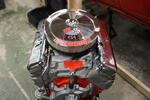
I have posted this before. This engine has cheap aluminum heads and a HR cam it's a 383. The TQ and HP is where you want it
Every time I post this someone tells me the date is wrong but if you look close the correct date is on there
(with Purple92)
Base your decision on facts or what a couple of engine builders think. More than one. Guys that have built a few thousand engines each. They're not on this forum cause they are too busy. I know of one who chimes in occasionally but haven't seen him in this thread. Unless you get lucky and someone has built this exact 427 combo and has had either good or bad luck with it. Haven't heard that here either. Best comment I heard was factory 400s lasted a long time. Now that's a fact. What stroke and rod length do they have? Was it ideal? Was it as good as a 350? I don't remember. Google says 4.125 x 3.75. Google says some ran a 5.7" typical sbc rods and some ran a .135 shorter 5.565" rod. The original 400s ran the shorter rod and they lived long lives. Not sure where the 5.7 came from . I'd figure out the stroke to rod ratio and compare it to the 427 variant. I am assuming you could build the 427 with different rod lengths if you could find a piston to match. There has got to be a minimum length needed to clear the crank, and I did see a 6.0" listed.
So based on that math the 427 SBC has the same rod ratio as a 400 SBC, and the 400 lived a long life. That's based on facts and not opinion. I'm a scientist so I put way more faith in verified facts, not opinions or theories.
This is what it will come down to, who builds the engine, what parts are used, who installs and tunes the engine, how and when the maintenance is done and how it is driven. Just think about this, your 350 did not even last 16000 miles, so even with all the pluses you have stated it has over any other size engine, it did not matter, as the others are lasting way longer than your 350 under way harder use. Lots of good information has been given to you, take it all in and make a good choice.
I have posted this before. This engine has cheap aluminum heads and a HR cam it's a 383. The TQ and HP is where you want it
Every time I post this someone tells me the date is wrong but if you look close the correct date is on there
thanks but not enough torque down low. I want LS5 torque curve. This engine never makes 500 ft lbs.
Last edited by Shovels and Vettes; Nov 10, 2019 at 11:27 AM.
This is what it will come down to, who builds the engine, what parts are used, who installs and tunes the engine, how and when the maintenance is done and how it is driven. Just think about this, your 350 did not even last 16000 miles, so even with all the pluses you have stated it has over any other size engine, it did not matter, as the others are lasting way longer than your 350 under way harder use. Lots of good information has been given to you, take it all in and make a good choice.
i agree, and just for the record my 350 is hardly worn out. I have some oil in intake which is most likely a leaking intake gasket and the timing issue can be fixed. The engine can and will be a great engine with long life ahead once theses issues are resolved. Yet nobody is offering to buy it.







 Miles
Miles












 (with Purple92)