




Blow by Question

Safety Car


Joined: Oct 2007
Posts: 4,222
Likes: 1,078
From: South Florida

exactly, you need to diagnose first and not blindly purchase products which mask blowby such as vacuum pumps and catch cans. That is the purpose of my post to help you learn and be immune to "buy something to fix something" type of instinctive reaction to new problems.
Diagnosis for blow-by Checklist (Not necessarily this order but I will try to keep an order)
1. Compression test engine with two or three different testers. Never use rented testers and always double check with another gauge to verify accuracy if the results have any question or doubt.
2. Leak Down test is often necessary to pinpoint potential leaking avenues which show up on #1 compression test.
3. Crankcase Pressure test (running engine): Measure and record the crankcase pressure using appropriate gauge (one that can read inches of water for example or a 2-bar map sensor) For the engine's varied output situations, A. Idle B. Cruise and C. Wide Open Throttle
The crankcase pressure should never rise above atmospheric pressure for very long, and when/if so only a little tiny bit at WOT (Never more than ~0.3PSI for example for a brief moment)
4. Crankcase pressure test (engine off): Place 0.1 to 1psi of pressure inside the crankcase and FIND ALL LEAKS. You can check the seal of the dipstick and verify the stick does not pop out with 1psi of pressure, for example. It will give insight as to how much pressure it takes to push the stick out, allow you to verify the seal on the dipstick. Dipstick should be tightly sealed when fully closed, no leaking.
5. Intake system pressure test: Place "boost pressure" Inside intake manifold to find intake leaks which may reflect PCV apparatus configuration (it should hold pressure) I have an example video if you'd like of this test.
General diagnostics: These are general for course of follow through diagnosing the oil related symptoms of blow-by and piston ring health,
1. Inspect all plugs, they should look similar, healthy color center (tan to white is fine) with the dark unbroken ring of carbon around the outside (under the thread area) and no signs of OIL or melting/warping/pitting and no flakes or flecks of aluminum or embedded materials. Also make sure there is no anti seize near the ends of the plugs and that they appear clean and free from dirt/debris like touched with greasy fingers. Handle with clean gloves.
2. Air filtration- Use only High quality air filter and preferably pre-filter as well. The more you care about the engine in question the more filtering you need to do and the more the pressure test and leaking of air past intake seals will matter.
So this is it. You filter the air the best you can. You make sure plugs are clean and free from oil. You get great compression test results. The only thing that can cause blow-by after that is improper PCV route (wrong hose or checkvalve positions or too long hoses or leaking crankcase etc... wrong setup) Or uncontrolled crankcase pressure- you must measure and determine whether the PCV system is doing its job or not. The PCV system's job is to maintain a crankcase pressure between 0.5" Hg and 1.5" Hg (up to 3" Hg is fine). If it is not doing this job, oil will blow out of the engine.
Diagnosis for blow-by Checklist (Not necessarily this order but I will try to keep an order)
1. Compression test engine with two or three different testers. Never use rented testers and always double check with another gauge to verify accuracy if the results have any question or doubt.
2. Leak Down test is often necessary to pinpoint potential leaking avenues which show up on #1 compression test.
3. Crankcase Pressure test (running engine): Measure and record the crankcase pressure using appropriate gauge (one that can read inches of water for example or a 2-bar map sensor) For the engine's varied output situations, A. Idle B. Cruise and C. Wide Open Throttle
The crankcase pressure should never rise above atmospheric pressure for very long, and when/if so only a little tiny bit at WOT (Never more than ~0.3PSI for example for a brief moment)
4. Crankcase pressure test (engine off): Place 0.1 to 1psi of pressure inside the crankcase and FIND ALL LEAKS. You can check the seal of the dipstick and verify the stick does not pop out with 1psi of pressure, for example. It will give insight as to how much pressure it takes to push the stick out, allow you to verify the seal on the dipstick. Dipstick should be tightly sealed when fully closed, no leaking.
5. Intake system pressure test: Place "boost pressure" Inside intake manifold to find intake leaks which may reflect PCV apparatus configuration (it should hold pressure) I have an example video if you'd like of this test.
General diagnostics: These are general for course of follow through diagnosing the oil related symptoms of blow-by and piston ring health,
1. Inspect all plugs, they should look similar, healthy color center (tan to white is fine) with the dark unbroken ring of carbon around the outside (under the thread area) and no signs of OIL or melting/warping/pitting and no flakes or flecks of aluminum or embedded materials. Also make sure there is no anti seize near the ends of the plugs and that they appear clean and free from dirt/debris like touched with greasy fingers. Handle with clean gloves.
2. Air filtration- Use only High quality air filter and preferably pre-filter as well. The more you care about the engine in question the more filtering you need to do and the more the pressure test and leaking of air past intake seals will matter.
So this is it. You filter the air the best you can. You make sure plugs are clean and free from oil. You get great compression test results. The only thing that can cause blow-by after that is improper PCV route (wrong hose or checkvalve positions or too long hoses or leaking crankcase etc... wrong setup) Or uncontrolled crankcase pressure- you must measure and determine whether the PCV system is doing its job or not. The PCV system's job is to maintain a crankcase pressure between 0.5" Hg and 1.5" Hg (up to 3" Hg is fine). If it is not doing this job, oil will blow out of the engine.
Safety Car
Joined: Oct 2007
Posts: 4,222
Likes: 1,078
From: South Florida
Are you referring to the pressure & inertia forces, acting on rings with respect to oil film?

Or perhaps the twisting aspects (either unwanted or desired), especially of 2nd rings as noted in literature?

The force of gas on the ring's 'lip' ? perhaps
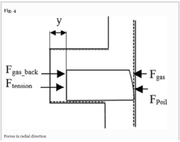
And what is this in relation to, blow-by properties you seek? Oil control?
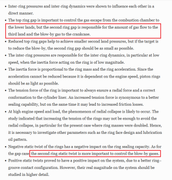
Many literature published from 1950's all the way to currently suggest that although Oil control and blow-by is related,
Methods of ring design which display superior control Oil also tend to increase blow-by, oddly enough

The issue of ring position switching, such as ring flutter and early ring position changes, ring 'uncertainty' in OEM engines is due almost all to crankcase pressure (pressure from below the ring tries to push the ring off the wall, collapsing or moving it up)

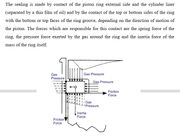
In general for Nissan/Toyota engines made between 1990 to 2002, and for Chevrolet engines made between 2002-2012, the OEM ring and pistons Designs are sufficient for approx 200hp/liter in daily driver applications provided the pistons are kept cool enough somehow (either Alcohol fuels or water injection). I've not run into any oddball issues regarding ring features since I Only use engines with 120,000 to 200,000 miles on them already, which means the vehicle has run fine for 10 to 20 years already and been maintained properly (Pass my thorough inspection)
There are many reasons why I prefer specifically 04-07 LS style truck engines, one of them is the suitable/sustainable cylinder ring sealing behaviors provided correct air filtration and PCV system setup, with extremely high mileage capability, no ring issues to speak of.
The bane of cast pistons is heat input and the bane of forged internals is cold starts.

Safety Car
Joined: Jan 2009
Posts: 4,000
Likes: 299
From: New York
I suspect many think blow by means a bad motor. When in fact every combustion engine has blow by new or old. And when you double and triple the power output. The blow by will also increase. Every piston on its down stroke pushes against these gasses and cause pressure to build up in the crank case if not evacuated
Hence the PCV system , A stock motor is "ok" using a simple PCV valve set up. However a high perf motor should seek a more efficient ways to remove these gasses. One way is using an exhaust set up were by the PCV system is attached to header collectors in such a way as to "Suck" the gasses out and expel them down the exhaust
The best way is to use a mechanical pump, belt or electric driven. That not only evacuates the gasses. But places the crank case in a vacuum. These types of systems add more HP then they use. Because the pistons are no longer pushing against gasses or atmosphere. And can add 15 to 40 hp depending on your build. NA motors are going to be on the lower side of HP gains. Were Nos or forced induction will benefit with bigger hp returns. Mainly because there ring gaps are bigger and allow more blow by.
Hence the PCV system , A stock motor is "ok" using a simple PCV valve set up. However a high perf motor should seek a more efficient ways to remove these gasses. One way is using an exhaust set up were by the PCV system is attached to header collectors in such a way as to "Suck" the gasses out and expel them down the exhaust
The best way is to use a mechanical pump, belt or electric driven. That not only evacuates the gasses. But places the crank case in a vacuum. These types of systems add more HP then they use. Because the pistons are no longer pushing against gasses or atmosphere. And can add 15 to 40 hp depending on your build. NA motors are going to be on the lower side of HP gains. Were Nos or forced induction will benefit with bigger hp returns. Mainly because there ring gaps are bigger and allow more blow by.

Racer


Joined: Jan 2020
Posts: 470
Likes: 147
From: Va.Beach Va.
My experience in the past in getting every oz of power was cemented in the cylinder being sealed as well as possible. For example 10% leak down on a 2 cylinder 50ci per cyl would be a loss of 10hp at least. I had received few tips in regard to cylinder RA and insuring the rings were flat before installation to keep leak down around 1%. At the time I was instructed to buy a machined flat surface, a large rubber block to cover the ring and 1000 grit compound. With this setup it was apparent if they were flat or not. The ones that were not I was told to toss in the garbage. I have performed vacuum testing around different parts of a race engines I had built to locate the best location for oil to return from the heads. I had 2-3 inches at my best location but I never have the opportunity to determine issues if any when running rings that were tested defective to those that were not. Just curious
Safety Car
Joined: Oct 2007
Posts: 4,222
Likes: 1,078
From: South Florida
My experience in the past in getting every oz of power was cemented in the cylinder being sealed as well as possible. For example 10% leak down on a 2 cylinder 50ci per cyl would be a loss of 10hp at least. I had received few tips in regard to cylinder RA and insuring the rings were flat before installation to keep leak down around 1%. At the time I was instructed to buy a machined flat surface, a large rubber block to cover the ring and 1000 grit compound. With this setup it was apparent if they were flat or not. The ones that were not I was told to toss in the garbage. I have performed vacuum testing around different parts of a race engines I had built to locate the best location for oil to return from the heads. I had 2-3 inches at my best location but I never have the opportunity to determine issues if any when running rings that were tested defective to those that were not. Just curious
I stopped fooling around with hobby level engine build projects. These days, I trust the OEM L33 engine from 05-07 trucks up to approx 1200rwhp and perhaps 150,000 to 300,000 miles is possible for street duty.
In 'racing' it depends what type of rules and restrictions will affect power. For example more leakdown and lost compression can be made up for with boost pressure as long as you can evacuate the crankcase properly. Large ring gaps = use more vacuum pump = power is restored or increased. Some racing limits boost or prevents you from using forced induction or turbos over a certain size or whatever so leakdown and compression/seal becomes more important. I will say from reading published documents that it appears different types of rings exist and some of them have static twist features (they will not be flat, they should not sit flat) But I Don't know how that pertains to racing or with natural aspiration, I focus mainly on reliability forced induction daily drivers using OEM pistons and OEM rings with OEM cylinder wall finish.
I will also like to point out oil molecules diameter is around 600picometers and the lengths of oil molecules may be around 6000picometers,
compared to 2uM of debris from the air that is like the empire state building compared to a typical pencil.
In other words, air filtration matters strongly to the cylinder ring seal. A tiny bit of microscopic invisible debris is a gigantic disruption between hydrophobic interactions between oil molecules and as it builds up over time will cause cylinder sealing issues and leakdown, among wear issues.
Thread Starter
Drifting

Joined: Dec 2020
Posts: 1,586
Likes: 956
From: Central Florida
2024 Corvette of the Year Winner - Modified
2023 C3 of the Year Winner - Modified
2021 C3 of the Year Finalist - Modified
I suspect many think blow by means a bad motor. When in fact every combustion engine has blow by new or old. And when you double and triple the power output. The blow by will also increase. Every piston on its down stroke pushes against these gasses and cause pressure to build up in the crank case if not evacuated
Hence the PCV system , A stock motor is "ok" using a simple PCV valve set up. However a high perf motor should seek a more efficient ways to remove these gasses. One way is using an exhaust set up were by the PCV system is attached to header collectors in such a way as to "Suck" the gasses out and expel them down the exhaust
The best way is to use a mechanical pump, belt or electric driven. That not only evacuates the gasses. But places the crank case in a vacuum. These types of systems add more HP then they use. Because the pistons are no longer pushing against gasses or atmosphere. And can add 15 to 40 hp depending on your build. NA motors are going to be on the lower side of HP gains. Were Nos or forced induction will benefit with bigger hp returns. Mainly because there ring gaps are bigger and allow more blow by.
Hence the PCV system , A stock motor is "ok" using a simple PCV valve set up. However a high perf motor should seek a more efficient ways to remove these gasses. One way is using an exhaust set up were by the PCV system is attached to header collectors in such a way as to "Suck" the gasses out and expel them down the exhaust
The best way is to use a mechanical pump, belt or electric driven. That not only evacuates the gasses. But places the crank case in a vacuum. These types of systems add more HP then they use. Because the pistons are no longer pushing against gasses or atmosphere. And can add 15 to 40 hp depending on your build. NA motors are going to be on the lower side of HP gains. Were Nos or forced induction will benefit with bigger hp returns. Mainly because there ring gaps are bigger and allow more blow by.
Safety Car
Joined: Oct 2007
Posts: 4,222
Likes: 1,078
From: South Florida
Vacuum pump is ideal for all engines. The reason OEM do not include them with every car is because of the extra complexity and they require routine maintenance, rebuild kits, and you have to set them up to some desired suction rate and monitor the crankcase pressure to make sure it does not exceed some limit based on the engine. Wet sump engines can suffer wrist pin failure and oil pump failure due to low crankcase pressure from a vacuum pump.
Corvette Stories
The Best of Corvette for Corvette Enthusiasts

Top 10 Most Expensive Corvettes Ever Sold on Bring A Trailer
Brett Foote
10 Things Every Corvette Owner Needs (2026 Edition)
Michael S. Palmer
8 Most "Only Corvette Owners Understand" Quirks and Problems
Pouria Savadkouei
10 Reasons the C6 Z06 is Still A Performance Benchmark After 20 Years
Joe Kucinski
How Much Horsepower Every Corvette Engine "LOST" in 1972
Joe Kucinski
Top 10 DOs and DON'Ts for Protecting Your Convertible Top!
Michael S. Palmer
Top 10 Most Explosive Corvettes Ever Made: Power-to-Weight Ratio Ranked!
Joe Kucinski
150 hp to 1,250 hp: Every Corvette Generation Compared by the Specs That Matter
Joe Kucinski
8 Coolest Corvette Pace Cars (and Replicas) of All Time
Verdad Gallardo
Thread Starter
Drifting
Joined: Dec 2020
Posts: 1,586
Likes: 956
From: Central Florida
2024 Corvette of the Year Winner - Modified
2023 C3 of the Year Winner - Modified
2021 C3 of the Year Finalist - Modified
Just ordered a brand new 3 vane full kit for sbc Aerospace Components. Guess how much I got it for

Thread Starter
Drifting
Joined: Dec 2020
Posts: 1,586
Likes: 956
From: Central Florida
2024 Corvette of the Year Winner - Modified
2023 C3 of the Year Winner - Modified
2021 C3 of the Year Finalist - Modified

Thread Starter
Drifting
Joined: Dec 2020
Posts: 1,586
Likes: 956
From: Central Florida
2024 Corvette of the Year Winner - Modified
2023 C3 of the Year Winner - Modified
2021 C3 of the Year Finalist - Modified


Thread Starter
Drifting
Joined: Dec 2020
Posts: 1,586
Likes: 956
From: Central Florida
2024 Corvette of the Year Winner - Modified
2023 C3 of the Year Winner - Modified
2021 C3 of the Year Finalist - Modified
Thread Starter
Drifting
Joined: Dec 2020
Posts: 1,586
Likes: 956
From: Central Florida
2024 Corvette of the Year Winner - Modified
2023 C3 of the Year Winner - Modified
2021 C3 of the Year Finalist - Modified
Thread Starter
Drifting
Joined: Dec 2020
Posts: 1,586
Likes: 956
From: Central Florida
2024 Corvette of the Year Winner - Modified
2023 C3 of the Year Winner - Modified
2021 C3 of the Year Finalist - Modified