




Oil Catch Can Question...

Team Owner


Joined: May 2004
Posts: 26,345
Likes: 232
From: SoCal

Originally Posted by Dave68
Howie,
The white filter is the borosilicate fiber filter. There is a black plastic piece that threads into the aluminum top, sealing against the filter. There is no appendage - that's my car in the background. The filter is a hollow cylinder through which the air passes. Will the filter get clogged? only if there is a large amount of liquid oil trying to pass through OR if there is more than a small amount of dirt and other particulates. Since the air that is passing through is somewhat clean of solid particles, I don't expect that the filter will clog anytime soon. many larger coalescing filters have built-in differential pressure indicators that change color if the DP is above a predetermined number (10 inches of water pressure, I believe). If our case, we can either plumb a DP gauge in between the two hose ends or wait until our idle become rough. A quick check would be to squeeze the hose entering the intake. If the idle stays the same, the filter is clogged. If the filter is good, the idle speed should decrease, I believe.
Dave
The white filter is the borosilicate fiber filter. There is a black plastic piece that threads into the aluminum top, sealing against the filter. There is no appendage - that's my car in the background. The filter is a hollow cylinder through which the air passes. Will the filter get clogged? only if there is a large amount of liquid oil trying to pass through OR if there is more than a small amount of dirt and other particulates. Since the air that is passing through is somewhat clean of solid particles, I don't expect that the filter will clog anytime soon. many larger coalescing filters have built-in differential pressure indicators that change color if the DP is above a predetermined number (10 inches of water pressure, I believe). If our case, we can either plumb a DP gauge in between the two hose ends or wait until our idle become rough. A quick check would be to squeeze the hose entering the intake. If the idle stays the same, the filter is clogged. If the filter is good, the idle speed should decrease, I believe.
Dave
What do you think about placing a layer or two of this material inside the AMW or Elite can just below the metal mesh they have in the coalescing chamber ????

DH
Race Director

Joined: Dec 2000
Posts: 19,304
Likes: 85
From: San Diego CA
Howie, I think the better way to do it would be to connect the low-flow coalescing filter in-line with the catch can via a pipe nipple. The coelescing filter assembly without bracket is about $35 - (company price) and a pipe nipple is a few bucks. The reason why I suggest this scenario is because it may be difficult to obtain a circular disc-sheet of borosilicate fiber that you can somehow attach to the catch can top.
Even if you don't have a catch can at all, it might be cheaper to buy a particulate filter to trap the liquid oil, a coaelescing filter to trap aerosols, and a larger can for the particulate filter. (I'm hoping that my extended can fits the particulate filter.) I will check into the particulate filter if my filter gets clogged. So far after almost 500 miles, it is doing very well.
Dave
Even if you don't have a catch can at all, it might be cheaper to buy a particulate filter to trap the liquid oil, a coaelescing filter to trap aerosols, and a larger can for the particulate filter. (I'm hoping that my extended can fits the particulate filter.) I will check into the particulate filter if my filter gets clogged. So far after almost 500 miles, it is doing very well.
Dave
Team Owner
Joined: May 2004
Posts: 26,345
Likes: 232
From: SoCal
Originally Posted by Dave68
Howie, I think the better way to do it would be to connect the low-flow coalescing filter in-line with the catch can via a pipe nipple. The coelescing filter assembly without bracket is about $35 - (company price) and a pipe nipple is a few bucks. The reason why I suggest this scenario is because it may be difficult to obtain a circular disc-sheet of borosilicate fiber that you can somehow attach to the catch can top.
Even if you don't have a catch can at all, it might be cheaper to buy a particulate filter to trap the liquid oil, a coaelescing filter to trap aerosols, and a larger can for the particulate filter. (I'm hoping that my extended can fits the particulate filter.) I will check into the particulate filter if my filter gets clogged. So far after almost 500 miles, it is doing very well.
Dave
Even if you don't have a catch can at all, it might be cheaper to buy a particulate filter to trap the liquid oil, a coaelescing filter to trap aerosols, and a larger can for the particulate filter. (I'm hoping that my extended can fits the particulate filter.) I will check into the particulate filter if my filter gets clogged. So far after almost 500 miles, it is doing very well.
Dave
I was also thinking about replacing my Husky's (I hear that the polycarbonate can creep
 ) with your little babies. I have one after the AMW in the PCV line. And the other in the vent line from valve cover.
So you have checked and you dont have any restriction...right. And are you catching oil....how much??
DH
Race Director
Joined: Dec 2000
Posts: 19,304
Likes: 85
From: San Diego CA
After 450 miles or so, I saw about 1/4-3/8 oz. My guess is that there may be more in the tubing, which is a couple of feet long. You might want to place one of these after your AMW can which I'm sure is allowing the majority of aerosols to pass through. Since your AMW would be catching most of the bulk liquids, the small can of the stock Watts coalescing filter assembly may be sufficient.
My filter has a flow capacity of 8 SCFM (227 LPM) and I measured approx. 36 LPM, using a digital flowmeter (calibrated for nitrogen, but close enough for this measurement) that was plumbed in-line with the PCV valve. Therefore. I know that it does have plenty of extra capacity.
Dave
My filter has a flow capacity of 8 SCFM (227 LPM) and I measured approx. 36 LPM, using a digital flowmeter (calibrated for nitrogen, but close enough for this measurement) that was plumbed in-line with the PCV valve. Therefore. I know that it does have plenty of extra capacity.
Dave
Team Owner
Joined: May 2004
Posts: 26,345
Likes: 232
From: SoCal
Originally Posted by Dave68
After 450 miles or so, I saw about 1/4-3/8 oz. My guess is that there may be more in the tubing, which is a couple of feet long. You might want to place one of these after your AMW can which I'm sure is allowing the majority of aerosols to pass through. Since your AMW would be catching most of the bulk liquids, the small can of the stock Watts coalescing filter assembly may be sufficient.
My filter has a flow capacity of 8 SCFM (227 LPM) and I measured approx. 36 LPM, using a digital flowmeter (calibrated for nitrogen, but close enough for this measurement) that was plumbed in-line with the PCV valve. Therefore. I know that it does have plenty of extra capacity.
Dave
My filter has a flow capacity of 8 SCFM (227 LPM) and I measured approx. 36 LPM, using a digital flowmeter (calibrated for nitrogen, but close enough for this measurement) that was plumbed in-line with the PCV valve. Therefore. I know that it does have plenty of extra capacity.
Dave
DH
Safety Car


Joined: Jan 2001
Posts: 3,879
Likes: 3
From: Hobart, WI
Perhaps if we used a high voltage electrostatic field driven by a flux capacitor we could develop the ultimate NASA catch can. Then we could leave the drain cracked open so it would be self purging.
Sorry-
Sorry-
Race Director
Joined: Dec 2000
Posts: 19,304
Likes: 85
From: San Diego CA
Originally Posted by Dirty Howie
Where do I look for this "stock Watts" filter. Thought you made this thing....??
DH
DH
The Watts filter number is F501-02DH (without bracket) and you might be able to hard-couple it to your catch can. As I mentioned earlier, I can get them for about $38 (no bracket) and $43 (with bracket). If you order them, yourself, they may be 25% higher in price.
Perhaps if we used a high voltage electrostatic field driven by a flux capacitor we could develop the ultimate NASA catch can. Then we could leave the drain cracked open so it would be self purging.
Sorry-
Today 10:34 AM
Sorry-
Today 10:34 AM
Team Owner
Joined: May 2004
Posts: 26,345
Likes: 232
From: SoCal
Originally Posted by Dave68
I made the extended length can. The other parts shown in one of my pics, along with a cast zinc "can" were all part of the package that I bought for $45. For most C5 owners, the zinc housing, which holds only 1 oz, is too small. However, it may be okay if it is downstream of a particulate filter or your catch can, assuming that the bulk liquids will be trapped before reaching the Watts filter.
The Watts filter number is F501-02DH (without bracket) and you might be able to hard-couple it to your catch can. As I mentioned earlier, I can get them for about $38 (no bracket) and $43 (with bracket). If you order them, yourself, they may be 25% higher in price.
The Watts filter number is F501-02DH (without bracket) and you might be able to hard-couple it to your catch can. As I mentioned earlier, I can get them for about $38 (no bracket) and $43 (with bracket). If you order them, yourself, they may be 25% higher in price.
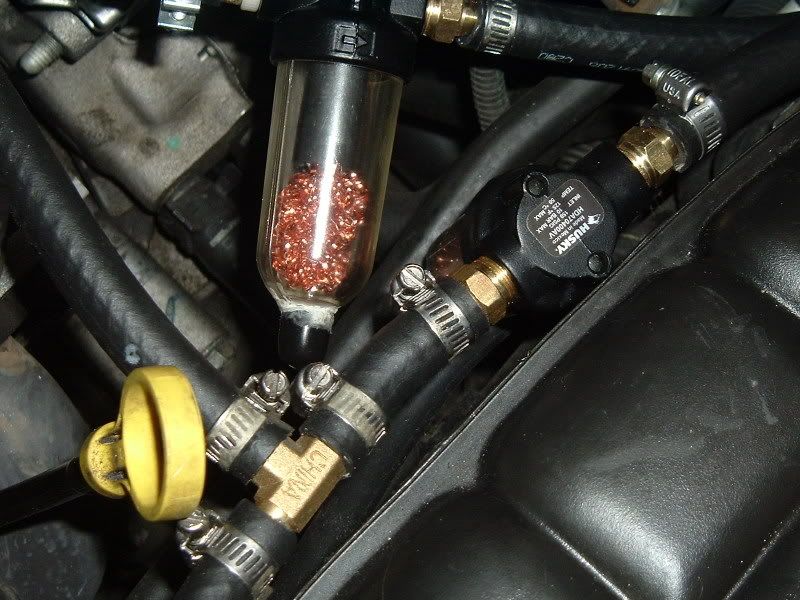
I'm thinking they are not much heavier than the Husky. So I could just splice them in to the 3/8 hose as I do now with the Husky. They stay in place as I have hoses ziptied.
DH
Corvette Stories
The Best of Corvette for Corvette Enthusiasts

Top 10 Most Expensive Corvettes Ever Sold on Bring A Trailer
Brett Foote
10 Things Every Corvette Owner Needs (2026 Edition)
Michael S. Palmer
8 Most "Only Corvette Owners Understand" Quirks and Problems
Pouria Savadkouei
10 Reasons the C6 Z06 is Still A Performance Benchmark After 20 Years
Joe Kucinski
How Much Horsepower Every Corvette Engine "LOST" in 1972
Joe Kucinski
Top 10 DOs and DON'Ts for Protecting Your Convertible Top!
Michael S. Palmer
Top 10 Most Explosive Corvettes Ever Made: Power-to-Weight Ratio Ranked!
Joe Kucinski
150 hp to 1,250 hp: Every Corvette Generation Compared by the Specs That Matter
Joe Kucinski
8 Coolest Corvette Pace Cars (and Replicas) of All Time
Verdad Gallardo
Le Mans Master

Joined: Dec 2003
Posts: 5,561
Likes: 448
From: Atlanta metro Ga.
Originally Posted by see5
Perhaps if we used a high voltage electrostatic field driven by a flux capacitor we could develop the ultimate NASA catch can. Then we could leave the drain cracked open so it would be self purging.
Sorry-
Sorry-


Team Owner
Joined: May 2004
Posts: 26,345
Likes: 232
From: SoCal
Originally Posted by Dave68
Howie,
It may even be lighter, since it is smaller in size. You can always get the longer can later if need-be.
Dave
It may even be lighter, since it is smaller in size. You can always get the longer can later if need-be.
Dave
I could not find the filter on the Watts site. Nor did a google of the part # F501-02DH get me any results ... ?????
DH
Race Director
Joined: Dec 2000
Posts: 19,304
Likes: 85
From: San Diego CA
Howie,
Go to http://www.wattsfluidair.com/catalogs/0714W_MiniFRL.pdf
and select "Air Line Coalescing Filters - miniature F501"
Distributor = Numatic Engineering (818) 768-1200
Dave
Go to http://www.wattsfluidair.com/catalogs/0714W_MiniFRL.pdf
and select "Air Line Coalescing Filters - miniature F501"
Distributor = Numatic Engineering (818) 768-1200
Dave

Team Owner
Joined: May 2001
Posts: 36,836
Likes: 244
From: Dear Karma, I have a list of people you missed.
St. Jude Donor '08-'09-'10-'11-'12-'13-'14-'15-'16
Originally Posted by Dirty Howie
I think this way is wrong. AMW thinks this way is wrong. Elite Engineering thinks this way is wrong.
Your way catches the oil vapors at the top where they will coalesce on the filter and then get sucked as oil drops into the intake.
The vapors should enter the filter at the top first, coalesce and oil drops should fall to bottom of can.
DH
Your way catches the oil vapors at the top where they will coalesce on the filter and then get sucked as oil drops into the intake.
The vapors should enter the filter at the top first, coalesce and oil drops should fall to bottom of can.
DH

Team Owner
Joined: May 2001
Posts: 36,836
Likes: 244
From: Dear Karma, I have a list of people you missed.
St. Jude Donor '08-'09-'10-'11-'12-'13-'14-'15-'16
Originally Posted by Dave68
..............Now, does anyone have a right-angle drill I can borrow.....?


So far so good with the tape and the extra bracket helps distribute the load of the can.
Robert
Race Director
Joined: Dec 2000
Posts: 19,304
Likes: 85
From: San Diego CA
Yikes! Thanks for the heads-up, Lonestar. I may try a carbide drill, but drilling at an angle, even with a right-angle attachment, is bound to be frustrating. I did order a right-angle attachment for $15 at Cummins Tool. The last think I want is a filter banging around in the engine bay, near the fans. I noticed that there is an oblong hole in that front crossbar. Maybe a snap-in plastic piece would do the trick.....Mmmmm...I'll have to check it out, further.
Dave
Dave
Team Owner
Joined: May 2004
Posts: 26,345
Likes: 232
From: SoCal
Originally Posted by Dave68
Howie,
Go to http://www.wattsfluidair.com/catalogs/0714W_MiniFRL.pdf
and select "Air Line Coalescing Filters - miniature F501"
Distributor = Numatic Engineering (818) 768-1200
Dave
Go to http://www.wattsfluidair.com/catalogs/0714W_MiniFRL.pdf
and select "Air Line Coalescing Filters - miniature F501"
Distributor = Numatic Engineering (818) 768-1200
Dave
I'm going to give those guys a call (818) might be in my neck of the woods.
Very detailed specs they provide. I did notice that orifice is only 1/4 inch not 3/8. Did I read this correctly?
They do have flow rates for the saturated filter eliment but I'm not sure how to read that. What do you make of it.
DH
Racer

Joined: Dec 2005
Posts: 431
Likes: 0
From: North Las Vegas Nevada
I cannot believe all the responses on this topic, that has been beaten to death 67 times! But it IS an important issue. I dont think you will ever stop all the oil from getting to the intake, unless you disconnect the PCV system from the intake & TB, and go with breathers.
I think the filters in the seperators are gonna slow down air flow, no matter what type of filter it is, especially when they get saturated with oil. Naturally, if you slow the flow of air down enough, you will get less oil in the intake. I say do a 2 can system with a glass fuel filter, with a little breather element in it, right before the intake, so you can monitor and see when oil is starting to make it's way through.
I have a seperator first, minus a filter stone, & mounted to the battery shield. This catches ALOT of oil! My AMW is 2nd and mounted near the air shroud so it can stay cooler and work more efficiently. Then is the glass filter with element for monitering the system. It all works well, but if not maintaned, oil will get into your motor! I do about 300 miles a week and need to drain my cans every 2 weeks or so!
I think the filters in the seperators are gonna slow down air flow, no matter what type of filter it is, especially when they get saturated with oil. Naturally, if you slow the flow of air down enough, you will get less oil in the intake. I say do a 2 can system with a glass fuel filter, with a little breather element in it, right before the intake, so you can monitor and see when oil is starting to make it's way through.
I have a seperator first, minus a filter stone, & mounted to the battery shield. This catches ALOT of oil! My AMW is 2nd and mounted near the air shroud so it can stay cooler and work more efficiently. Then is the glass filter with element for monitering the system. It all works well, but if not maintaned, oil will get into your motor! I do about 300 miles a week and need to drain my cans every 2 weeks or so!

Race Director
Joined: Dec 2000
Posts: 19,304
Likes: 85
From: San Diego CA
Originally Posted by Dirty Howie
Thanks Dave
I'm going to give those guys a call (818) might be in my neck of the woods.
Very detailed specs they provide. I did notice that orifice is only 1/4 inch not 3/8. Did I read this correctly?
They do have flow rates for the saturated filter eliment but I'm not sure how to read that. What do you make of it.
DH
I'm going to give those guys a call (818) might be in my neck of the woods.
Very detailed specs they provide. I did notice that orifice is only 1/4 inch not 3/8. Did I read this correctly?
They do have flow rates for the saturated filter eliment but I'm not sure how to read that. What do you make of it.
DH
When differential pressure reaches 10 psi, it's time to replace the filter. However, you should not have to do that for a good long time, especially in your situation. The 1/4 NPT opening is rated for 8 SCFM - way more than our PCV line will ever see. It's better to use a low-flow filter; otherwise, many aerosols will pass through the larger, courser filter media. I can get a 25% discount because the company for which I work does business with that distributor.
I think the filters in the seperators are gonna slow down air flow, no matter what type of filter it is, especially when they get saturated with oil.
And actually you CAN trap virtually all of the oil, if you are a true fanatic. There are charcoal filters that when used downstream of standard coalescing filters, will trap oil molecules so small that you wouldn;t even be able to smell them. Of course, this would be totally unneccessary, as you'd be changing all kinds of filters, all too often.
Last edited by Dave68; Dec 6, 2006 at 12:02 AM.

Le Mans Master
Joined: Mar 2002
Posts: 5,955
Likes: 161
From: PNW
Originally Posted by see5
Just so you know this is the latest (~90days) GM recommended PCV "valve" for LSx engines. It is a hollow shell with a ~2mm hole in the big end.
Don't expect much flow.

Don't expect much flow.