





 ) and ask for a PCV valve for my 2000?
Oil Catch Can Question...

Le Mans Master


Joined: Feb 2003
Posts: 6,683
Likes: 144
From: Memphis Tennessee

On my '03 AE, the PCV valve is located very near the TB. There is a short line (four inches or so) that leads from the valve to the TB. I used that as my splice. Does that make it easier to understand?

Le Mans Master

Joined: Dec 2003
Posts: 5,561
Likes: 448
From: Atlanta metro Ga.
Review the picture in post #7..
In the very top right hand-side, that is the "TB" line.. Just below that and to the left, is the "intake" port.
Catch-can should be inserted into the "intake" port loop, not the "TB" loop.
If this isn't clear, could you post a pic?
Now that I'm thinking, I do believe I've seen your config on 03's and 04's.. If you could post a picture or email, that would be helpful. teamsfr@bellsouth.net
Check out this link, lots of good info. http://eliteengineeringusa.com/Insta...uctions_CC.pdf
In the very top right hand-side, that is the "TB" line.. Just below that and to the left, is the "intake" port.
Catch-can should be inserted into the "intake" port loop, not the "TB" loop.
If this isn't clear, could you post a pic?
Now that I'm thinking, I do believe I've seen your config on 03's and 04's.. If you could post a picture or email, that would be helpful. teamsfr@bellsouth.net
Check out this link, lots of good info. http://eliteengineeringusa.com/Insta...uctions_CC.pdf
Last edited by Dan_the_C5_Man; Nov 30, 2006 at 05:18 PM.
Le Mans Master
Joined: Feb 2003
Posts: 6,683
Likes: 144
From: Memphis Tennessee
Here's my set up.
The best description I can give you is that the plastic line from the back of the intake manifold leads (eventually) to a rubber line and to the PCV valve. Then from the valve it (used to) lead into the TB. I ran hoses from the PCV to the can and then back to the TB.


The best description I can give you is that the plastic line from the back of the intake manifold leads (eventually) to a rubber line and to the PCV valve. Then from the valve it (used to) lead into the TB. I ran hoses from the PCV to the can and then back to the TB.
Le Mans Master
Joined: Dec 2003
Posts: 5,561
Likes: 448
From: Atlanta metro Ga.
From what I can see it looks correct, i.e. PCV valve > input of catch-can > output of catch-can > nipple on intake manifold.
TB hose not involved at all.
I would say be careful with the type and length of hose in use; you want minimum restriction, hoses that will not collapse under vacuum and heat, esp. in the sharp turn coming out of the PCV valve.
TB hose not involved at all.
I would say be careful with the type and length of hose in use; you want minimum restriction, hoses that will not collapse under vacuum and heat, esp. in the sharp turn coming out of the PCV valve.

Team Owner


Joined: May 2004
Posts: 26,345
Likes: 232
From: SoCal
Originally Posted by see5
Just so you know this is the latest (~90days) GM recommended PCV "valve" for LSx engines. It is a hollow shell with a ~2mm hole in the big end.
Don't expect much flow.

Don't expect much flow.
DH
Corvette Stories
The Best of Corvette for Corvette Enthusiasts

Top 10 Most Expensive Corvettes Ever Sold on Bring A Trailer
Brett Foote
10 Things Every Corvette Owner Needs (2026 Edition)
Michael S. Palmer
8 Most "Only Corvette Owners Understand" Quirks and Problems
Pouria Savadkouei
10 Reasons the C6 Z06 is Still A Performance Benchmark After 20 Years
Joe Kucinski
How Much Horsepower Every Corvette Engine "LOST" in 1972
Joe Kucinski
Top 10 DOs and DON'Ts for Protecting Your Convertible Top!
Michael S. Palmer
Top 10 Most Explosive Corvettes Ever Made: Power-to-Weight Ratio Ranked!
Joe Kucinski
150 hp to 1,250 hp: Every Corvette Generation Compared by the Specs That Matter
Joe Kucinski
8 Coolest Corvette Pace Cars (and Replicas) of All Time
Verdad Gallardo
Le Mans Master
Joined: Dec 2003
Posts: 5,561
Likes: 448
From: Atlanta metro Ga.
Done (at least enough research to get the point).
Here is my opinion..
This new PCV design is a feeble attempt to accomplish what we are already doing, i.e. installing a catch-can. Severly restricting the flow in an attempt to regulate oil into the intake doesn't seem like the best method.
My vote is "maximum flow, standard PCV valve with a catch-can".
Here is my opinion..
This new PCV design is a feeble attempt to accomplish what we are already doing, i.e. installing a catch-can. Severly restricting the flow in an attempt to regulate oil into the intake doesn't seem like the best method.
My vote is "maximum flow, standard PCV valve with a catch-can".
Thread Starter
Melting Slicks


Joined: Jun 2006
Posts: 2,923
Likes: 1
From: Cleveland Tennessee
I agree with Dan, I too have sone some research and found that the way we have decided to handle the issue was to get and install these catch cans, and hook them up the way that we did. 
Race Director

Joined: Dec 2000
Posts: 19,304
Likes: 85
From: San Diego CA
Originally Posted by ALLEGRO
Here's my set up.
The best description I can give you is that the plastic line from the back of the intake manifold leads (eventually) to a rubber line and to the PCV valve. Then from the valve it (used to) lead into the TB. I ran hoses from the PCV to the can and then back to the TB.
The best description I can give you is that the plastic line from the back of the intake manifold leads (eventually) to a rubber line and to the PCV valve. Then from the valve it (used to) lead into the TB. I ran hoses from the PCV to the can and then back to the TB.
Also, I measured flow through the PCV line and saw approx. 36 LPM. With vacuum pressure at 20"Hg, these parameters constitute a low flow, low pressure condition. An effective filter should be sized accordingly. I selected a coalescing filter with zinc bowl, but due to its small, 1 oz capacity, made my own extended length bowl out of aluminum. I will post pics, soon. I did select the battery area, too, and the only thing I don't like about this is the need for the inlet hose to loop upward. Liquid oil can be trapped in the loop. Currently, I am testing this setup and may reroute the filter if oil is piling up at the bottom of the loop.
Dave
Team Owner
Joined: May 2004
Posts: 26,345
Likes: 232
From: SoCal
Originally Posted by Dave68
A word of caution about using commercial particulate filters with polycarbonate bowls: These filter assemblies are typicated temperature-rated to 120 or 125F. The engine bay area where most catch cans are mounted gets up past 140F. Even the battery area, which is cooler, gets up past 130F. What can happen is that the bowl material can creep, compromising its sealing ability.
Also, I measured flow through the PCV line and saw approx. 36 LPM. With vacuum pressure at 20"Hg, these parameters constitute a low flow, low pressure condition. An effective filter should be sized accordingly. I selected a coalescing filter with zinc bowl, but due to its small, 1 oz capacity, made my own extended length bowl out of aluminum. I will post pics, soon. I did select the battery area, too, and the only thing I don't like about this is the need for the inlet hose to loop upward. Liquid oil can be trapped in the loop. Currently, I am testing this setup and may reroute the filter if oil is piling up at the bottom of the loop.
Dave
Also, I measured flow through the PCV line and saw approx. 36 LPM. With vacuum pressure at 20"Hg, these parameters constitute a low flow, low pressure condition. An effective filter should be sized accordingly. I selected a coalescing filter with zinc bowl, but due to its small, 1 oz capacity, made my own extended length bowl out of aluminum. I will post pics, soon. I did select the battery area, too, and the only thing I don't like about this is the need for the inlet hose to loop upward. Liquid oil can be trapped in the loop. Currently, I am testing this setup and may reroute the filter if oil is piling up at the bottom of the loop.
Dave
I am keeping an eye on my cheepo-carbonate-creeping filters. So far they seem very intact, screwing in and out without binding or any signs of creep.

Why don't you mount your can to the right side frame up front as I and others have done?? Its cooler and a down hill run from intake to can.

DH

Melting Slicks


Joined: May 2000
Posts: 3,028
Likes: 226
From: Locust Valley NY USA
Originally Posted by Dirty Howie
Dave
I am keeping an eye on my cheepo-carbonate-creeping filters. So far they seem very intact, screwing in and out without binding or any signs of creep.
Why don't you mount your can to the right side frame up front as I and others have done?? Its cooler and a down hill run from intake to can.
DH
I am keeping an eye on my cheepo-carbonate-creeping filters. So far they seem very intact, screwing in and out without binding or any signs of creep.
Why don't you mount your can to the right side frame up front as I and others have done?? Its cooler and a down hill run from intake to can.
DH
FRED
Race Director
Joined: Dec 2000
Posts: 19,304
Likes: 85
From: San Diego CA
Originally Posted by Dirty Howie
Dave
I am keeping an eye on my cheepo-carbonate-creeping filters. So far they seem very intact, screwing in and out without binding or any signs of creep.
Why don't you mount your can to the right side frame up front as I and others have done?? Its cooler and a down hill run from intake to can.
DH
I am keeping an eye on my cheepo-carbonate-creeping filters. So far they seem very intact, screwing in and out without binding or any signs of creep.
Why don't you mount your can to the right side frame up front as I and others have done?? Its cooler and a down hill run from intake to can.
DH
I'm sure there is a safety factor in that max temp, but it's kinda like using radiator hose when you need fuel line hose. You might be able to have no issues for a year, a month, or ?????
I may very well change my location just because of the downhill factor. The battery compartment makes removing the can a breeze; how is it when it's mounted down low? Is it a pain to get to when you have the back of a 48 year-old?
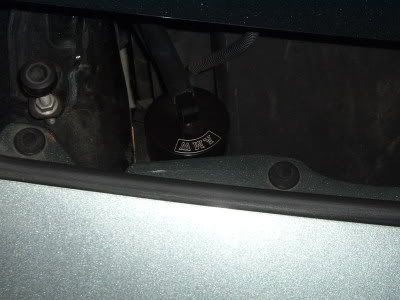
Ron, Here's a pic of my custom extended can. It quadruples the oil capacity of the original.

Team Owner
Joined: May 2004
Posts: 26,345
Likes: 232
From: SoCal
Originally Posted by FRED HAMBLE
Do you have a pic of this ? Would like to see where you installed the can. I have the Chrome tension cover which interfers with the standard installation.
FRED
FRED
DH
Team Owner
Joined: May 2004
Posts: 26,345
Likes: 232
From: SoCal
Originally Posted by Dave68
Howie,
I'm sure there is a safety factor in that max temp, but it's kinda like using radiator hose when you need fuel line hose. You might be able to have no issues for a year, a month, or ?????
I may very well change my location just because of the downhill factor. The battery compartment makes removing the can a breeze; how is it when it's mounted down low? Is it a pain to get to when you have the back of a 48 year-old?
Ron, Here's a pic of my custom extended can. It quadruples the oil capacity of the original.
I'm sure there is a safety factor in that max temp, but it's kinda like using radiator hose when you need fuel line hose. You might be able to have no issues for a year, a month, or ?????
I may very well change my location just because of the downhill factor. The battery compartment makes removing the can a breeze; how is it when it's mounted down low? Is it a pain to get to when you have the back of a 48 year-old?
Ron, Here's a pic of my custom extended can. It quadruples the oil capacity of the original.
Quit your bitchin.......I'm 56 so I'm sure you can handle it
You get on your knees, pull hoses, loose allen screw which keeps can in bracket, pull can ........ 75 seconds max
Your can looks very small or you have a huge freakin hand...
DH
Le Mans Master
Joined: Dec 2003
Posts: 5,561
Likes: 448
From: Atlanta metro Ga.
Dave has access to CAD/CAM and milling machines, so it looks like he made a small aluminum can to replace the small plastic / glass unit on the air compressor filter.
If I had access to the tools and machines Dave does, hell, my wife and kids would only see me twice a day, once to eat and once to (eventually) sleep.
If I had access to the tools and machines Dave does, hell, my wife and kids would only see me twice a day, once to eat and once to (eventually) sleep.
Le Mans Master
Joined: Feb 2003
Posts: 6,683
Likes: 144
From: Memphis Tennessee
I finally found a diagram of the PCV system.
What I did is spice my can line at the front of the PCV valve and routed it back into the TB.
Maybe this diagram helps to understand my install better.
Comments??

What I did is spice my can line at the front of the PCV valve and routed it back into the TB.
Maybe this diagram helps to understand my install better.
Comments??
Le Mans Master
Joined: Dec 2003
Posts: 5,561
Likes: 448
From: Atlanta metro Ga.
Barry, I think we keep saying the same thing, but using different terminology..
The line with the PCV valve should have been connected to the intake nipple, not the throttle-body nipple, before you installed the catch-can. The diagram you posted shows the PCV valve terminating to the intake nipple. Do you agree? Did you but the car new or used?
Again, it should go valley cover / crankcase > PCV valve (either before or after the valve, makes no difference), > catch-can > intake manifold.
You should have a separate hose from the throttle-body to (I presume on your car) a nipple on a valve cover.
If you have it routed valley cover / crankcase > PCV valve > catch-can > throttle-body nipple, then you have disconnected the fresh air supply to the crankcase, and it must be hanging open somewhere un-filtered (not good).
No worries; the picture you posted clearly shows you have the catch-can in the correct location, you just need to understand the black plastic nipple is from the intake manifold, not the throttle-body (that's the aluminum nipple).
The line with the PCV valve should have been connected to the intake nipple, not the throttle-body nipple, before you installed the catch-can. The diagram you posted shows the PCV valve terminating to the intake nipple. Do you agree? Did you but the car new or used?
Again, it should go valley cover / crankcase > PCV valve (either before or after the valve, makes no difference), > catch-can > intake manifold.
You should have a separate hose from the throttle-body to (I presume on your car) a nipple on a valve cover.
If you have it routed valley cover / crankcase > PCV valve > catch-can > throttle-body nipple, then you have disconnected the fresh air supply to the crankcase, and it must be hanging open somewhere un-filtered (not good).
No worries; the picture you posted clearly shows you have the catch-can in the correct location, you just need to understand the black plastic nipple is from the intake manifold, not the throttle-body (that's the aluminum nipple).
Last edited by Dan_the_C5_Man; Dec 2, 2006 at 04:43 PM.