






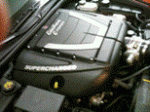

Edelbrock E-Force?

Thread Starter
Safety Car


Joined: Sep 2007
Posts: 3,502
Likes: 82

I've had a couple of requests from guys looking for more info on exactly where I cut the plastic "radiator baffle" under the Halltech shroud to let more cool air in. This should give you a pretty good idea...easily done with the baffle in the car using a box knife with a fresh blade.


Burning Brakes


Joined: Mar 2006
Posts: 790
Likes: 63
From: Ft Worth TX
You need to find a deal like I ran across this weekend...The "Heat Buster"... 15,000 cfm per minute at only 500rpm....very quiet, made in the good ole U.S. of A. and evacuates my entire garage 3x a minute! Oh and the guy only wanted $125.00 for it...ever so slightly used. 

Advanced

Joined: Mar 2010
Posts: 65
Likes: 0
From: Temple City CA
You need to find a deal like I ran across this weekend...The "Heat Buster"... 15,000 cfm per minute at only 500rpm....very quiet, made in the good ole U.S. of A. and evacuates my entire garage 3x a minute! Oh and the guy only wanted $125.00 for it...ever so slightly used.
 When you get to work with the intercooler let us know.

Former Vendor
Joined: Jul 2008
Posts: 4,327
Likes: 7
From: Oxnard SoCal www.aacorvette.com www.superchargersuperstore.com

Advanced
Joined: Dec 2009
Posts: 52
Likes: 0
From: ione CA
Cool. Please let me know how it goes. It does look like a lot of work to install but hopefully, it will be worth it. I am definitely interested but I have my concerns (engine heating, reliability, etc). It they work, I will probably try to find a good installer in Northern CA, if they exist.
Corvette Stories
The Best of Corvette for Corvette Enthusiasts

10 Reasons the C6 Z06 is Still A Performance Benchmark After 20 Years
Joe Kucinski
How Much Horsepower Every Corvette Engine "LOST" in 1972
Joe Kucinski
Top 10 DOs and DON'Ts for Protecting Your Convertible Top!
Michael S. Palmer
Top 10 Most Explosive Corvettes Ever Made: Power-to-Weight Ratio Ranked!
Joe Kucinski
150 hp to 1,250 hp: Every Corvette Generation Compared by the Specs That Matter
Joe Kucinski
8 Coolest Corvette Pace Cars (and Replicas) of All Time
Verdad Gallardo
Top 10 Corvette Engines RANKED by Peak Torque (70+ Years of Muscle!)
Joe Kucinski
Corvette ZR1X Will Be Pacing the Indy 500, And Could Probably Race, Too!
Verdad Gallardo
Top 10 Corvettes Coming to Mecum Indy 2026!
Brett Foote

 Same here.



Le Mans Master

Joined: Oct 2009
Posts: 5,000
Likes: 2,261
Could you just use boost-a-pump as an alternative to replacing the stock fuel pump ?
So question for the forum please: I drive 70mph with KB set at 1 and get x miles. I drive 70mph with KB set at 3 and I get much less. Would make sense until the below are considered:
Engine is a gas "pull" system so why do I consume more at same load?
At 70mph the KB should not engage anyway?
Ultimately it is just hard for me to believe that the engine is consuming more because the KB is providing more fuel at the same comparable load? (push gas instead of pulling gas?)
Thread Starter
Safety Car
Joined: Sep 2007
Posts: 3,502
Likes: 82
I went the KB route with the 1591. Have logged 3000 miles with the setup and am happy with it with no major issues to report. Please consider I am a "cruiser? vs a "racer" and have gone WOT only a couple of times so far. What I have subjectively noticed with the KB is that the gas consumption seems directly proportional to the amount of boost power (1-5) applied to the pump. Have to admit have had not the time to gather empirical evidence but it is almost evident.
So question for the forum please: I drive 70mph with KB set at 1 and get x miles. I drive 70mph with KB set at 3 and I get much less. Would make sense until the below are considered:
Engine is a gas "pull" system so why do I consume more at same load?
At 70mph the KB should not engage anyway?
Ultimately it is just hard for me to believe that the engine is consuming more because the KB is providing more fuel at the same comparable load? (push gas instead of pulling gas?)
So question for the forum please: I drive 70mph with KB set at 1 and get x miles. I drive 70mph with KB set at 3 and I get much less. Would make sense until the below are considered:
Engine is a gas "pull" system so why do I consume more at same load?
At 70mph the KB should not engage anyway?
Ultimately it is just hard for me to believe that the engine is consuming more because the KB is providing more fuel at the same comparable load? (push gas instead of pulling gas?)
Le Mans Master

Joined: Oct 2007
Posts: 6,149
Likes: 11
From: Greater Detroit Metro MI, when I'm not travelling.
Le Mans Master
Joined: Oct 2007
Posts: 6,149
Likes: 11
From: Greater Detroit Metro MI, when I'm not travelling.
When you turn up the Boost-A-Pump your are increasing the voltage to the pump which in turns delivers more fuel to the rails. If you had a fuel pressure gauge installed I bet you'd also see an increase in pressure at the rails. This in turn screws with the calibration you had done. I would be willing to bet that if you had a wideband o2 in the circuit you'd see a lower AFR when you turn up the wick on the BAP.
Also since the car runs closed loop it would simply recalibrate the fuel trims if what you said were true (which it isn't).
The BAP's only job is to provide more fuel capacity under boost to prevent a drop in fuel pressure which is what happens when you try to flow more fuel than the stock system can support.
Even if you ran 20V to the pump at idle all that would happen is that it would end up running hotter.
Le Mans Master
Joined: Oct 2009
Posts: 5,000
Likes: 2,261
Thank you both Motorhead-47 and PowerLabs. I think I am getting closer to understand.
I guess when you say "hotter" you are referring to the pump getting hotter?
So at a basic level I am concluding that the 1591 obviously implies more gas consumption at any load because of the bigger injectors and associated tuning and not because of the augmented supply via BAP which engages at boost anyway?
If it is so why then more consumption as I turn the BAP wick up at the same load?
Please consider this is not about fuel consumption but on whether I am running richer/poorer fuel mix?
Even if you ran 20V to the pump at idle all that would happen is that it would end up running hotter.
So at a basic level I am concluding that the 1591 obviously implies more gas consumption at any load because of the bigger injectors and associated tuning and not because of the augmented supply via BAP which engages at boost anyway?
If it is so why then more consumption as I turn the BAP wick up at the same load?
Please consider this is not about fuel consumption but on whether I am running richer/poorer fuel mix?
Le Mans Master
Joined: Oct 2007
Posts: 6,149
Likes: 11
From: Greater Detroit Metro MI, when I'm not travelling.
Thank you both Motorhead-47 and PowerLabs. I think I am getting closer to understand.
I guess when you say "hotter" you are referring to the pump getting hotter?
So at a basic level I am concluding that the 1591 obviously implies more gas consumption at any load because of the bigger injectors and associated tuning and not because of the augmented supply via BAP which engages at boost anyway?
If it is so why then more consumption as I turn the BAP wick up at the same load?
Please consider this is not about fuel consumption but on whether I am running richer/poorer fuel mix?
I guess when you say "hotter" you are referring to the pump getting hotter?
So at a basic level I am concluding that the 1591 obviously implies more gas consumption at any load because of the bigger injectors and associated tuning and not because of the augmented supply via BAP which engages at boost anyway?
If it is so why then more consumption as I turn the BAP wick up at the same load?
Please consider this is not about fuel consumption but on whether I am running richer/poorer fuel mix?
If it can't do that it will throw a code.
The reason you observe poorer fuel economy with a supercharger is because your engine now has to run itself, along with all the accessories, PLUS the supercharger. The blower IS bypassed under all vacuum conditions, but it is not by any means a zero restriction piece, it is not frictionless, and it doesn't have zero mass, so it takes some additional horsepower to turn, and as a result it shows some loss of fuel economy.
Larger losses can be accounted for deficiencies in the tune; it is possible that too little timing is being commanded, for example. If the loss is very large that would be my guess. Typically you'd see a 1 - 2MPG drop from the blower, as per Corky Bell, in his book "Supercharged".
My current full time occupation is in fuel and fuel economy research btw


Le Mans Master

Joined: Dec 2005
Posts: 6,999
Likes: 1,685
From: Southeast TX
The LS2 actually has a little higher c/r. I'd bet if they put the same blower with the same drive pulley on an LS2 and LS3, they'd make near the same power. The boost on the LS3 would be less. Pulley the LS3 down to where the boost pressure is similar to the LS2 and the LS3 would make more power.