






Interior Heat

Racer


Joined: Sep 2012
Posts: 259
Likes: 6

You are very right about all that heat at the steering box. I also have blasted headers and they will cook everything under the hood. I have really thought it over and it seems you will gain most by spending your time on wrapping the headers. I believe you will cut the heat dramatically plus cut down on some of the loud header sound.
Johnny Y
Johnny Y

Le Mans Master


Joined: Oct 2006
Posts: 6,842
Likes: 285
From: Palmdale CA
Nice C5! I like it! I'm sure it helps out and thanks for the detailed pics! Some thoughts. Johnny, it may just come to wrapping the header, but I'll save that for last. I made up a seven layer shield and it was only a half inch thick. With the new, super dense 1/8" fiberglass making up three layers and Kapton, four, it was almost book like in heft and feel. It was tough to bend, but it does give.
Also made up a nine layer pad, four layers of insulation and five reflective. Fits nicely against the AC Plenum and is 11"x14". Used the 3M 90 High Strength Adhesive to bond the layers together. Finally, if we go Phase II, the Ram Air option, I may plumb it, on the driver's side, so that the exit nozzle, coming out of the left fenderliner, would point directly at the #1 and #3 exhaust header bend.
Also made up a nine layer pad, four layers of insulation and five reflective. Fits nicely against the AC Plenum and is 11"x14". Used the 3M 90 High Strength Adhesive to bond the layers together. Finally, if we go Phase II, the Ram Air option, I may plumb it, on the driver's side, so that the exit nozzle, coming out of the left fenderliner, would point directly at the #1 and #3 exhaust header bend.
Racer
Joined: Jul 2013
Posts: 385
Likes: 3
From: Leesburg VA
This problem never ceases to surprise me! I really thought the hood vents would make a huge difference. Just imagine what the steering box temps were before you added the hood vents. I can only imagine the environment inside the steering box...it is amazing that they last as long as they do.
OK, so having thought about this all night here is my brainstorming thoughts. I think the ram air is a good idea assuming that it increases the airflow UP and through the hood vents. I think the ram air needs to be aimed upward somewhat to try to ensure the exit air is going through the vents in the hood. My theory is that the underside of the car is packed with air already and airflow through the radiator and in the engine bay trying to exit under the car is slowed down kind of like the eddy in a river. Plus the heat naturally flows upward, so trying to exit heat under the car is terribly inefficient. Regis, the studies you showed earlier in the thread showed the flow of air under the vehicle and it is fast and flat, the slower air in the engine compartment is just bled off from the bottom as it accelerates to the speed of the free airstream below the car. Giving the air an exit above the engine compartment is the natural way to extract the heat. I think the goal of the ram air system is to increase the airflow through the engine compartment and out the hood vents. It may sound obvious, but it is an important distinction.
Based on the temperatures of the steering box, I think we still have an air circulation problem. If enough air was moving through the engine compartment, there is no way that steering box could get that hot which is why the next logical step is the ram air system. I am just thinking out loud now, but I wonder what options are available to inhibit engine compartment airflow from trying to exit under the car? Also, we need to pay attention to the engine temperatures to ensure the ram air system, by forcing more air into the engine compartment, does not inhibit airflow through the radiator itself. Not likely, but it was a thought that crossed my mind.
Very perplexing problem, but interesting at the same time.
John
OK, so having thought about this all night here is my brainstorming thoughts. I think the ram air is a good idea assuming that it increases the airflow UP and through the hood vents. I think the ram air needs to be aimed upward somewhat to try to ensure the exit air is going through the vents in the hood. My theory is that the underside of the car is packed with air already and airflow through the radiator and in the engine bay trying to exit under the car is slowed down kind of like the eddy in a river. Plus the heat naturally flows upward, so trying to exit heat under the car is terribly inefficient. Regis, the studies you showed earlier in the thread showed the flow of air under the vehicle and it is fast and flat, the slower air in the engine compartment is just bled off from the bottom as it accelerates to the speed of the free airstream below the car. Giving the air an exit above the engine compartment is the natural way to extract the heat. I think the goal of the ram air system is to increase the airflow through the engine compartment and out the hood vents. It may sound obvious, but it is an important distinction.
Based on the temperatures of the steering box, I think we still have an air circulation problem. If enough air was moving through the engine compartment, there is no way that steering box could get that hot which is why the next logical step is the ram air system. I am just thinking out loud now, but I wonder what options are available to inhibit engine compartment airflow from trying to exit under the car? Also, we need to pay attention to the engine temperatures to ensure the ram air system, by forcing more air into the engine compartment, does not inhibit airflow through the radiator itself. Not likely, but it was a thought that crossed my mind.
Very perplexing problem, but interesting at the same time.
John

Drifting


Joined: Jun 2013
Posts: 1,269
Likes: 226
From: Cocoa FL
I was thinking about this heat issue last night, and it seems most of the talk/ideas revolve around removing heat at speed, not sitting at a light or slowly idling through traffic, which is mostly what I do when I drive mine. So, with that long winded sentence I think the venting ideas would not really benefit me. The shield under the floor pan seems to be the best option for slow driving to keep the heat out of the cabin in the first place. I hope those work as I feel that would be my best option. Just throwing my $.02 in there.

Instructor
Joined: Nov 2012
Posts: 118
Likes: 0
From: Pennsylvania
How close to the back of the engine bay are the hood vents? Like, how close to the firewall?
I think there's a few ways you can get the header heat away from the steering box and firewall, unfortunately I don't have my vette with me for the next few days to really see what space there is in there to do things.
I think there's a few ways you can get the header heat away from the steering box and firewall, unfortunately I don't have my vette with me for the next few days to really see what space there is in there to do things.
Le Mans Master
Joined: Oct 2006
Posts: 6,842
Likes: 285
From: Palmdale CA
How close to the back of the engine bay are the hood vents? Like, how close to the firewall?
I think there's a few ways you can get the header heat away from the steering box and firewall, unfortunately I don't have my vette with me for the next few days to really see what space there is in there to do things.
I think there's a few ways you can get the header heat away from the steering box and firewall, unfortunately I don't have my vette with me for the next few days to really see what space there is in there to do things.
I'm going to apply a heat shield to the Steering box, with the very limited space that I have and see if that works. The next step after seeing if it works, is to find a set of exhaust manifolds, that marry up to my D-Port L98 Aluminum Heads (87-91 Corvette), same as ZZ4 HO motor.
It could be the LT-1 stock exhaust or maybe something more exotic, but I've got to get the heat away from the steering box. That is the hottest thing in the firewall (that's why I wish I had a FLIR camera, because it would've been easy to pick out, versus, finding it by trial, error and intuition!).
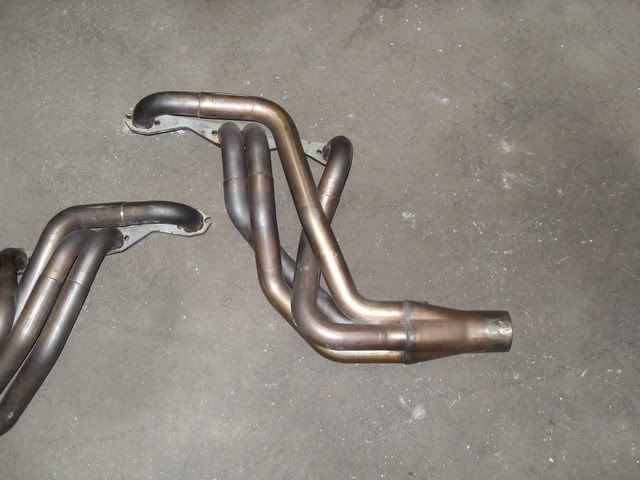
LT1 exhaust manifolds $369 from SSAC. I like how they're made, with the tight folds and bends

Kooks Headers. Note the driver's side, #1 goes up and over, and both #3 and #5, sweep back hard. I can see the spacing needed for the steering box, right there.
Last edited by F22; Oct 18, 2013 at 11:05 AM.

Thread Starter
Melting Slicks

Joined: Sep 2011
Posts: 3,372
Likes: 215
From: Peoria Arizona
You are very right about all that heat at the steering box. I also have blasted headers and they will cook everything under the hood. I have really thought it over and it seems you will gain most by spending your time on wrapping the headers. I believe you will cut the heat dramatically plus cut down on some of the loud header sound.
Johnny Y
Johnny Y
Thanks again for all of your hard work and experimentation on this F22! Look forward to any results you post up.

Adam
Corvette Stories
The Best of Corvette for Corvette Enthusiasts

Corvette & Porsche 911: How Two Icons Conquered the Last 25 Years
Joe Kucinski
2027 Chevrolet Silverado 1500 First Look: Everything You NEED to Know!
Michael S. Palmer
5 Best & 5 Worst Corvette Daily Drivers
Joe Kucinski
The Headlights of Every Corvette Generation Explained
Joe Kucinski
5 Best & 5 Most Overrated Corvette Track Packages of All Time!
Joe Kucinski
Every 2027 Corvette Engine Explained
Joe Kucinski
Designer Imagines A Corvette That Looks More Like a Corvette Than the Corvette
Verdad Gallardo
10 Ugly Corvettes That We Still Kinda Love
Joe Kucinski
Top 10 Most Expensive Corvettes Ever Sold on Bring A Trailer
Brett Foote
Le Mans Master
Joined: Oct 2006
Posts: 6,842
Likes: 285
From: Palmdale CA
This problem never ceases to surprise me! I really thought the hood vents would make a huge difference. Just imagine what the steering box temps were before you added the hood vents. I can only imagine the environment inside the steering box...it is amazing that they last as long as they do.
OK, so having thought about this all night here is my brainstorming thoughts. I think the ram air is a good idea assuming that it increases the airflow UP and through the hood vents. I think the ram air needs to be aimed upward somewhat to try to ensure the exit air is going through the vents in the hood. My theory is that the underside of the car is packed with air already and airflow through the radiator and in the engine bay trying to exit under the car is slowed down kind of like the eddy in a river. Plus the heat naturally flows upward, so trying to exit heat under the car is terribly inefficient. Regis, the studies you showed earlier in the thread showed the flow of air under the vehicle and it is fast and flat, the slower air in the engine compartment is just bled off from the bottom as it accelerates to the speed of the free airstream below the car. Giving the air an exit above the engine compartment is the natural way to extract the heat. I think the goal of the ram air system is to increase the airflow through the engine compartment and out the hood vents. It may sound obvious, but it is an important distinction.
Based on the temperatures of the steering box, I think we still have an air circulation problem. If enough air was moving through the engine compartment, there is no way that steering box could get that hot which is why the next logical step is the ram air system. I am just thinking out loud now, but I wonder what options are available to inhibit engine compartment airflow from trying to exit under the car? Also, we need to pay attention to the engine temperatures to ensure the ram air system, by forcing more air into the engine compartment, does not inhibit airflow through the radiator itself. Not likely, but it was a thought that crossed my mind.
Very perplexing problem, but interesting at the same time.
John
OK, so having thought about this all night here is my brainstorming thoughts. I think the ram air is a good idea assuming that it increases the airflow UP and through the hood vents. I think the ram air needs to be aimed upward somewhat to try to ensure the exit air is going through the vents in the hood. My theory is that the underside of the car is packed with air already and airflow through the radiator and in the engine bay trying to exit under the car is slowed down kind of like the eddy in a river. Plus the heat naturally flows upward, so trying to exit heat under the car is terribly inefficient. Regis, the studies you showed earlier in the thread showed the flow of air under the vehicle and it is fast and flat, the slower air in the engine compartment is just bled off from the bottom as it accelerates to the speed of the free airstream below the car. Giving the air an exit above the engine compartment is the natural way to extract the heat. I think the goal of the ram air system is to increase the airflow through the engine compartment and out the hood vents. It may sound obvious, but it is an important distinction.
Based on the temperatures of the steering box, I think we still have an air circulation problem. If enough air was moving through the engine compartment, there is no way that steering box could get that hot which is why the next logical step is the ram air system. I am just thinking out loud now, but I wonder what options are available to inhibit engine compartment airflow from trying to exit under the car? Also, we need to pay attention to the engine temperatures to ensure the ram air system, by forcing more air into the engine compartment, does not inhibit airflow through the radiator itself. Not likely, but it was a thought that crossed my mind.
Very perplexing problem, but interesting at the same time.
John
The ram air system, I think, is going to be a go, even if we solve the steering column problem. Frankly, I was amazed at how blazing hot to the touch, that plate was! I encourage all of you, to try it out on your next long drive. Pull over at the hour mark and start at the outside of the footwell and measure the heat with your hand. It's cooler on the outside and around that plate. Then touch that plate. You'll see that it's the the hottest part of the floorwell!
Yesterday, was moderate temps, 78 degrees or so and it was 143 degrees. Can you imagine, what the temps would be on a 95 degree day, 100? I'm betting 150 plus, easy! And I'm also betting, that is the primary source of the floorboard heat, with the firewall and accessories on that firewall, second. Remember, the A/C plenum was 134 and the the top of the wiperwell was 143!
The wiper motor was 150 or so, but last time I got that temp, that was after the car had sat for 30 minutes! So we did reduce the heat under the hood, successfully. Now to work on the steering column.
Le Mans Master
Joined: Oct 2006
Posts: 6,842
Likes: 285
From: Palmdale CA
I had our headers ceramic coated (inside and out) and it's amazing how much cooler they run, and also how fast they cool off after the car is shut down. I'll try to remember to post up some temps after I get the fuel system and carb setup this weekend.
Thanks again for all of your hard work and experimentation on this F22! Look forward to any results you post up.
Adam
Thanks again for all of your hard work and experimentation on this F22! Look forward to any results you post up.
Adam
You're very welcome, Sir! I'm on a mission and with any luck, we will figure out what's going on, fix them and mitigate as much of the heat as possible.
Instructor
Joined: Nov 2012
Posts: 118
Likes: 0
From: Pennsylvania
I do feel like the solution to engine bay heat, cabin heat and front end lift is a mixture of heat shielding and venting and maybe some scooping. But as with all thermo-aerodynamics, positioning is key!
Instructor
Joined: Nov 2012
Posts: 118
Likes: 0
From: Pennsylvania
It is hard to tell from pictures. My left Hooker headers sweep back to get around the steering box more than the passenger side, but they still get really bloody close to it.
Le Mans Master
Joined: Oct 2006
Posts: 6,842
Likes: 285
From: Palmdale CA
The ones pictured, the #1, goes UP and OVER and the #3 and #5 are more recessed, than what I have on there now. There's a a big gap underneath, where your steering box would go and I think that would help, versus the straight out and down design I have on there now.
These are LT1 headers too. Not sure if you can get a set of regular SBC headers that look like that (with the upward sweep). These are specific for the D-port heads and are made for the 93-95 LT-1 Camaro's and Firebirds, so not sure if they'll fit yet....
Isn't that weird though, my C4 has none of the heat problems with the floorboards, that my C3 has. Maybe that's how they fixed it?


Melting Slicks
Joined: Mar 2008
Posts: 2,666
Likes: 289
From: Spring Park MN
I haven't read this whole thread, but I will. It looks very interesting. I can share what I did with my 80 Vette.
First off, it had the engine and tranny in my signature below in it. I did the basics and made sure I had a good cooling system with a new aluminum radiator, high flow aluminum water pump and of course the heads and intake were aluminum. All of the fan shroud and the seals to the hood were all in place. Car never ran over 190 degrees in the worst heat of summer.
I ran Jet Hot Sterling coated headers, coated inside and outside of the tubes. This really does lower heat put out by the headers.
Next I had Thermo Tec's aluminized thermo barrier under the car where the headers and exhaust passed starting from halfway down the firewall and ending under the seats. The stock tunnel insulation was still in place and in good shape. The engine was also well tuned, which keeps the exhaust temps down at cruise.
I made sure the firewall and tunnel where the shifter is was sealed everywhere.
The interior was almost like new, so I didn't do anything under the carpet.
For the air conditioner I replaced the dryer and converted to R32. It blew pretty cold air.
That's about it. Pretty basic stuff and I can't say I had any issues with cabin heat. We usually don't get a lot of 100 degree days, but we had some during the summers I had the car and it was always comfortable inside. I had glass T-tops, so if I left it parked in the sun, it would get really hot inside. It would take the air a while to get it cooled down.
First off, it had the engine and tranny in my signature below in it. I did the basics and made sure I had a good cooling system with a new aluminum radiator, high flow aluminum water pump and of course the heads and intake were aluminum. All of the fan shroud and the seals to the hood were all in place. Car never ran over 190 degrees in the worst heat of summer.
I ran Jet Hot Sterling coated headers, coated inside and outside of the tubes. This really does lower heat put out by the headers.
Next I had Thermo Tec's aluminized thermo barrier under the car where the headers and exhaust passed starting from halfway down the firewall and ending under the seats. The stock tunnel insulation was still in place and in good shape. The engine was also well tuned, which keeps the exhaust temps down at cruise.
I made sure the firewall and tunnel where the shifter is was sealed everywhere.
The interior was almost like new, so I didn't do anything under the carpet.
For the air conditioner I replaced the dryer and converted to R32. It blew pretty cold air.
That's about it. Pretty basic stuff and I can't say I had any issues with cabin heat. We usually don't get a lot of 100 degree days, but we had some during the summers I had the car and it was always comfortable inside. I had glass T-tops, so if I left it parked in the sun, it would get really hot inside. It would take the air a while to get it cooled down.
Last edited by v2racing; Oct 18, 2013 at 01:47 PM.
Racer
Joined: Jul 2013
Posts: 385
Likes: 3
From: Leesburg VA

Melting Slicks
Joined: Oct 2012
Posts: 2,156
Likes: 273
From: Dunedin NZ.
Just thinking aloud here, need to put a new rib across the inside of the hood near the back so that vents can be fitted as close to the firewall as possible by cutting away part of the existing rib. Then block off the intake to the plenum and make a new one with a duct to bring in air from somewhere ahead of the radiator.
Racer
Joined: Jul 2013
Posts: 385
Likes: 3
From: Leesburg VA
Just thinking aloud here, need to put a new rib across the inside of the hood near the back so that vents can be fitted as close to the firewall as possible by cutting away part of the existing rib. Then block off the intake to the plenum and make a new one with a duct to bring in air from somewhere ahead of the radiator.
John
Instructor
Joined: Nov 2012
Posts: 118
Likes: 0
From: Pennsylvania
Yeah, I was thinking you could just cut the hood structure near the top and then reinforce it with the vents themselves... but I always like to test things with plastic/cardboard before going all out and making it out of Steel/Aluminium.
But if the problem is the headers/steering column, I'd want to take a long hard look at the area before trying more hood venting. You could easily add venting in the wrong place, lowering the pressure under the hood and reducing the effectiveness of the side vents while simultaneously not actually venting the header/steering box area any better than you were before.
I can see heat rising from the slot in my L88 hood, but that doesn't necessarily mean the heat is being removed from the area that's causing the high cabin temps.
You could (if there's space) change your ram air design so it dumps air near the headers rather than behind the radiator, this would drive the cooling of that specific area and then trusting the radiator fan to drive the cooling of the front area of the engine bay.
But if the problem is the headers/steering column, I'd want to take a long hard look at the area before trying more hood venting. You could easily add venting in the wrong place, lowering the pressure under the hood and reducing the effectiveness of the side vents while simultaneously not actually venting the header/steering box area any better than you were before.
I can see heat rising from the slot in my L88 hood, but that doesn't necessarily mean the heat is being removed from the area that's causing the high cabin temps.
You could (if there's space) change your ram air design so it dumps air near the headers rather than behind the radiator, this would drive the cooling of that specific area and then trusting the radiator fan to drive the cooling of the front area of the engine bay.
Instructor
Joined: Nov 2012
Posts: 118
Likes: 0
From: Pennsylvania
 Might even be able to squeeze it in to the wind tunnel at some stage (would have to line up with other testing, though).
Le Mans Master
Joined: Oct 2006
Posts: 6,842
Likes: 285
From: Palmdale CA
I'm happy with how the hood came out! I've gotten nothing, but enthusiastic complements about it. The overall consensus is; "That looks Bad-***!", so no regrets and it does help evacuate the heat out of the engine compartment.
Took the '74 out for a long drive and at the hour mark, stopped at my local watering hole and shot some temps. This time, I shot the passenger side footwell, in the exact same spot, where the steering column would be: 110 degrees. Reshot the driver's side and again, the hottest thing there was the steering column support plate at 144 degrees!
Popped the hood and the plate on the outside of the firewall, opposite the inside, was192 degrees! Again, that whole steering gear box and column, were beyond blazing. So I'm going to capitulate and try the header wrap. I don't like the look, but until I can spec out a set of headers for my D-Port, L98 heads (ZZ4), that's what I'm going to do. I like the way, the LT1 headers for the 93-95 Camaro's and Firebird's completely avoid the steering box. Maybe that is how they avoided the whole heat C4 issue, in the first place! Nothing like that for the C3, that I can see, but if anybody knows of something similar, I'd like to know.
Finally, I'd like to ask all of you, that are following this thread, to check the relative temp of that steering column plate against the surrounding area and chime in with the results. You don't need an IR gun, just use your hand. It is a good 20-30 degrees hotter, than the surrounding area. You just have to pull over, or at a stop, get out of the car and reach underneath there.
I'd like to know, too, stock manifolds, or headers? The heat output from that area is amazing! Until now, I've never heard or found in any searches, that the steering column is the main culprit in transmitting heat to the cockpit and even with stock manifolds, it still may be a problem, I don't know, so that's why I'm asking for your help.
Thanks!
Took the '74 out for a long drive and at the hour mark, stopped at my local watering hole and shot some temps. This time, I shot the passenger side footwell, in the exact same spot, where the steering column would be: 110 degrees. Reshot the driver's side and again, the hottest thing there was the steering column support plate at 144 degrees!
Popped the hood and the plate on the outside of the firewall, opposite the inside, was192 degrees! Again, that whole steering gear box and column, were beyond blazing. So I'm going to capitulate and try the header wrap. I don't like the look, but until I can spec out a set of headers for my D-Port, L98 heads (ZZ4), that's what I'm going to do. I like the way, the LT1 headers for the 93-95 Camaro's and Firebird's completely avoid the steering box. Maybe that is how they avoided the whole heat C4 issue, in the first place! Nothing like that for the C3, that I can see, but if anybody knows of something similar, I'd like to know.
Finally, I'd like to ask all of you, that are following this thread, to check the relative temp of that steering column plate against the surrounding area and chime in with the results. You don't need an IR gun, just use your hand. It is a good 20-30 degrees hotter, than the surrounding area. You just have to pull over, or at a stop, get out of the car and reach underneath there.
I'd like to know, too, stock manifolds, or headers? The heat output from that area is amazing! Until now, I've never heard or found in any searches, that the steering column is the main culprit in transmitting heat to the cockpit and even with stock manifolds, it still may be a problem, I don't know, so that's why I'm asking for your help.
Thanks!