When you click on links to various merchants on this site and make a purchase, this can result in this site earning a commission. Affiliate programs and affiliations include, but are not limited to, the eBay Partner Network.
what concerns me about this is that it looks like the gasket wasnt installed correctly and may not be sealing. Here is why I say that.
See how the gasket follows the casting of the block and in your picture the gasket is recessed leaving the matting surface exposed. When was the last time the heads were off?
This 383 was built in 2012 I believe, with the heads never removed since.
Buy inexpensive dye kit (with UV penlight); clean off the right side of the block (water flush, pressure washer [on LO]; put dye in coolant and warm up engine; look for leakage at the head gasket.
Check the head gasket area and also around the side of the block (below the head gasket) to see where dye shows up FIRST. THAT will be the source of the leak.
If you find the head gasket is the problem, remove the valve cover and re-torque the head bolts. If you did not do this after a few days of use following the initial head assembly work, chances are you have several loose head bolts. Re-torquing after the gasket has seen heat/cool cycles is a MUST for head gasket integrity. If you find loose bolts you can try to re-torque, then see if you still have the leak. Low probability of success, but worth a try. You should also tighten up the bolts on the left cylinder head to prevent the same thing occurring there.
If you need to replace the head gasket, you may as well replace on both sides. You can't buy just one head gasket, anyway. And you already know that the gaskets are now "questionable". But buy Fel-pro gaskets and follow their directions. Also, put a thin wipe of Permatex Ultra Black RTV on the bottom 3 threads of each head bolt before you install them. This prevents any possible coolant from wicking up the head bolt if there is porosity between tapped thread areas and coolant passages in the block.
This 383 was built in 2012 I believe, with the heads never removed since.
Yet.
Steve
This photo is a Big Block.....the OP has a small block....and the gasket on that small block is fine. There are many overhangs and short material spots on head gaskets to accommodate the 40 years of changes to the block......
A member mentioned to pressurize the system.......good advice......I bet it is leaking from a freeze plug......also look at the 1/4" block plugs in the center at the bottom.
7T1vette,
You are right about some things like removing the valvecover to retorque the bolts. However, its about impossible to do that with exhaust system attached.
O.P. if you do a retorque, make sure you follow the sequence for SBC.
Rumor has it that glycol on the head-bolts will break-down Permatex Black given enough time. A better fix is a tube of Permatex thread sealant. Supposedly glycol proof and is a thread lube for accurate torque numbers.
And last, yes you can buy just one headgasket. The high-end units come one to a pack says the fella that paid $47 and only got one. Holy crap! $100 a pair.
Last edited by HeadsU.P.; Mar 27, 2019 at 01:49 PM.
what concerns me about this is that it looks like the gasket wasnt installed correctly and may not be sealing. Here is why I say that.
See how the gasket follows the casting of the block and in your picture the gasket is recessed leaving the matting surface exposed. When was the last time the heads were off?
SBC head gaskets follow the head. normal notch in the photos.
Last edited by Gunfighter13; Mar 27, 2019 at 03:14 PM.
Buy inexpensive dye kit (with UV penlight); clean off the right side of the block (water flush, pressure washer [on LO]; put dye in coolant and warm up engine; look for leakage at the head gasket. The leak has gotten so bad, I'm going to first attempt a simple visual check first as it is, taking your advice on cleaning the hell out of the areas first.
Check the head gasket area and also around the side of the block (below the head gasket) to see where dye shows up FIRST. THAT will be the source of the leak.
If you find the head gasket is the problem, remove the valve cover and re-torque the head bolts. If you did not do this after a few days of use following the initial head assembly work, chances are you have several loose head bolts. Re-torquing after the gasket has seen heat/cool cycles is a MUST for head gasket integrity. If you find loose bolts you can try to re-torque, then see if you still have the leak. Low probability of success, but worth a try. You should also tighten up the bolts on the left cylinder head to prevent the same thing occurring there. I always thought re-torqueing the head bolts within a few hundred miles after new head gaskets is as routine as putting oil into the crankcase. Even with the "No Re-torque" types.
If you need to replace the head gasket, you may as well replace on both sides. You can't buy just one head gasket, anyway. And you already know that the gaskets are now "questionable". But buy Fel-pro gaskets and follow their directions. Also, put a thin wipe of Permatex Ultra Black RTV on the bottom 3 threads of each head bolt before you install them. This prevents any possible coolant from wicking up the head bolt if there is porosity between tapped thread areas and coolant passages in the block. Good advice.
This photo is a Big Block.....the OP has a small block....and the gasket on that small block is fine. There are many overhangs and short material spots on head gaskets to accommodate the 40 years of changes to the block...... Agree. Would be leakin from day one, no?
A member mentioned to pressurize the system.......good advice......I bet it is leaking from a freeze plug......also look at the 1/4" block plugs in the center at the bottom.
7T1vette,
You are right about some things like removing the valvecover to retorque the bolts. However, its about impossible to do that with exhaust system attached.
O.P. if you do a retorque, make sure you follow the sequence for SBC.
Rumor has it that glycol on the head-bolts will break-down Permatex Black given enough time. A better fix is a tube of Permatex thread sealant. Supposedly glycol proof and is a thread lube for accurate torque numbers.
And last, yes you can buy just one headgasket. The high-end units come one to a pack says the fella that paid $47 and only got one. Holy crap! $100 a pair.
Hmmmm..... Not able to torque head bolts because the exhaust system is in place.... Really???? Those below the exhaust manifolds may be inconvenient to reach; but 9 of the 17 bolts on each head are under the valve cover. As I suggested, remove the valve covers and CHECK the head bolts to see if any are significantly loose. If they are NOT loose, those below the exhaust systems are probably OK, too. If they are loose (and there is no leak...yet) tighten them up; and tighten the ones below the manifolds, too. {They can be reached.]
P.S. When checking for head bolt torque, the suspect bolts need to be TIGHTENED with a torque wrench to see at what torque the bolt head begins to move. ALL torqued bolts take much less torque to turn them CCW. Your task is to prove or disprove that they are torqued properly in the CW direction.
Ran it until hot and the leak appeared. It's not coming from the Cylinder Head-to-Block area.
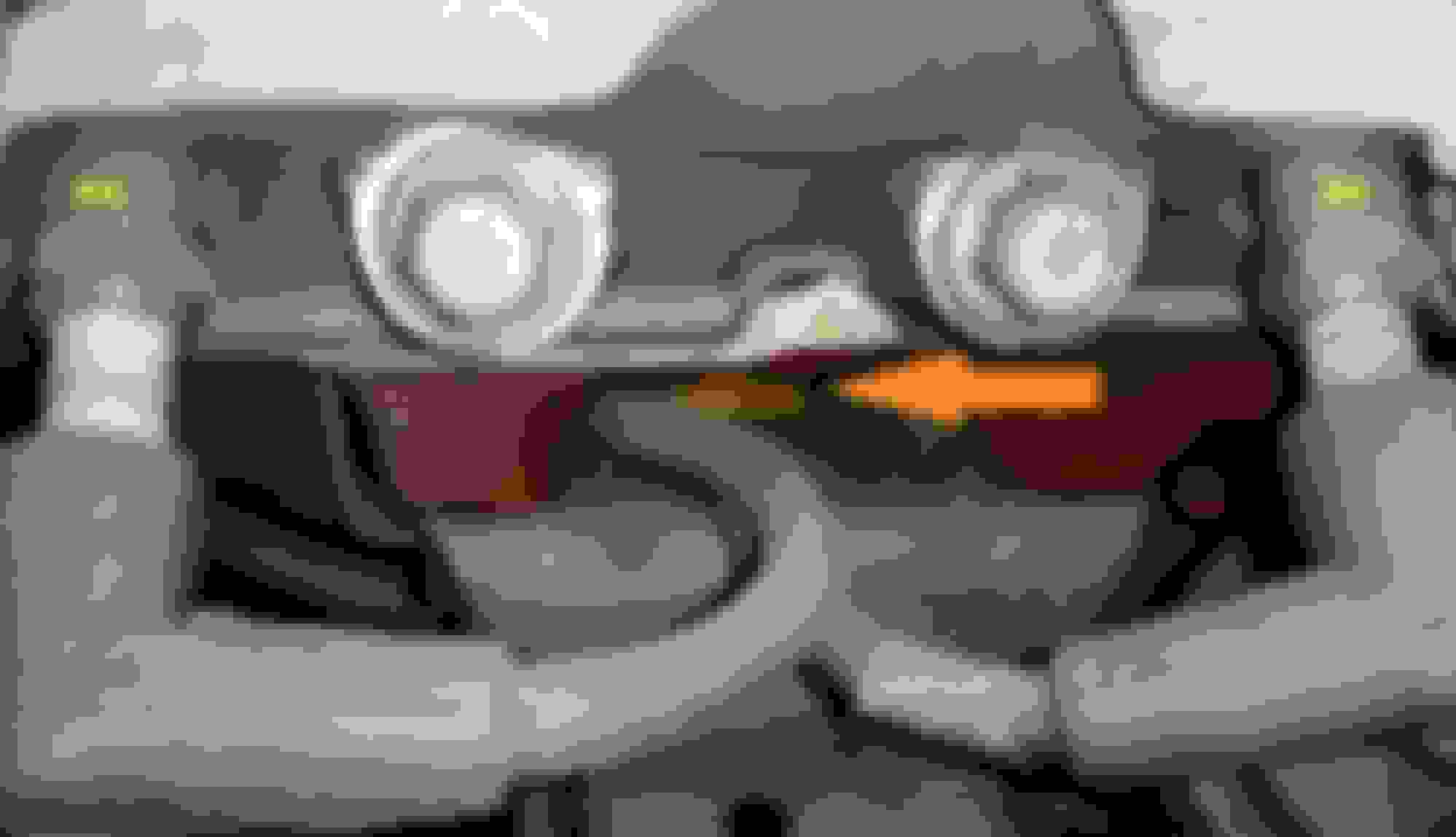
There's a buildup of yellow crud right on top of the lower engine mount "bulge" of the case. The drip is coming down from inside where those ignition wire feed into, and drip right on the yellow buildup.
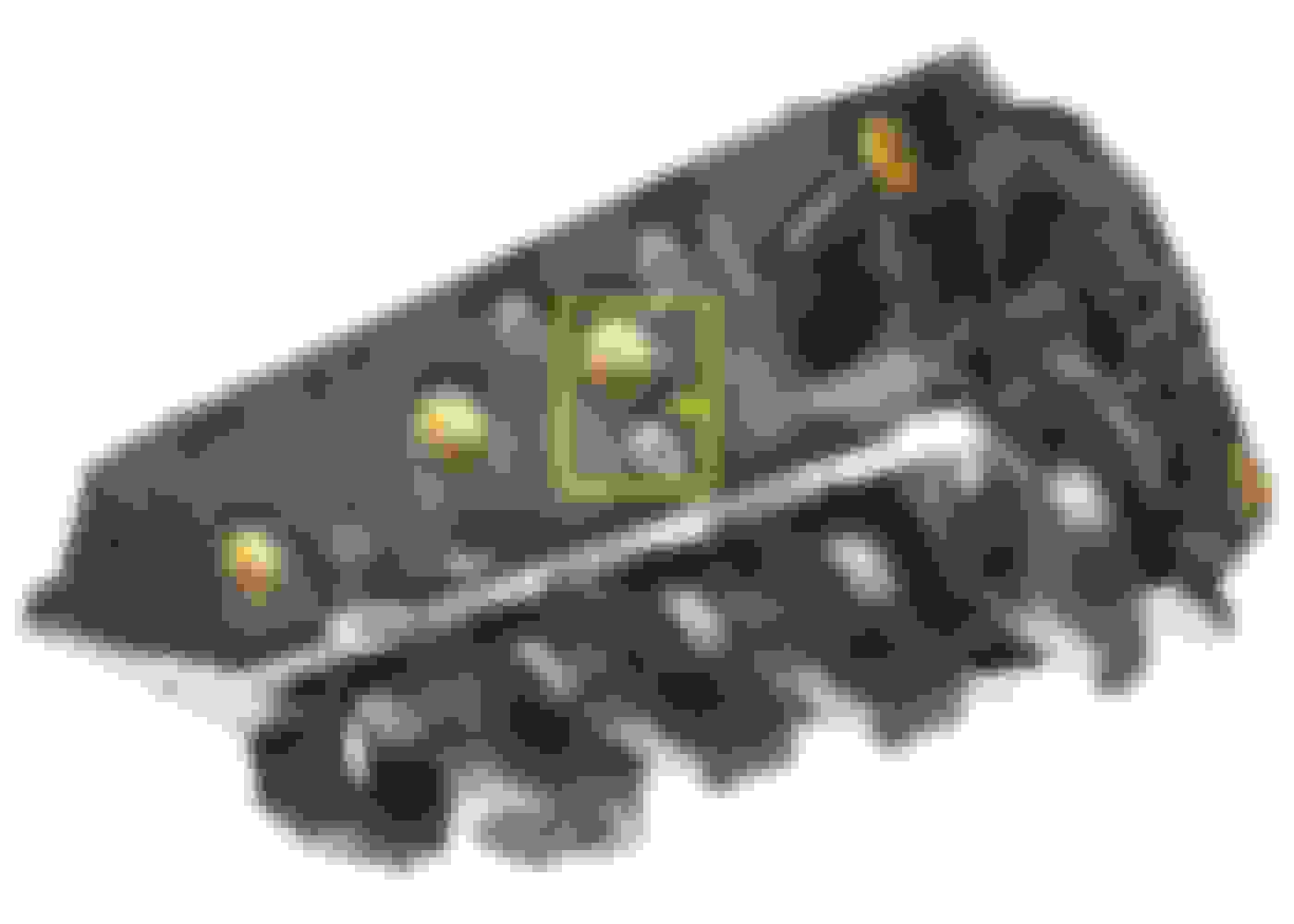
That yellow crap corresponds to the area right below that forward Freeze Plug on the right engine side. The arrow points to the area where the crud is sitting.
A leaking Freeze Plug. Really? How often does that occur? I used Permatex #2. At least I thought I used ENOUGH Permatex #2.
So, how to go about getting to it for replacement? I don't have an engine hoist handy (been meaning to buy on for the longest time). What could I jack that side of the engine up on, so as to remove the mount and R&R the freeze plug?
Can anyone here give me pointers on how to do that?
Some clever mechanic has probably figured how to replace one with engine still on the mounts. But I don't know how to do that. One can probably remove the damaged freeze plug (it happens more than you know! stock pieces were just steel stampings). Expandable rubber plugs for that diameter are available. I would not suggest them as a permanent fix; but they will suffice temporarily, until there is a good opportunity to make the proper repair. BTW, all of the freeze plugs should be replaced--not just the one which leaked FIRST!
Some clever mechanic has probably figured how to replace one with engine still on the mounts.
That's what I'm hoping for Fran. I'm thinking of just loosening the left mount too, and then jacking up from the bottom somewhere. Header off. Radiator hoses may have to come off depending on how far I've got to get away from that frame mount in order to reach the plug. And then there's the Distributor clearance to maybe worry about. Guess I'll find out.
If the Fuel Lines aren't too much in the way, this jacking point may work.
Yea it's worth a try - You would have to dissemble some of those items anyway to pull the motor. Maybe the casting plug does not have a hole but just poped out abit.
I believe the fan would have to come off also. Might not hurt to loosen the tranny mount bolts so as not to stress them.
Never thought of that one. Thank you sir.
You know, one of the videos online show the en vivo replacement of that plug under the motor mount not requiring all that much clearance once the mount was out. Although the author was unaware of the block drain, he proved that plug can be R&R'd with less hassle than what I thought.




























 How often does that occur?
  I used Permatex #2. At least I thought I used ENOUGH Permatex #2.


