When you click on links to various merchants on this site and make a purchase, this can result in this site earning a commission. Affiliate programs and affiliations include, but are not limited to, the eBay Partner Network.
Thanks bats, that helps now when I'm feeling a bit intimidated by what lays ahead.
Trust me we are sempatico on feeling intimated with our projects, i havent posted much in your thread as i have little to add as far as help, others got you covered well, but i believe you might just find the rest is not as uphill as it might seem, i could even see a pleasant surprise of some easy flowing,
Im going by both feel i get and how much you have already conquered and to be blunt, you kick ***!
Last edited by The13Bats; Feb 26, 2017 at 11:16 PM.
I check your thread on this project a lot.
It has helped tremendously with figuring out the logistics of my similar project.
As my body is off the frame and the frame is totally broken down, I am ready to move on.
I'll do my frame and drivetrain first, then the body.
The interesting part that just showed up with yours is the bonding of the rear upper clip and the lower valance.
I wondered about attaching them together beforehand.
Now I see why that is not the best idea.
With the different rear metal structures between the early chrome bumper setup and the latter 75-82 style, I will add my rear after the body is back on the frame.
I can do the flares while it sits on the dolly, but all other modifications and seams will be addressed after the body is back on the frame.
Thanks Priya for sharing all your trials and tribulations and solutions.
It helps to learn from those that have taken this road before me.
Wish you continued success with your project.
You have a strong will to match your perception of your project.
Thanks Dennis. One of my goals in documenting this is to hopefully show others doing the same thing the problems I ran into so they can avoid them themselves.
Although I've had a lot of problems in bonding the exhaust filler panel to the ACI aftermarket tail light panel, if I had used the factory made 69 rear clip I had started with I wouldn't have run into all these fitment issues - the exhaust filler panel fit perfectly with the factory 69 rear clip.
Thanks Bats. I think the hardest part is going to be sorting out the bumper brackets. I've been looking at the rear part of my frame today compared to the 68-73 and they're quite a bit different. This could be quite a challenge.
Just a thought, when I did marine mods years ago, I would often overlay the drawings of the two structural members to help visualize the needed mods. I would then make cardboard templets to help visualize the needed changes.
There is / was a frame restoration book I saw last year that had detailed dimensions on the frame.
This may make it easier to fabricate needed parts.
I enclosed the drawings from the shop manuals
if you don't have them .
one is 1980, the other is 1972.
Your work looks great. Great posts.
Last edited by BLUE1972; Feb 27, 2017 at 02:48 PM.
Priya you are doing a great job on this car. I was following along to see it done so I can do it to my 80. Unfortunately I don't have my 80 anymore. I got a good deal on a 72 and traded in the 80 along with some cash for it. I guess that's one project I won't have to worry about now.
Just a thought, when I did marine mods years ago, I would often overlay the drawings of the two structural members to help visualize the needed mods. I would then make cardboard templets to help visualize the needed changes.
There is / was a frame restoration book I saw last year that had detailed dimensions on the frame.
This may make it easier to fabricate needed parts.
I enclosed the drawings from the shop manuals
if you don't have them .
one is 1980, the other is 1972.
Your work looks great. Great posts.
Thanks so much! The frame drawings are a big help. For example, I was measuring from the rearmost body mount and its important to know they are not quite in the same place from the early to the late frame.
Well, maybe not quite. Hubby has removed the hydraulic hoses from the lift to get some new ones made and I can't get the car back on the ground until that's done.
After reading what I quoted above... I am assuming that you are going to have the car on the ground when you start your fitting up of your rear clip????
If so...his is what I would also do having it on the ground) and if I needed the rear of the car up a little bit.... I would roll the car up on my wood ramps and blocks that raise if about 2-3 inches. In this area of what you are doing it should not matter.... BUT...I ASSUME NOTHING!
***SOMETHING TO CONSIDER****
Also...not knowing how far you are taking this. I will add this. IF you are going to use metal brackets that are secured to the rear cross member and then go to the backside of your clip (like GM did) so you have something strong for your bumpers to be supported by. Think about this.
We all know and the factory press molded panels are slick on the backside. In this area you will be dealing with...GM made these area slick and FLAT. SO...with you clip being hand laid fiberglass. There is NO WAY for them to get it like GM did it. And thus....when you go and place your support brace on the backside of your clip...the surface may feel flat and good...but when you go and tighten the bolts you may being to hear cracking sounds.
When I do hand laid rear clips. When I get to this area of where the bumper brackets are going to touch the backside of the hand laid clip. I previously prepped this area with my grinder slightly. Then when I have everything test fitted and check...often times seeing that the angles are off slightly which would cause the to clip to crack....even if the bumper fit the outside of the clip correctly.
I mask off the bumper brace and apply VPA in this area and get the brace or bracket in place and allow the VPA to begin to set up fairly well....Then I remove it BEFORE it goes to full cure.. This leave me PERFECTLY FLAT surface that the bumper bracket will now contact and when I am tighten the bumper on final assembly...I do not hear any noises and I can get the bumper bolts tight due to ALL of the test fitting I have done.
BECAUSE...only speaking form experience.....nothing is worse than installing the bumpers and you hear a CRACK and the body split on your fresh paint job. I know this all to well....and I will spend the time I need to make sure I do not ever have to deal with that ever again.
Thanks for telling me that Dub, I would have smoothed the surface of the fiberglass where the brackets attach but the stuff with the Vette panel adhesive never would have occurred to me.
The car is on a lift but it is a drive on lift with two rails the tires rest on. So while I'll have the car off the ground while I'm putting the rear clip on, the car is resting on its tires.
The car is on a lift but it is a drive on lift with two rails the tires rest on. So while I'll have the car off the ground while I'm putting the rear clip on, the car is resting on its tires.[/QUOTE]
Just another thought..
If you can use a water level and check if the tire resting area of the lift is at equal elevations at all 4 locations. The lift may have a twist.
You can make one if needed with a garden hose, some clear tubing.
Thanks for telling me that Dub, I would have smoothed the surface of the fiberglass where the brackets attach but the stuff with the Vette panel adhesive never would have occurred to me.
Glad to do what I can. Hopefully what I wrote made sense and you know that when the VPA is wet...you attach your bracket so if it is angled...the VPA will compensate for this when it cures.
The car is on a lift but it is a drive on lift with two rails the tires rest on. So while I'll have the car off the ground while I'm putting the rear clip on, the car is resting on its tires.
As long as the car is resting on something basically level is better than supported by jack stands.
As for your lift being 100% level. I would not sweat it that much. But if it is off a lot.....then I might worry about it....and by 'a lot' I mean few inches or so where you can visually tell the lift rails are not basically even. Still worth checking out like previously mentioned.
Well-nuts, they are basically a "rubber" T that has a brass or SS threaded insert in the bottom of the T. As you tighten the screw from the top of the T - it causes the body of the T to swell and jam in the hole. It's like a wall anchor for fiberglass. Chevy used them to hold the defroster motor to the rear wheel well and other places.
I've used them on friends cars when the mounting hole was enlarged and the panel did not fit flush against the steel reinforcement. I would cut off the threaded insert and use them as a grommet and washer to cushion the fiberglass against the steel.
When I was in R&D we used them in mock-ups to hold panels together.
They are listed by thread size and hole depth. For example 6-32 thread and 1" dep. They go up to 1.5 inch screws and 3" length.
Most marine supply houses and McMaster-Carr has them.
Last edited by BLUE1972; Mar 3, 2017 at 11:16 PM.
Reason: hate auto spell
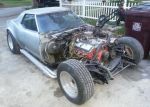
As I'm ready to graft on the ACI 70-73 rear clip I made cuts where I thought the best join position was. There's no defined point to measure from but I did my best to pick starting points on the curved surfaces and measured to try to make both sides as close to the same as I could. I cut the upper deck panel where I knew it was a little too long so I can gradually trim until I get the fit I want. The remaining black line along the upper deck panel is where I think the perfect cut would be.
I tried fitting the ACI clip to the car to see if the width was right. As I had previously removed the inner wheel well panels the quarter panels were very floppy so I decided I wanted to stabilize them before proceeding. Hubby suggested gluing the panels back in place but I didn't like that idea much as it was already quite a bit of work to remove them. So, for a temporary fix, duct tape! The quarters aren't quite as stable as if the wheel well panel was glued in but its a great deal less floppy than it was. It probably would have been a good idea to leave the wheel well panels in place until absolutely necessary to remove them but I was thinking I'd need to build up the inner surface of the quarter panels where they attached to the wheel well panel in order to provide enough thickness to shave down the mid quarter panel horizontal character line that rises slightly to the rear on 78-82 Corvettes but not on chrome bumper cars.
I felt a little sick doing this, but there's no turning back now!
I felt a little sick doing this, but there's no turning back now!
Priya, there`s an old saying....
"ANYBODY can restore an old car....
but it takes a REAL man to cut one up!"
In your case, we`ll use "woman", instead of "man".
As already stated above.... you`re doing GREAT!
When i did my conversion i measured from the rear door opening on a chrome bumper car to the top of the duck tail and matched that dimension. after doing several mock ups and comparing it side by side to a chrome bumper car i found that straying too far from that distance made a big difference in how the rear of the car " flowed". just a suggestion , i'm sure you have things well under control but i thought i would throw my experience in the mix , maybe it will help